dsh-flymemory
aujurd22/dsh-flymemory
Structural long-term memory for DSH: supersede, decay and entity-state tracking across 15 MCP tools, automatic recall and capture hooks, and a bounded pointer index published per request instead of filling the window. Requires Python 3.10+ with torch and sentence-transformers; the first run downloads a ~470 MB embedding model.
Installer
dsh plugin --profile web add github:aujurd22/dsh-flymemoryREADME
dsh-flymemory
English | 中文


Long-term memory for DeepSeek Harness.
This is a plugin (a DSH bundle) that runs FlyMemory as a local MCP service and plugs it into the harness. You end up with 15 memory tools, plus a pair of hooks that quietly record what you've been working on and pull the relevant bits back when they matter — so you stop re-explaining the same context every session.
Everything stays on your machine. The service listens on 127.0.0.1:8791, the
library is a single file under your DSH home, and nothing is sent anywhere.
DSH session ──┬── mcp__flymemory__*   15 tools the model can call
              └── hooks               recall before a turn, store after it
                        │
                        ▼
              FlyMemory service on 127.0.0.1:8791
                        │
                        ▼
              $DSH_HOME/flymemory-data/flymemory_v3.pkl
Why not just a vector store
Most agent "memory" plugins are a note table plus cosine search. This is a full store, and the differences show up in ordinary work:
| a note table + cosine search | dsh-flymemory | |
|---|---|---|
| A fact changed | old and new both come back | supersede retires the old one; recall hides it unless you ask for history |
| The same thing said twice | piles up | length-tiered dedup merges or strengthens instead |
| "What is X now" | you write the query yourself | state_key/state_value keep a current value plus its chain of previous ones |
| Age | everything looks equally fresh | power-law decay weights results by retention |
| Where an entry came from | lost | source (model-judged vs mechanically captured) and app:<name> |
| Several clients | one store each | ZCode, Qoder and DSH can share one store; app= tags say who wrote what |
| Per-turn cost | full text or nothing | a bounded pointer index (≤1.2 KB), and the model pulls what it needs |
| Did anyone use it | unknown | usegate.jsonl: every injected pointer accounted as expanded / recalled / superseded |
Measured upstream, not re-run here (protocols live in the FlyMemory repo):
- aggregation questions: one-shot top-5 scored 6% strict, the "collect wide, then read each entry verbatim" protocol 16% (P-ANSWER);
- two-hop questions: letting a retriever filter candidates first cut the evidence from 100% to 75% (P-COMBO);
- pointer injection lifted evidence-in-pool 63.9% → 74.4% but at 12.15× pool tokens (P-USEGATE, verdict PARTIAL) — which is exactly why this plugin points at entries and never expands one by itself.
What this page does not claim: that a memory store makes a model smarter, or that this recall wins on every metric. The honest summary of the upstream record is that structured memory reproduces across runs, while adaptive read policies have not (yet) survived independent replication.
The notebook, and who does the thinking
The engine is easier to explain as a notebook than as an architecture.
Every sentence you send gets written on its own line, so topics don't blur together. Say something nearly identical and the old line is underlined harder instead of copied twice. Correct something ("actually I moved to Hangzhou") and the old line is crossed out, not torn out — you can still read crossed-out lines when you ask about history. Short scribbles condense into summary notes; anything untouched for months fades (power law: the true half-life is 3τ, 90 days by default). Finding a line works two ways at once: by meaning, and by the exact keywords embeddings cannot see — part numbers, file paths, ids.
The division of labour is the design bet: the server never runs an LLM. It owns
the mechanical part — chunking, dedup, fusion, decay math, lineage hygiene,
persistence; the calling model owns every judgment — what matters, what is
outdated, what is worth forgetting. A wrong judgment is therefore a recorded
wrong judgment: supersede leaves a tombstone with valid_from/valid_to
instead of a hole.
An entry's life:
- write — a hook captures it, or the model stores it deliberately (
sourcekeeps the two apart); - strengthen — a near-duplicate updates the existing entry rather than adding a second copy; dedup is length-tiered and prefers not merging;
- supersede —
supersede(old, new)retires an outdated state; it stays queryable viainclude_supersededwhile normal recall skips it; - consolidate —
consolidate(ids, conclusion)builds a higher-level entry that keepsevidence_idsback-links, so abstraction never destroys the raw material; - fade or forget — power-law decay prunes what nothing touches;
forgetremoves something that was simply wrong.
The ablated versions of these rules, including the ones that measured worse than doing nothing, stay in the engine repo: source · research ledger.
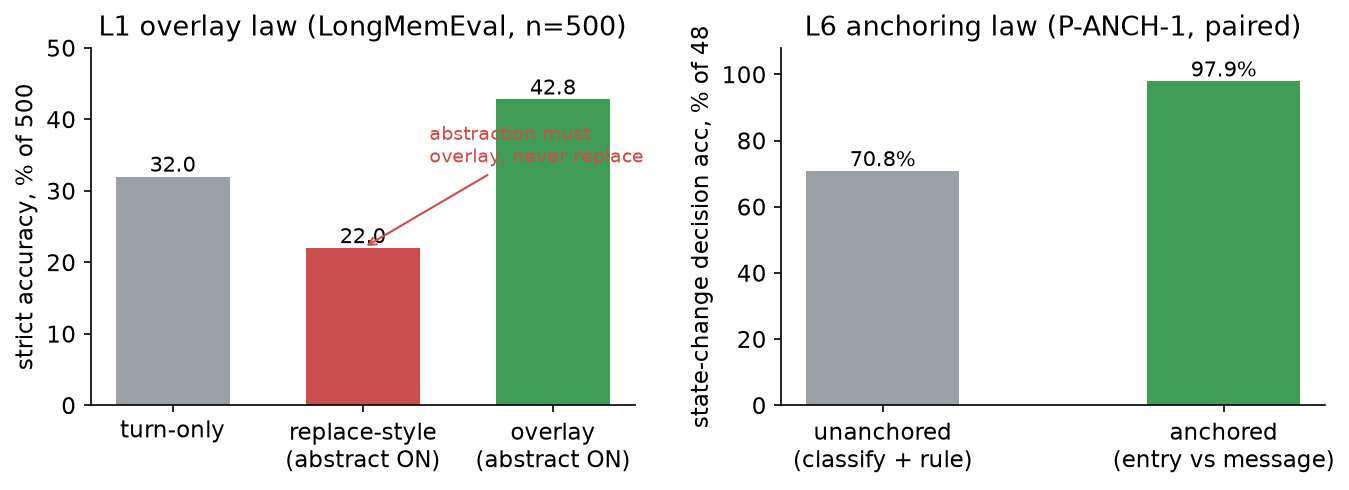
Two of the engine's laws. Left: replace-style abstraction scores 10 points below storing nothing, so consolidation overlays instead. Right: the same 48 turns through two collection strategies — anchored judgment is near-mechanical, pre-registered paired experiment, discordant 13:0.
What you get
Fifteen tools, all under the mcp__flymemory__ prefix:
| Tool | What it's for |
|---|---|
flymemory_remember | Store a decision or finding. Near-duplicates are merged automatically. compartment groups entries by topic; state_key/state_value track "the current value of X" and retire the old one. |
flymemory_recall | Search. Dense embeddings and keyword matching are fused, older entries fade, and results come back with id, age and where they came from. include_superseded digs into history. |
flymemory_auto | Recall and store in one call. This is what the hooks use. |
flymemory_recall_index / flymemory_get_memory | Look first, read later: a one-line index, then the full text of whatever looks interesting. |
flymemory_supersede | Say "this old entry is out of date, that one replaces it". |
flymemory_state_lookup / flymemory_state_history | Current value for an entity key, or the whole history of it. |
flymemory_consolidate | Fold several entries into one conclusion; the originals stay as evidence. |
flymemory_find_conflicts / flymemory_insights | Pairs that look contradictory; valuable entries that are fading. |
flymemory_forget / flymemory_cleanup | Delete one entry, or sweep everything that has decayed past a threshold. |
flymemory_session_pack | A short pack of the recent trail and the latest conclusions. |
flymemory_stats | Counts, ages, access counts. |
And two hooks that work on their own:
- On every prompt — the prompt is stored, and memories that match it get appended to the turn. No model call, just local search.
- On session start — a recovery pack of recent activity, so a fresh session isn't starting from nothing.
Both hooks are silent when the service is down, and neither can block a turn.
Requirements
-
DeepSeek Harness with
@deepseek-ai/dsh-mcp-clientavailable. Built and tested against0.2.0-rc.2and44.7.0. -
Node 20+ (the add-on and its CLI).
-
Python 3.10+ with the engine's dependencies:
pip install torch sentence-transformers "mcp>=1.30,<2" numpyThe plugin finds the interpreter for you: it checks
FLYMEMORY_PYTHON, the usual install locations, thenPATH, and it verifies thatsentence_transformersactually imports before picking one. On a machine with several Pythons that saves you the "why won't it start" half hour.The first run downloads the multilingual embedding model (~470 MB) into the HuggingFace cache. After that it works offline.
Install
# from npm (published 2026-10-26)
dsh plugin --profile desktop add dsh-flymemory

# from GitHub (use your own profile name)
dsh plugin --profile desktop add github:aujurd22/dsh-flymemory

# from a local checkout (absolute path)
dsh plugin --profile desktop add /absolute/path/to/dsh-flymemory
Or, from inside an agent session, point the plugin_manager tool at the same
spec:
plugin_manager(action: "install_bundle", target: "dsh-flymemory")
plugin_manager(action: "install_bundle", target: "github:aujurd22/dsh-flymemory")
plugin_manager(action: "install_bundle", target: "/absolute/path/to/dsh-flymemory")
Or use the Plugins page in the Web sidebar and pick the folder. The harness
reloads, two rows come up (flymemory, flymemory-mcp), and the tools appear.
Trust signals. License: MIT. Profile: any base-backed profile
(desktop/web); written against DSH 0.2.0-rc.2 and verified on 44.7.0.
Permissions: it writes one data directory under $DSH_HOME, starts a Python
child process, and talks to it over 127.0.0.1 only — no credentials required
and no outbound network calls. External requirement: Python 3.10+ with torch and
sentence-transformers (see above); the engine is vendored, so no separate
FlyMemory checkout is needed.
Check it:
node bin/flymemory.mjs status     # what it resolved, and what's live
node bin/flymemory.mjs doctor     # interpreter, dependencies, endpoint
Then ask the model to remember something and search for it. If the tools don't
show up, doctor usually says why.
Removing it is the same in reverse:
plugin_manager(action: "remove_bundle", target: "dsh-flymemory")
Your memory file is not deleted — remove it by hand if you want it gone.
How it runs
The bundle inserts two rows:
| Row | Module | Job |
|---|---|---|
flymemory | this package | Probes the port, starts the engine if nothing is there, records the resolved settings, registers the recall/capture hooks |
flymemory-mcp | @deepseek-ai/dsh-mcp-client | Turns the service's tools into mcp__flymemory__<tool> |
The hooks used to ride DSH's Claude-Code hook bridge. Builds from 44.7 onwards no
longer ship that package, so the same logic now runs on the plugin's own
agent/pre-step listener and the bundle declares no hook-bridge dependency.
When the harness starts, the first row checks 127.0.0.1:8791. If a FlyMemory
service is already answering there, it's reused — two harness windows share one
engine and one library. If the port is free, the bundled engine starts in the
background and the row waits for it before letting the next row connect. If
something else owns the port, the plugin says so and leaves it alone; it never
kills a process it didn't start.
Cold starts are slow: the engine imports torch before it can listen, which takes 15–20 seconds. The row waits up to 25 seconds by default, and the mcp-client reconnects on its own if it has to.
If the engine can't start at all — no interpreter, missing dependency, port conflict — the harness still boots. You just don't get the tools, and the reason is in the log.
Settings
Environment variables, read before the harness starts:
| Variable | Default | |
|---|---|---|
FLYMEMORY_MCP_PORT | 8791 | Service port |
FLYMEMORY_MCP_URL | http://127.0.0.1:<port>/mcp?app=dsh | Full endpoint (an ?app= already present is kept) |
FLYMEMORY_APP | dsh | Source tag written on every entry this plugin stores |
FLYMEMORY_DATA_DIR | $DSH_HOME/flymemory-data | Library, logs, settings record, pid file |
FLYMEMORY_PYTHON | auto-detected | Interpreter for the engine |
FLYMEMORY_DEVICE / FLYMEMORY_MODEL | cpu / multilingual MiniLM | Passed to the engine |
A FlyMemory service can be shared by several clients, and each write carries an
app:<name> tag saying which one produced it. This plugin connects with
?app=dsh, so its entries are marked app=dsh in recall output and counted under
Apps: in flymemory_stats — next to ZCode's app=zcode and older untagged
app=legacy entries. Change the tag with FLYMEMORY_APP if you run several DSH
profiles against one store.
Anything else goes on the row itself, in your profile's cordis.patch.yml. A
patch entry replaces the whole config, so write out everything you need:
- id: flymemory
  name: 'dsh-flymemory'
  config:
    port: 8791
    dataDir: 'D:\dsh-memory'
    libraryPath: 'D:\dsh-memory\my-lib.pkl'
    pythonExe: 'C:\Python313\python.exe'
    device: cpu
    readinessTimeoutMs: 25000   # 0 = don't wait, let the tools show up later
    shutdownOnDispose: true     # stop the engine this activation started
    nativeHooks: true           # recall/capture on every typed prompt
    hookTimeoutMs: 6000         # budget per hook request
    workingContext: true        # publish a bounded memory digest per request
    workingContextChars: 1200   # cap for that digest, wrapper included
    workingContextMinutes: 240  # how far back the digest looks
    useGate: true               # account injected pointers -> expansions/re-calls
    writeHooksConfig: true      # also write hooks.json for clients outside DSH
    seedFromUpstream: false     # don't import another library implicitly
    upstreamLibrary: ''         # set both to import one, once
    autostart: true
The rest of the options are documented in resolveOptions() in
lib/index.js. Unknown keys are ignored.
Where your memory lives
$DSH_HOME/flymemory-data/flymemory_v3.pkl — one file, plain data, easy to back
up or delete. Alongside it:
hooks.json— regenerated on every activation; describes the two hooksstate.json— what the last activation resolved (endpoint, library, interpreter, how the service was obtained);statusanddoctorread it, so they report an override instead of the defaultsengine.log— stdout/stderr of the engine processserver.log— the engine's own logserver.pid— soflymemory stopknows what to kill
To run the service on its own, without the harness:
node bin/flymemory.mjs start
node bin/flymemory.mjs stop
node bin/flymemory.mjs log -n 40
node bin/flymemory.mjs mute 30m     # silence the per-request digest (tools keep working)
node bin/flymemory.mjs mute off
node bin/flymemory.mjs ledger       # injection -> use rate and hottest ids (add --json)
node bin/flymemory.mjs version      # this copy vs the published one
Nothing auto-updates: DSH never polls the registry, so dsh plugin --profile <profile> add dsh-flymemory again is the upgrade. version tells you whether
one exists.
After installing the bundle, the same CLI is linked into the profile at
<profile>/node_modules/.bin/dsh-flymemory.
About the hooks
They're on by default, because automatic memory is the whole point of the thing.
They run inside this plugin on agent/pre-step — no hook bridge package needed.
Worth knowing exactly what that means:
- Only messages you actually typed are stored and recalled. The harness tags
a typed prompt
source.kind === "user"; peer deliveries, system reminders, automation prompts and model-change notices carry other kinds and are ignored. A delegated agent gets one recall at task start, then nothing more. - Credential-shaped text never gets stored, and automation/heartbeat prompts are skipped before they reach the service.
- Recalled memories are appended to the turn, capped at about 2.5 KB, with a header saying they are data rather than instructions.
- A second request pulls the top two entries of
compartment="lessons"and injects them on their own, so pitfalls come back every turn instead of competing with ordinary recall. Store one withflymemory_rememberandcompartment="lessons", starting the text with the tool or environment names that should bring it back — the keyword channel is what finds it.
If you'd rather have the tools and no automation, turn the hooks off on the row
(a patch entry replaces the whole config, so restate what you need):
- id: flymemory
  name: 'dsh-flymemory'
  config:
    port: 8791
    nativeHooks: false
Keeping context in a band
A session should not have to fill the window before anything happens. Four pieces keep each request small and keep what matters available.
1. The working context is an index, not a memory dump. On every request the
plugin publishes <working-context source="flymemory" type="index">: at most
1.2 KB of pointers (#id | age | app | one line), refreshed at most every 45
seconds from flymemory_session_pack, with the header saying to call
flymemory_get_memory(id) before acting on one. The model pulls the full text;
the plugin never expands a pointer itself. That split is deliberate — upstream
measured the pointer form at +10.5pp evidence coverage only when the pointer
was followed by an expansion, and that expansion cost 12.15× pool tokens
(P-USEGATE, 2026-10-26), so expansion stays a model decision. The context is
optional: a runtime suppressor can drop it, dsh-flymemory mute silences it for
a while, and a memory outage just leaves the previous digest in place.
2. use_gate accounting. Every pointer id that reaches the prompt is stamped
into a per-session ledger (<dataDir>/usegate.jsonl, one JSON line per event,
shaped like upstream's injected id -> uses). A later flymemory_get_memory,
recall or flymemory_supersede is attributed to it as expanded, recalled or
superseded. dsh-flymemory ledger reports the injection→use rate and the
hottest ids — the measurement upstream adopted (it closes the "injected, but
nobody records whether it was ever used" gap).
3. Condensation goes back to memory. When the session logs a
compaction/summary, its text is stored as a checkpoint,compaction entry in
the context compartment. The condensed history stays recallable, and the store
remains the authority rather than the checkpoint being the only copy.
4. Early compaction (opt-in). DSH's compaction-basic row lives inside the
agent preset, so its threshold can only be changed by restating the preset.
examples/early-band.patch.yml does that with
three numbers: compact at 45% of the window instead of 80%, keep 12%
verbatim instead of 16%, and a smaller headroom so small windows are valid. Paste
it into your profile patch. It pins a copy of the preset declaration — regenerate
it after a DSH upgrade instead of letting it go stale.
What this deliberately does not do: it does not replace DSH's compaction
backend, and cannot — a zero-dependency plugin cannot import
@deepseek-ai/dsh-compaction. So the condensing itself stays DSH's, driven
earlier by the preset change, while FlyMemory owns what the model sees every turn
and keeps whatever was condensed.
Prior art this borrows from:
- MemGPT / Letta (arXiv 2310.08560) — treat the context window as RAM and an external store as disk, paging explicitly between them.
- InfiAgent (ACL Anthology) — keep the reasoning context bounded by rebuilding it from a state snapshot plus a fixed recent window, instead of compressing only on overflow.
- Chroma's "context rot" measurements — long contexts degrade; prefer fewer, higher-signal tokens over a bigger window.
Importing a library you already have
Nothing is imported unless you ask. If you have a FlyMemory library from somewhere else and want to move it in, point the plugin at it once:
- id: flymemory
  name: 'dsh-flymemory'
  config:
    port: 8791
    upstreamLibrary: 'D:\path\to\flymemory_v3.pkl'
    seedFromUpstream: true
On the next activation the file is copied into place if the target doesn't exist yet. The original is left alone. The format is the same in both directions, so you can move it back out later.
Sharing a service you already run
If a FlyMemory service is already running on this machine and you want DSH to share its memory rather than keep its own, override both rows in your profile patch:
- id: flymemory
  name: 'dsh-flymemory'
  config:
    port: 8765
    libraryPath: 'D:\path\to\flymemory_v3.pkl'
- id: flymemory-mcp
  name: '@deepseek-ai/dsh-mcp-client'
  config:
    serverName: flymemory
    transport: streamable-http
    url: 'http://127.0.0.1:8765/mcp'
port is where the plugin looks for the existing service; libraryPath is the
file it serves if it ever has to start the engine itself, so both routes lead to
the same memory. Leave the hooks row alone — it follows the endpoint the plugin
resolved. node bin/flymemory.mjs status prints "from hooks.json" when an
override like this is in effect, so you can tell it apart from the defaults.
Why the hooks row needs no override
The supervisor writes <dataDir>/hooks.json on every activation from the config
it resolved, so the hook scripts always post to whatever endpoint the plugin
actually uses. That file is also how status and doctor discover an override.
Working on it
node --check lib/index.js    # syntax
npm test                     # unit tests, no Python needed, ~0.3 s
node tests/engine_smoke.mjs  # end-to-end against the real engine (needs torch)
python tests/http_smoke.py   # protocol check against a running service
npm test covers the parts that are easy to get wrong: port and library
defaults, config precedence, the generated hook file, endpoint probing. The
engine smoke test runs apply() in a throwaway directory against a real Python
engine — it needs torch and sentence-transformers, and prints SKIP if they aren't
there. CI runs the syntax check and the unit tests on Linux, macOS and Windows
across Node 20, 22 and 24.
lib/index.js        Host half: port probing, engine supervision, hook config
bin/flymemory.mjs   CLI built on the same helpers
cordis.patch.yml    the two rows this bundle inserts
python/             vendored FlyMemory engine (server, hooks, engine package)
locale/{en,zh}.json title and description for the Plugins page
tests/              unit tests, engine smoke test, protocol smoke test
Rough edges
- The first start takes 15–20 seconds. That's torch loading. Set
readinessTimeoutMs: 0if you'd rather the harness start immediately and have the tools appear a few seconds later. - The Python dependencies are heavy. The plugin won't install them for you;
doctortells you what's missing. - DSH has no
PreCompacthook, so the recovery pack runs at session start rather than right after a compaction. - Tool names are long.
mcp__flymemory__flymemory_recallis what the mcp-client naming rule produces —mcp__<server>__<tool>— and it's stable, just not pretty. - One engine per port. Two harnesses share it; a third instance needs its own port and its own library, set explicitly.
- Recall gets slower as the library grows. Upstream measured ~11 ms per query at about 1,400 entries on CPU.
License
MIT. See LICENSE.
The bundled FlyMemory engine is MIT as well, Copyright (c) 2026 Junrong Du. THIRD_PARTY_NOTICES.md lists exactly which files were copied, which were adapted, and why.
Plugins associés
hindsight (coding-agents)
vectorize-io/hindsight
OpenViking (dsh-memory-plugin)
volcengine/openviking
MemOS (memos-local-plugin)
memtensor/memos
ReMe (dsh)
agentscope-ai/reme