dsh-memory-delta
lpf20200901/dsh-memory-delta
Layered cross-session memory for DSH that pushes only what changed. The first round injects every active entry, later rounds push only added / updated / removed ones, and nothing at all is injected when nothing changed. Facts and decisions carry semantic keys (one active truth per key), the model may only write to an inbox that a human promotes, an entry can carry a review date that raises a one-time reminder when it comes due, search is relevance-ranked with Chinese matched by bigram, and a sidebar tab tells the lifecycle story instead of just listing files — entries are grouped into awaiting confirmation / in use / archived, viewable by type, tag or date, and the tab can promote a candidate, withdraw or archive a standing entry, restore an archived one and delete a candidate, alongside the global and workspace instruction files and the current injection size. A zero-dependency CLI ships with it, so the store is usable without DSH.
Installer
dsh plugin --profile web add github:lpf20200901/dsh-memory-deltaREADME
dsh-memory-delta
English | 中文
Layered, auto-injected cross-session memory for AI coding agents. A DSH (DeepSeek Harness) plugin, plus a zero-dependency standalone CLI. It borrows the spec / change / archive discipline from OpenSpec — but pushes instead of pulls.
Canonical repository: GitHub · Gitee is a read-only mirror — please file issues and pull requests on GitHub.
Status: M1–M4 done; M3/M4 (differential injection, both tools, the distillation nudge) were verified inside a real DSH session, and the M5 improvements below are covered by 825 assertions plus a real-machine preflight. See Verification.
Why
AI coding assistants have two recurring problems:
- A new session remembers nothing. You re-explain the background, your preferences, and every conclusion you already reached.
- What does get remembered is unmanaged. Everything piles into one or two Markdown files that grow without bound, cost more every session, and — worst of all — stale conclusions are never removed.
Existing spec-driven tools (OpenSpec and friends) solve "the code drifts away from the plan". But they are pull-based: the agent has to be told to go read the specs, so a fresh session does not spontaneously remember anything. dsh-memory-delta is push-based: at session start the agent is handed what it should know — but only the distilled part, and only what changed. Details stay retrievable on demand.
Design
        ┌─ PUSH: injected automatically at session start (hard byte budget)
        │    T0 identity & conventions   user preferences / machine facts / accounts
        │    T1 index & next actions     what to pick up
store ──┤
        └─ PULL: retrieved on demand (costs nothing by default)
             inbox/      candidate entries — **the only layer the model may write**
             facts/      current truth (only status=active is injected)
             decisions/  choices plus their reasons (append-only)
             archive/    superseded entries
             journal.md  activity log (never injected)
Read the directory names along two axes (this was unclear before — facts especially invites the wrong
guess: it is a kind of content, not a stage of the flow):
| Directory | Stage in the flow | What it holds | Who may write | Injected? |
|---|---|---|---|---|
inbox/ | candidate (unconfirmed) | conclusions the model thinks are worth keeping | only the model (memory_write) | ❌ never |
facts/ | standing | pitfalls hit + how to avoid them: environment limits, tool behaviour, real failures and their fixes | only the human (promote) | ✅ every turn |
decisions/ | standing | conventions you decided: business / process / taste calls — so you never have to answer twice | only the human (promote) | ✅ every turn |
archive/ | archived | retired entries: superseded, or no longer applicable | moved on supersede/archive | ❌ never (still searchable, restorable) |
The main flow: the model may only write inbox/ → the human promotes into facts/ or decisions/ →
retired entries move to archive/. Unsure which side an entry belongs to? Ask: "if the world changes
tomorrow, does this stop being true?" Yes → facts/; only you can invalidate it → decisions/.
Two writing habits that make these layers actually useful: a facts/ entry should say when it applies
(a pitfall is worth recording so it is not hit twice, not because it once happened); a decisions/ entry should
say why it was decided — with the reason, the agent can judge by itself instead of asking you again.
mem initwrites the full explanation of these four directories (plusjournal.md/index.md/memory.config.json) into the store's ownREADME.md— open the memory directory and it is right there.
Seven rules:
- The pushed part must be tiny. Everything in the injected layer is paid for on every session, so the
journal and design docs stay out of it. Measured on a real store (6 entries): 953 bytes total, 68% of
it the entry lines themselves, ~300 bytes of framing — about 159 bytes per entry, so the 3 KB default
budget holds ~19 entries. Entry ids are deliberately not written into the text (they ride along in the
message's structured
source.entries); inlining them used to eat 34% of the budget. - Only the delta is pushed. Every entry carries a 12-char content hash; the plugin remembers the
previous round's state and next round pushes only added / updated / removed. When nothing changed it
injects nothing at all. (The upstream
dsh-agent-instructionsplugin has no diffing: any file change re-injects the whole file — measured at ~58k wasted tokens for 15 edits of one 8.5 KB file.) - State is recovered from the conversation itself. No side-car state file: the plugin reads back the
{id: hash}map from the message it previously injected, so session resume, replay and compaction all stay correct. - The model may only write to the inbox. A wrong conclusion that silently reaches the standing layer
gets re-injected forever. Promotion is an explicit
promote. - One key, one truth. Facts and decisions carry a semantic
key, and only one active entry may exist perscope+key. A new conclusion must explicitly--supersedesthe old one — that gate is what keeps memory rot out of the injected layer. - Entries have state:
active/superseded/expired. Superseded entries get bidirectional links and are archived, never appended forever. - Plain Markdown + frontmatter: human-readable, diffable, reviewable, committable like code.
Install (as a DSH plugin)
⚠️ This section is the result of real trial and error — both wrong turns below are silent failures:
❌ Adding the package to package.json's dsh.profile.bundles
   → DSH regenerates that list from the market registry (.generations/desired.json) at boot;
     entries it does not know about are dropped.

❌ Writing a bare entry in cordis.patch.yml
   → silently ignored (a patch entry only targets an existing id for config/disable).

✅ Wrapping it in `- insert:` inside cordis.patch.yml
Steps (DSH_HOME is usually %APPDATA%\dsh-desktop\harness):
-
Copy this package into the profile's
node_modules:<DSH_HOME>\profiles\web\node_modules\dsh-memory-delta\ package.json bin\mem.mjs src\plugin.mjs src\hook.mjs src\planner.mjs -
Append to
<DSH_HOME>\profiles\web\cordis.patch.yml:- insert: - id: dsh-memory-delta name: dsh-memory-delta config: root: '' # empty = <session cwd>/memory maxBytes: 3072 # byte budget for the baseline injection enabled: true dueWithin: 0 # remind this many days before verify_when (0 = only when due) panel: true # the memory tab's state/action routes allowWrite: true # let panel buttons write the store (promote / rename) -
Save. The patch layer is watched (
watchUserPatches) — it hot-reloads, no restart needed.
Uninstall: remove that - insert: block and delete node_modules\dsh-memory-delta.
The market/registry publishing flow was not investigated yet; the above is the local install path.
What the plugin provides
| Capability | Detail |
|---|---|
| Differential injection | First round injects every active entry (baseline); afterwards only added / updated / removed; nothing at all when unchanged |
memory_search | Relevance-ranked search across facts / decisions / inbox / archive / journal / session index. Field weights (key/id > tags > conclusion > body), a whole-phrase bonus, and Chinese matched by bigram so a query like 沙箱禁管道 hits 沙箱禁止命名管道 without spaces. Each hit carries a score and a snippet from its best-matching line |
memory_write | Record a candidate into the inbox — the model cannot touch the standing layer |
| Distillation nudge | Once a session has run a few steps and memory is already current, it reminds the model to record conclusions with memory_write; one nudge per session, and the nudge message carries no state, so it cannot corrupt the diff baseline |
| Due-for-review reminder | verify_when is no longer a dead field: when an entry reaches its review date, the session is told once — "this conclusion may be stale, re-check it" — with the exact command to supersede or expire it. Prose values (等换机器时) never trigger it, so the reminder can always be resolved; it fires only on a step that injects nothing else, and it carries no state either |
| Sidebar memory tab | With dsh-better-sidebar installed, a 记忆 tab groups entries by stage in the flow (待你确认 → 已在用 → 已归档, each with one plain-language line plus a flow strip on top), collapsible (a drawn caret), with a search box (entries and the journal, Chinese run-together queries included — the same scoring as mem recall and the model's memory_search). The standing layer can be viewed along three axes: type (facts/decisions — "which side does it belong to"), tag (by topic) and date (when it was recorded, labelled today / yesterday / weekday). Clicking an entry opens its .md through better-sidebar's official openFile (preview/edit in the sidebar editor). Both directions: candidates can be promoted, standing entries can be withdrawn (back to candidates) or archived, archived ones restored, candidates deleted — every destructive action goes through an inline confirm bar (never window.confirm, which blocks the page and would hang headless screenshots). The standing layer also shows the global instructions (~/.dsh/AGENTS.md, injected by DSH into every workspace — read-only preview, collapsed by default) and the workspace instructions (AGENTS.md / AGENTS.local.md, with an Edit button that opens them in the sidebar editor). The client half is a hand-written, zero-build browser bundle (a window.__ModuleLoader__.load({id, factory}) wrapper, no bundler); its data comes from this plugin's own read-only POST /dsh-memory-delta/state and POST /dsh-memory-delta/search routes — loopback-only, JSON in / JSON out, reading nothing but the memory store. The one route that writes is POST /dsh-memory-delta/action (promote / withdraw / archive / restore / delete candidate / safe rename); turn it off with allowWrite: false |
| Why editing/deleting memory is not built into the panel | The sidebar already ships an editor (opening an entry is enough) and a file tree with confirmed rename/delete. Re-implementing full CRUD in the panel would be duplication plus a permanent maintenance tax, so the panel offers entry points plus the two actions that genuinely need human judgement: open file, one-click promote of an inbox candidate (the human-confirmation step finally has a UI) and tidy the file name (mem rename: id + file name + references together). Pure "jump to the folder" buttons are deliberately not built — a caret to expand plus clicking an entry for detail is enough, and an extra button only adds noise plus a route that launches an external process. ⚠️ Do not rename memory entries through the file tree — the id lives in the frontmatter and must match the file name, or mem validate reports id 与文件名不一致; that is exactly why renaming is a dedicated safe operation instead of free-form editing |
The plugin never spawns the CLI: the DSH sandbox forbids named pipes (capturing a child's output fails
with EPERM), and there is no need — it imports the same store module directly (bin/mem.mjs only runs
the CLI when executed as the entry point). It also never requires the sidebar: webServer is read
through ctx.get('webServer') (an optional capability), so a headless or CLI-only composition loads the
plugin unchanged and simply skips the panel route.
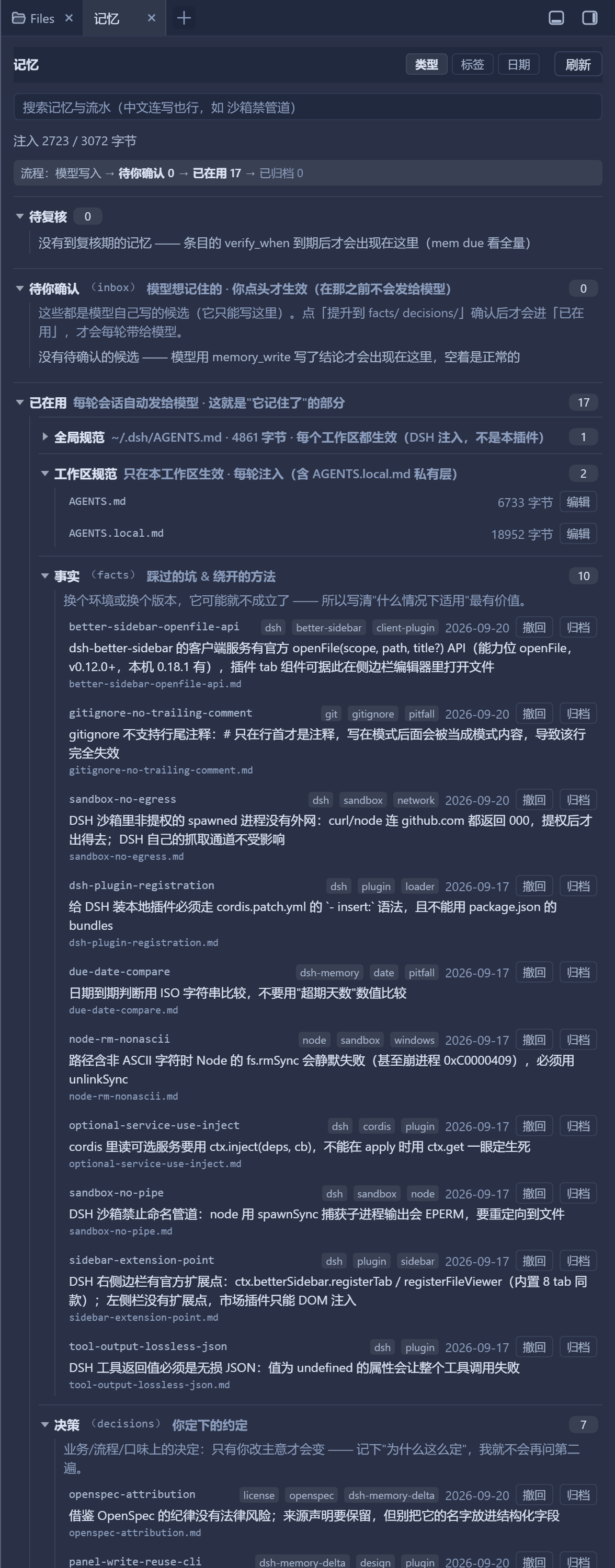
The 记忆 tab, opened from the sidebar's + menu: collapsible groups (the monospace text after a
title is the directory on disk), standing entries with their keys/tags/dates/file names, the
due-for-review section, the inbox candidates, and how many bytes the current store costs per session.
Clicking an entry opens it in the editor — the panel itself never writes to the store; the only
writes are the two inbox buttons (promote / tidy file name).
CLI usage
# init (defaults to <cwd>/memory; override with --root or $DSH_MEMORY_ROOT)
mem init --root ./memory --scope "workspace:/path/to/project"

# record a candidate (lands in inbox, never injected)
#   --id  prefer an explicit short id; otherwise derived from the conclusion (capped at 20 chars)
#   --key semantic key: only one active truth per scope+key
mem new --type fact --id win-update-cache --key disk-cleanup \
        --conclusion "Cleaning the update cache reclaimed nothing measurable" \
        --reason "Directory emptied but free space did not move" --tags windows,disk --source session-abc
# with --key but no --id, the key *is* the id (and the file name): sandbox-no-pipe.md
# without a key the id falls back to "<date>-<truncated conclusion>" — prefer giving a key

# promote it once confirmed; when the key already has an active entry you must say who supersedes whom
mem promote win-update-cache
mem promote win-update-cache-v2 --supersedes win-update-cache

mem set <id> --key k --tags a,b --conclusion "…"   # edit an entry (add a key, reword, mark expired)
mem rename <old-id> <new-id>   # safe rename: frontmatter id + file name + supersedes refs together
                               # (never rename through the file tree — id must match the file name)
mem list --status active --tag windows
mem show <id>
mem validate [--fix]   # format / ids / bidirectional links / cycles / same-key conflicts / index / budget
mem index              # rebuild index.md
mem inject [--json] [--budget 3072]   # render what should be injected; --json adds per-entry hashes
mem recall <keywords> [--where all|facts|decisions|inbox|archive|journal|sessions|index] [--limit N] [--json]
                       # relevance-ranked: Chinese is matched by bigram, no spaces needed
mem due [--within N] [--json]   # entries whose verify_when is due (--within N also warns N days ahead)
mem journal add "one line"
verify_when takes either a date (2027-03-01) or a relative phrase measured from the entry's own
date (3个月后, 2周后, 立即); anything else is treated as prose and simply never auto-fires.
Verification
Checked item by item inside a real DSH session:
| Capability | Live evidence |
|---|---|
| baseline injection | the session received every active entry |
| no change → zero injection | the next step injected nothing, only the one-time nudge |
| delta · added | "新增:", explicitly noting "the other N entries are unchanged" |
| delta · updated | after editing one entry, only "已更新:" was pushed |
| due-for-review reminder | adding an entry whose verify_when was 16 days overdue produced a one-time form='due' reminder on the next no-change step, and the step after it injected nothing (the reminder did not reset the diff baseline) |
| sidebar 记忆 tab | the tab opened on a live store and showed the real root, "常驻 12 条", "注入 1792 / 3072 字节", the facts/decisions split and the (empty) inbox |
memory_search / memory_write | both called successfully in the real runtime |
| writes land only in the inbox | the written candidate did not enter the injection payload; it appeared as a delta only after promotion |
Development
npm test # 825 assertions, zero dependencies
| Suite | Assertions | Covers |
|---|---|---|
test/run-tests.mjs | 180 | CLI end-to-end (incl. a non-ASCII path regression, ranked recall, mem due, mem rename with reference sync, key-as-file-name) |
test/planner-tests.mjs | 43 | the diff algorithm (pure logic) |
test/search-tests.mjs | 51 | tokenizing / scoring / snippet selection (pure logic) |
test/due-tests.mjs | 93 | verify_when parsing (dates, relative phrases, prose) and due collection (pure logic) |
test/hook-tests.mjs | 63 | plugin wiring (fake agent / decision): diff injection, nudge, due reminder |
test/plugin-tests.mjs | 217 | plugin integration (stubbed DSH modules, real apply() + both tools + both panel routes + promote/rename actually writing the store + whitelist/origin checks) |
test/client-tests.mjs | 178 | the sidebar panel bundle (fake React + fake fetch: grouping/collapse, entry click → openFile, promote/tidy, failure states) |
test/plugin-tests.mjs replaces the four @deepseek-ai/* packages with the stubs in test/stubs/
(via test/stub-loader.mjs) and actually apply()s the plugin, so its behaviour is verifiable
without a DSH installation. test/preflight-import.mjs goes one step further: run it from inside a
profile and it exercises the real @deepseek-ai/* modules (does the real defineTool accept our
tool definitions, does the real schemastery accept our config schema).
Regression tests baked in from real bugs:
- With a non-ASCII path, Node's
fs.rmSyncfails silently (and can crash the process withrecursive) —unlinkSyncmust be used instead; - The DSH sandbox forbids named pipes, so
spawnSyncwith the defaultstdio: 'pipe'hits EPERM — tests must redirect child output to a file; - An entry written by the tool must carry the session workspace scope, not the harness process cwd;
new URL(import.meta.url).pathnamepercent-encodes a non-ASCII user name (C:\Users\李鹏飞→C:\Users\%E6%9D%8E%E9%B9%8F%E9%A3%9E), which turns "write into my plugin folder" into "write into a path that does not exist" — always usefileURLToPath;- A field added to some early-return paths of an internal planner function (
due) was destructured intoundefinedand threw on every step, which the outertry/catchsilently reported as "failed to load memory" — hence the defensive read and the zero-warning assertion.
Roadmap
- M1 ✅ CLI + structured entries + validate + index/injection budget
- M2 ✅ explicit short ids, semantic keys and "one key one truth",
inject --jsondiff payload,validate --fix,mem set - M3 ✅ DSH plugin: differential injection + both tools + the distillation nudge (verified live)
- M4 ✅ published (GitHub primary / Gitee mirror)
- M5 ✅ the memory got usable at scale: index-style injection (id-free text, ~159 bytes per
entry), relevance-ranked search with Chinese bigrams, and
verify_whenturned into a real due-for-review reminder - Next keep the store small as it grows; publish to npm
Prior art & acknowledgements
The spec / change / archive discipline — a human-readable current truth, plus a staged change set that gets archived once it lands — is borrowed from OpenSpec (MIT).
dsh-memory-delta is an independent implementation: it contains and calls no OpenSpec code, its store format and CLI are its own, and the direction is inverted — memory is pushed into the session instead of the agent being told to pull it.
"OpenSpec" is its authors' name/trademark; the mentions here are attribution only, and imply no affiliation with or endorsement by that project.
License
MIT
Plugins associés
OpenViking (dsh-memory-plugin)
volcengine/openviking
hindsight (coding-agents)
vectorize-io/hindsight
ReMe (dsh)
agentscope-ai/reme
ReMe (typescript)
agentscope-ai/reme