dsh-phone-inbox
perrylink/dsh-phone-inbox
Lists the attachments the current session actually received through the WeChat bridge and adopts one into the workspace on demand.
Installer
dsh plugin --profile web add github:perrylink/dsh-phone-inboxREADME
dsh-phone-inbox
English · 简体中文 · Español · Português · हिन्दी
The session's inbound phone (WeChat bridge) attachment inbox: list the attachments this conversation actually received, and adopt one into the workspace on demand.
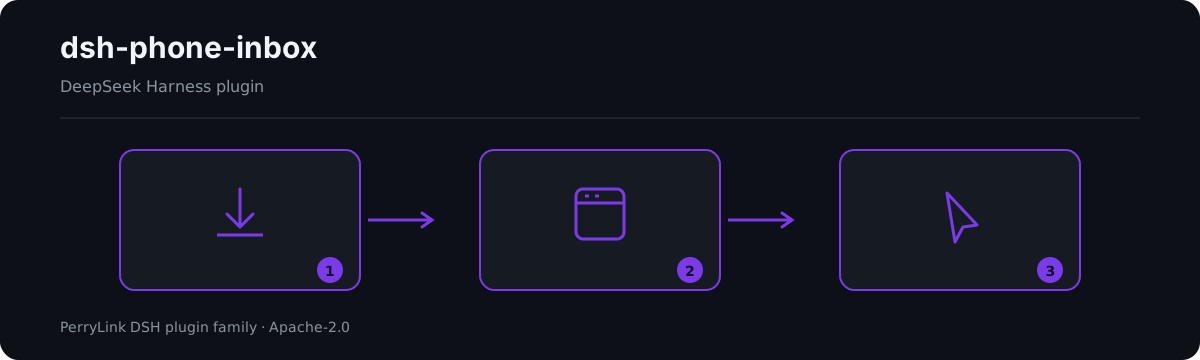
Workflow overview: install → open panel → act. The examples below use the real command surface.
Install & uninstall
dsh plugin --profile <name> add dsh-phone-inbox
dsh plugin --profile <name> remove dsh-phone-inbox
The plugin has no runtime dependencies (dependencies is empty). Its only peers are the host packages it is built against; see the peerDependencies block in package.json.
The problem this closes
dsh-wechat saves inbound phone media to ~/.dsh-wechat/tempfile/ — outside the session workspace — and writes the absolute path into a plain text block. Two consequences follow, and neither is visible to the user:
- Workspace-confined tools cannot read it.
dsh-data-qualityrejects any path that escapes the session workspace (path-escape), so "I sent you a CSV, profile it" fails even though the file is right there. - The file name is destroyed. The bridge names the file
${Date.now()}-${rand4hex}-${name.replace(/[^\w.-]/g, "_")}, so材料.csvlands on disk as__.csv. The user cannot recognize their own file.
dsh-phone-inbox adds no new channel and copies nothing by default. It makes the session's own inbound list addressable, and it restores the name the bridge mangled — from the [收到文件: <name>] marker the bridge already writes.
What you get
| Tool | Question it answers |
|---|---|
inbox_list | "Where is the file I just sent you from my phone?" |
inbox_adopt | "Put it somewhere my workspace-confined tools can read it." |
Both tools are registered by the function plugin, so they appear in the model's tool list as soon as the bundle row is mounted.
Quick start
# 1. Mount the plugin (a bundle row in the target profile)
dsh plugin --profile <name> add dsh-phone-inbox
Then, in a session that received a phone attachment:
inbox_list                                   # the paths this session received
inbox_adopt { "path": "<the path from inbox_list>" }
inbox_adopt returns relativePath (for example phone-inbox/材料.csv). Pass that to a workspace-confined tool such as data_profile; pass the original host path only to consumers that accept any absolute path.
Compatibility
| Engine | Range |
|---|---|
| Node.js | ^22.19.0 || >=24.0.0 |
| DSH | >=0.2.1-alpha.1 |
The host peer range is the ecosystem's canonical six-clause OR range (see dsh-plugin-kit/data/peer-range.json). The host evaluates peerDependencies at preflight and silently disables a plugin row whose range does not admit the running version, so a wrong range looks like "the plugin mounted and does nothing". The host also adjudicates engines.dsh independently; a mismatch there can disable the row even when the peer range admits the version.
Examples
These are the plugin's real entry points; install once, then call one.
Detailed example
Command
inbox_adopt
Input
{
  "path": "/tmp/dsh-test-phone-inbox-acceptance-5AoMHy/.dsh-wechat/tempfile/1792414010975-0a67121b-__.csv"
}
Output
{
  "relativePath": "phone-inbox/材料.csv",
  "copyMethod": "node-fs"
}
Observed from plugins/dsh-phone-inbox/scripts/acceptance.mjs:134-147
Failure branch
Input
{"path":"/tmp/dsh-phone-inbox-example/workspace/local.csv"}
Output
phone-inbox could not adopt that attachment.
reason: not-in-inbox
/tmp/dsh-phone-inbox-example/workspace/local.csv is not inside the inbox directory /tmp/dsh-phone-inbox-example/inbox; this plugin only adopts files the bridge saved there
Observed from plugins/dsh-phone-inbox/src/provider-base.ts:443-449; plugins/dsh-phone-inbox/src/render.ts:108-115; plugins/dsh-phone-inbox/tests/integration.test.ts:359-368
Brief examples
inbox_adopt
Configuration
Every field is optional; the table lists the default. See cordis.patch.yml for the same values with inline comments.
| Key | Default | Meaning |
|---|---|---|
enabled | true | Master switch; false mounts no service and no tools. |
inboxDir | "" → ~/.dsh-wechat/tempfile | Directory the bridge drops inbound media into. Empty derives the bridge's own default; set it when the bridge's storageDir was moved. |
maxItems | 5 | Cap on entries inbox_list returns. The MVP contract is "the session's most recent few". |
provider | session | Which registered provider answers: session (this conversation's own messages) or tempdir (session plus a scan of inboxDir). |
allowTempdirScan | false | Enables the directory scan at all. Off because inboxDir is global. |
tempdirScanMaxItems | 5 | Cap on entries a scan may contribute. |
tempdirScanMaxAgeMs | 3600000 | Age ceiling for a scanned file; 0 disables the filter. |
markers | see below | Marker wording per media kind, as RegExp sources. |
defaultSubdir | phone-inbox | Workspace subdirectory inbox_adopt writes into. |
restoreOriginalName | true | Use the sender's recovered original name as the adopted file name. |
writeChannel | auto | auto (fs service for text, node:fs otherwise) · fs (host fs service only) · node (bytes directly). |
registerAttachment | false | Also register adopted bytes as a durable host attachment. Attachment objects are never garbage-collected. |
The markers default wording, per media kind — each value is a RegExp source whose first capture group is the path:
image.path—文件已保存到:\s*(\S+)file.path—(?:文件已保存到|文件路径):\s*(\S+)file.name—\[收到文件:\s*([^\]\r\n]+)\]video.path—文件已保存到:\s*(\S+)
Marker wording is a soft contract with the bridge: it writes the path into prose, and the prose can change between bridge releases without notice. The patterns are configuration precisely so a wording change is a config edit rather than a plugin release.
Tools & surfaces
inbox_list({
  limit?: number,            // default: config.maxItems
  includeTempdir?: boolean,  // only honoured when allowTempdirScan is true
})
Returns { ok: true, source, inboxDir, items[], attachments, deriveMessages, emptyReason?, emptyDetail?, tempdirScan, unresolvedAttachmentBlocks }, or { ok: false, reason, detail }.
inbox_adopt({
  path: string,              // required: exactly what inbox_list reported
  name?: string,             // default: the recovered original name
  subdir?: string,           // default: config.defaultSubdir
  channel?: 'auto' | 'fs' | 'node',
  overwrite?: boolean,       // default false: a duplicate gets a -1 suffix
  register?: boolean,        // default: config.registerAttachment
})
Returns { ok: true, item } with hostPath, workspacePath, relativePath, bytes, sha256, copyMethod, nameRestored, sourceLeafName, and attachmentId/attachmentHostPath when registered; or { ok: false, reason, detail }.
The plugin also appends one system-prompt section (phone-inbox, order 320) so the model knows the capability exists, and subscribes to session/event for user/message observation. Neither is required for correctness: the history read is authoritative on every call.
Permissions & data
- Reads
inboxDirand the calling session's own messages. Nothing else. - Writes only inside the session workspace (
path.resolve+ a separator-aware containment check), and only wheninbox_adoptis called. - Refuses a source path that is not under
inboxDir, asubdirthat escapes the workspace, and a name that could traverse. Thepathargument comes from the model and is never trusted. - Does not scan the shared inbox directory unless
allowTempdirScanis explicitly enabled; when it does, every entry it contributes is stampedsource: "tempdir". - Never overwrites silently. A duplicate destination gets a
-1,-2, … suffix unlessoverwrite: true. - Registers nothing as a durable attachment unless asked; registration copies bytes into the host's attachment store, which has no garbage collection.
Security boundaries
- Reads are not fenced by the host's fs sandbox (the fence wraps only
writeText/editText), so this plugin enforces its own containment on both ends of the copy. - The
fswrite channel goes throughctx.fs.writeTextwith the session-scoped sandbox policy, so a confining backend fences it exactly as it fences thewritetool.nodebypasses that fence by construction; it exists becausectx.fshas no byte-write API. The returnedcopyMethodalways says which one ran. autoprefers the fs service for text and falls back tonode:fs; the fallback reason is recorded and the channel is reported, never implied.- The tempdir scan cannot prove which conversation a file belongs to. That is why it is off by default and why its items carry their own
source. - The bridge's inbox directory is not guaranteed to be private (a bridge refactor removed the explicit
0o700/0o600handling). This plugin does not assume otherwise.
Known limitations
- A path containing a literal space is truncated at the space by the default marker wording. The capture is
(\S+)because that is what stops it from swallowing the sentence the bridge writes after the path; the bridge's own temp names never contain a space. - Image and video kinds are reported as
file. The bridge uses the same wording for both, so the kind is not recoverable from the text; the leaf name (image.png,video.mp4) tells them apart. - An image or video has no recoverable original name. The bridge saves them as
image.<ext>/video.mp4and the wording carries no original name. The plugin reports the on-disk name and says so rather than inventing one. - A Windows path is only usable on Windows (and a POSIX path only on POSIX). The plugin normalizes separators the way the running platform does.
inbox_adoptneeds the file to still exist. The bridge never cleanstempfile/, but nothing guarantees it stays.- No real WeChat traffic has been exercised. See the acceptance script for what is verified, and its output for the scripted-vs-real boundary.
Development
pnpm install
pnpm run typecheck && pnpm test && pnpm run build \
  && pnpm run verify:self-contained && pnpm run verify:artifacts \
  && pnpm run check:readmes && pnpm run check:lockfile
pnpm run acceptance          # end-to-end: probe -> list -> adopt -> dsh-data-quality
prepublishOnly re-runs the gate, so a release cannot ship an unbuilt or drifted tree.
Topics
dsh · dsh-plugin · deepseek-harness · cordis · wechat · inbox · attachment · phone
Contributors
PerryLink.
PerryLink DSH Plugin Family
This project is part of the DeepSeek Harness plugin family from PerryLink. The roster stays collapsed below so every README keeps a short first screen; expand it to see every row and its status.
Expand all plugins
License
Apache-2.0. Every file in this repository is covered by it.
Plugins associés
dsh-web-ui (dsh-chat-recovery)
zhu1090093659/dsh-web-ui
billion-context
ranxianglei/billion-context
dsh-synapse
liangmianya/dsh-synapse
dsh-chat-import
nwflower/dsh-chat-import