dsh-meta-analysis
perrylink/dsh-meta-analysis
Metanalisi DeepSeek Harness: dimensioni effetto (OR/RR/d/r/SMD, SE da CI), formule nominate, aggregazione fissa/DerSimonian-Laird casuale, Q/df/p, I2, tau2, forest plot e report Markdown/SARIF. Locale, senza dipendenze, riproducibile.
Installazione
dsh plugin --profile web add github:perrylink/dsh-meta-analysisREADME

dsh-meta-analysis
当前版本 0.1.5。
Pool the effect sizes — with arithmetic you can check line by line.
Effect-size conversion with named formulas, fixed-effect and DerSimonian–Laird random-effects pooling, Q / I² / τ², forest-plot data, Markdown + SARIF, and a light Egger test that refuses to run on fewer than ten studies.
简体中文 · Español · Português · हिन्दी


What it does
ma_pool— inverse-variance pooling on one analysis scale. Fixed:w = 1/v, pooledΣwθ/Σw,SE = 1/√Σw. Random: DerSimonian–Lairdτ², weights1/(v+τ²). Reports Q, df, p, I², τ², per-study weights and the pooled CI/p at the requested confidence level (level, default 0.95).ma_convert— OR⇄logOR, RR⇄logRR (SE from a CI), d⇄r, d⇄OR (logistic approximation), SMD from two means, SE from a CI. Every result names the formula and any approximation.ma_report— renderer-agnostic forest data (effect, CI, weight % + pooled row), Markdown, SARIF 2.1.0.- Egger — only at k ≥ 10: OLS of θᵢ/SEᵢ on 1/SEᵢ; the intercept tests small-study effects. Labelled a screening aid, not proof of reporting bias.

Structure: input → pool → report; result, markdown and sarif are the outputs, and a level other than 0.95 is honoured everywhere. The token labels inside the diagram are the real tool and field names, so the same picture serves all five languages.
What it does not do
- No model fitting beyond DL. No REML/Paule–Mandel, no meta-regression, no subgroup or leave-one-out automation (the inputs are yours to vary), no trim-and-fill.
- No risk-of-bias judgement. Weights do not encode study quality.
- No data extraction. Effect sizes and SEs must be supplied on one scale;
ma_converthelps produce them. - No plots. Forest data is provided; drawing belongs to the host or another tool.
- No evidence store. This plugin is pure arithmetic: nothing is written to disk, and the README says so instead of pretending there is a REP record.
Formulas
| Quantity | Formula |
|---|---|
| Fixed pooled | Σwᵢθᵢ / Σwᵢ, wᵢ = 1/vᵢ |
| Random pooled | same with wᵢ* = 1/(vᵢ + τ²) |
| Q | Σ wᵢ(θᵢ − θ_FE)², df = k−1 |
| I² | max(0, (Q − df)/Q) |
| τ² (DL) | max(0, (Q − df)/(Σw − Σw²/Σw)) |
| SE from CI | (high − low)/(2·z) |
| d→r | d/√(d²+4) |
| d⇄OR | exp(d·π/√3) / log(OR)·√3/π |
| SMD | (m₁−m₂)/s_pooled, SE √(1/n₁+1/n₂+d²/(2(n₁+n₂))) |
| Egger | OLS intercept of θᵢ/SEᵢ on 1/SEᵢ, t with df = k−2 |
Normal-tail p uses an A&S 7.1.26 approximation (~1e-7); Φ⁻¹ uses Wichura's AS 241 / PPND16 (~1e-16); χ² and t use regularized incomplete gamma/beta continued fractions (~1e-10). All are implemented in src/math.ts with no dependencies.
Tools
ma_pool
{ studies: [{label, effect, se?, ciLow?, ciHigh?}], model?, level? } → { ok, result }.
ma_convert
{ conversion, value?, low?, high?, level?, mean1?, sd1?, n1?, mean2?, sd2?, n2? } → { ok, result }.
ma_report
{ result, measure? } → { ok, forest, markdown, sarif }.
Error codes
INVALID_INPUT (non-finite values, non-positive SE/OR/RR, |r| ≥ 1, SE/CI disagreement, k < 2).
Compatibility & install
| DeepSeek Harness | dsh-v0.2.2-rc.4 (verified 2026-11-18); peer >=0.2.1-0 <0.3.0 || >=0.2.2-0 <0.3.0 |
| Node | ^22.19.0 || >=24.9.0 (tested 24.22.1), ESM only |
| Peers | @perrylink/dsh-research-core ^0.1.0, @deepseek-ai/cordis ^4.0.5-alpha.1, @deepseek-ai/dsh-tools, @deepseek-ai/schemastery ^3.18.5-alpha.1 |
| Runtime dependencies | zero |
dsh plugin --profile <name> add @perrylink/dsh-research-core dsh-meta-analysis
dsh --profile <name> --dump-config | grep dsh-meta-analysis
Family-wide peer note:
@perrylink/dsh-research-coreis declared as a peer for a single, uniform install contract across the research family, even though this package does not import it at runtime.
Configuration
| Key | Default | Meaning |
|---|---|---|
enabled | true | false mounts nothing |
model | both | default pooling model (fixed / random / both) |
level | 0.95 | default confidence level |
Evaluation
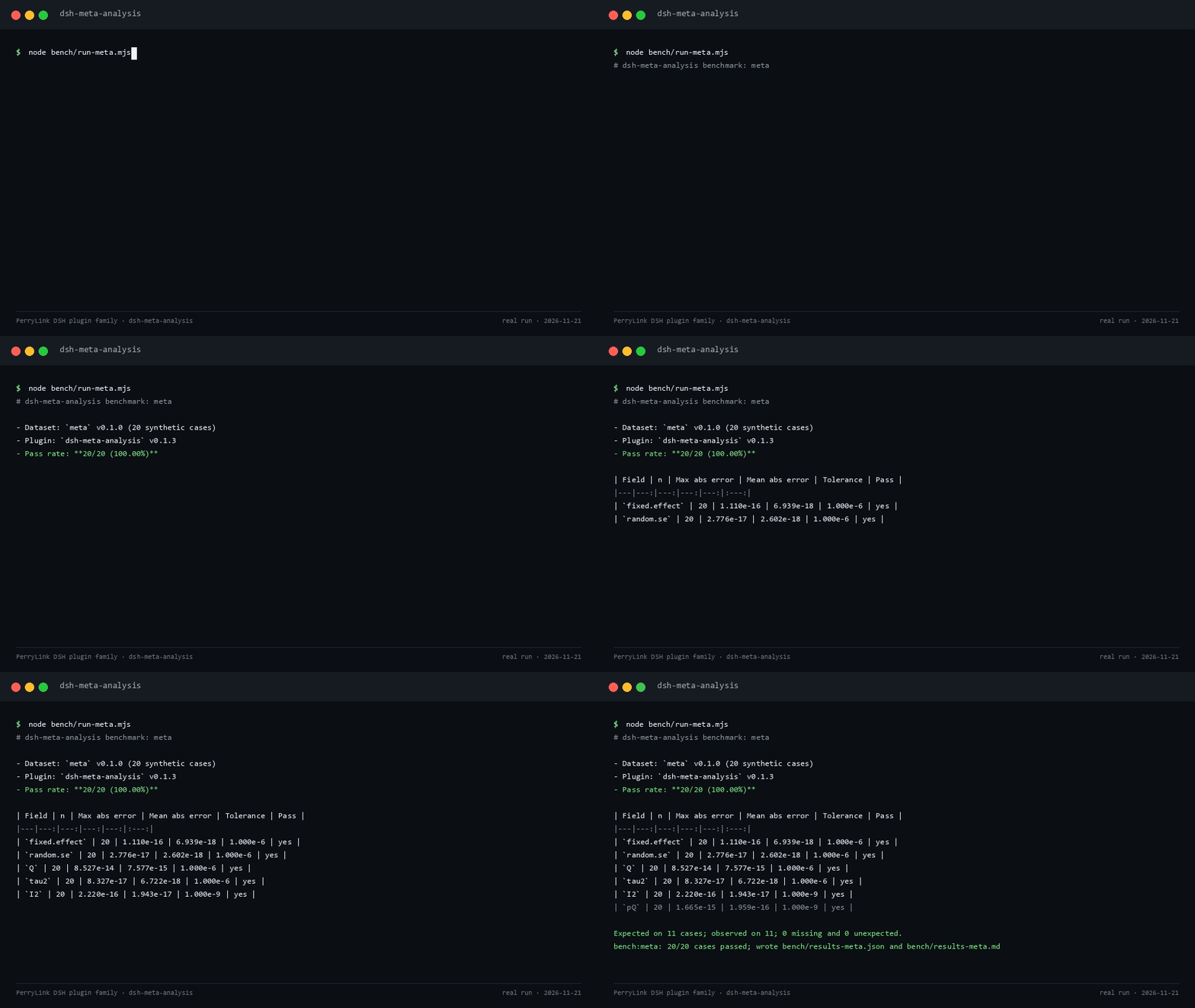
Animated: the benchmark adapter's real stdout over the frozen fixtures (no network; re-run 2026-11-21). The expected values are the generator's independent closed form, not plugin output.
23 unit tests: special functions against known critical values (χ²(8,2)=0.9817, t(2.306,8)≈0.05, z(1.96)≈0.05, Φ⁻¹(0.975) to 12 decimal places), conversions (logOR+SE, d⇄r, d⇄OR, SMD, impossible inputs), pooling (hand-calculated fixed/random estimates, Q=8, I²=0.75, τ²=0.03 from three studies), the requested confidence level for pooled and study CIs, CI-derived SE and SE/CI disagreement rejection, invalid models/levels/studies, Egger gating at k=10, heterogeneity warnings, tool schemas, malformed-report rejection, end-to-end report, plugin contract, package contract and the enabled/disabled mount contract.
Synthetic meta-analysis benchmark
A separate 20-case, deterministic synthetic benchmark (dataset meta v0.1.0, frozen) lives in the sibling dsh-research-bench repository under data/meta; it is not vendored into this package. Each case supplies studies (effect + SE, or a symmetric CI) and closed-form expected values for fixed/random pooling, Q, df, pQ, I², τ² and Egger presence.
Coverage: 5 homogeneous cases (I²=0, τ²=0), 5 medium- and 4 high-heterogeneity cases (Q>df, τ²>0), 2 zero-effect, 2 negative-effect and 2 small-k cases; k = 2 (4 cases), 5 (5), 10 (6) and 12 (5); 10 equal-SE and 10 unequal-SE designs; SE-only, CI-only and mixed inputs. Egger runs on the 11 cases with k ≥ 10 (including the k=10 boundary) and on none of the 9 below it.
The adapter calls pool(studies, { model: 'both' }) and compares against the generator's independent implementation (no plugin import, no expected value derived from plugin output). 20/20 cases pass; absolute errors:
| Quantity | Max abs error | Mean abs error | Tolerance |
|---|---|---|---|
| fixed/random effect | 1.11e-16 | 8.33e-18 | 1e-6 |
| fixed/random SE | 2.78e-17 | 1.74e-18 | 1e-6 |
| fixed/random CI | 2.22e-16 | 3.96e-17 | 1e-6 |
| Q | 8.53e-14 | 7.58e-15 | 1e-6 |
| τ² | 8.33e-17 | 6.72e-18 | 1e-6 |
| I² | 2.22e-16 | 1.94e-17 | 1e-9 |
| pQ | 1.67e-15 | 1.96e-16 | 1e-9 |
The benchmark surfaced one real precision limit: the old Acklam Φ⁻¹ was 1.6e-9 off at 95%, and CI-derived SEs amplified it into I² deviations of 1.12e-9 on two cases. normalQuantile now uses AS 241; the largest Q error is 8.5e-14.
pnpm run build
pnpm run bench:meta        # reads ../dsh-research-bench/data/meta (BENCH_DIR overrides)
It writes bench/results-meta.json and bench/results-meta.md (no timestamps; re-running is byte-identical).
Known limitations (v0.1)
- One analysis scale per call; multi-scale harmonisation is the caller's job.
- DL τ² is known to be biased at small k; the plugin warns when k < 5.
- The Egger test assumes a normal distribution of effects and is underpowered below ~10 studies.
- No prediction interval (could be added without changing the interface).
License
Apache-2.0. No third-party runtime code.
Plugin correlati
archify (deepseek-harness)
tt-a1i/archify
WeKnora (dsh-weknora)
tencent/weknora
next-ai-draw-io (dsh-plugin)
dayuanjiang/next-ai-draw-io
weknora
tencent/weknora