dsh-better-edit
rianico/dsh-better-edit
Strumenti read / edit / batch_edit / undo_last_edit ancorati tramite hash: ogni riga riceve un hash di contenuto univoco di 3 caratteri, le modifiche puntano agli hash invece che ai numeri di riga, e la verifica dello stato servito rifiuta gli intervalli obsoleti con ancore aggiornate.
Installazione
dsh plugin --profile web add github:rianico/dsh-better-editREADME
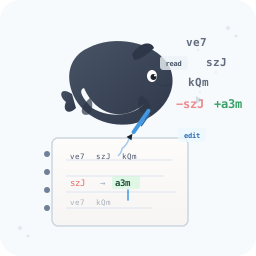
dsh-better-edit
High-precision, hash-anchored file editing for DeepSeek Harness (dsh).
Replaces fragile line numbers and token-wasting code echoes with content-addressed line hashes — 0 silent miswrites, 0 token re-reads.
English · 简体中文



Why You Need It • Core Pillars • Quick Start • Tools • Benchmark • How Anchors Work • Development







What is
dsh-better-edit? A high-precision file editing plugin for DeepSeek Harness (dsh) that replaces volatile line numbers and token-wasting code echoes with immutable, content-addressed 3-character line hashes (szJ│code).Core Philosophy: Local compute is free; the model's context window is the most precious resource. By shifting verification, snapshotting, and alignment to the host,
dsh-better-editslashes output tokens by 40–60%, auto-rebases external file drift (e.g., Prettier, Git), and eliminates silent miswrites without forcing full-file re-reads.
Why You Need It
The 3 Fatal Editing Traps of Autonomous Coding Agents
File editing is the #1 point of failure for autonomous agents. Traditional tools break down in three distinct ways:
| Fatal Trap in Traditional Tools | Why It Breaks Agents | How dsh-better-edit Solves It |
|---|---|---|
str_replace Token Bleed | Must re-type 30+ lines of unchanged code just to change 1 line ($O(S+R)$), burning expensive output tokens (billed ~5–6× input). | $O(R)$ Payloads: Sends only two 3-char hashes (anchor_from, anchor_to) + replacement. Cuts output tokens by 40–60%. |
| Line-Number Coordinate Rot | Inserting 1 line shifts all line numbers below it. Agents suffer off-by-one errors or must repeatedly re-read the file. | Position-Independent Anchors: Line hashes follow content, not line coordinates. Exterior shifts auto-rebase cleanly. |
| Silent Miswrites & Drift | Duplicate lines match the wrong function; external formatters (Prettier) or git updates cause blind overwrites or fatal errors. | Content-Addressed Line Verification: Unique anchors via coprime probing; format-tolerant whitespace hashing; fail-closed reject-and-serve. |
Core Pillars
1. 🪙 Token Economics (40–60% Context Savings)
- $O(R)$ Edit Payloads: The model emits only
{ "path": "...", "edits": [["a1b", "c3d", "..."]] }, never echoing existing code. - Self-Serving Diffs: Every applied edit returns fresh anchors in the post-edit diff — zero re-read roundtrips to chain edits.
- Zero-Token Auto-Rebase: Non-conflicting exterior shifts resolve locally without agent intervention — 0 tokens, 0 retries.
- Atomic Multi-Item Batches: Apply up to 32 same-file edits in one tool call; overlapping spans abort atomically (
[E_BATCH_ABORT]) before touching disk.
2. 🛡️ Resistance to External Writes (Drift & Concurrency)
- Auto-Formatter Immunity: Strips ASCII whitespace before hashing. Prettier, Black, and ESLint format-on-save passes never rotate anchors.
- Exterior Shift Auto-Rebase: External edits, git checkouts, or background processes outside the edit span rebase seamlessly without agent intervention.
- Fail-Closed Reject-and-Serve: Contested interior spans fail closed without disk corruption and immediately return fresh on-disk rows in the error (
[E_STALE_RANGE],[E_UNSERVED_RANGE]) — recovering in exactly 1 turn. - Session-Keyed Leases: Leases are isolated per session, preventing cross-agent race conditions or state pollution.
3. 🎯 Zero Silent Miswrites
- Decoupled Line Identity: Lines are verified against served snapshot lineage, not ephemeral line coordinates.
- Collision-Free Anchors: Coprime bitset probing ensures duplicate lines in a file receive distinct, unambiguous 3-character hashes.
- No Heuristic Guessing: Retires fuzzy matching. If an anchor cannot be unambiguously resolved, it fails closed safely.
- Persisted Undo:
undo_last_editrestores exact file content, BOM, line endings, and original anchors, persisting across session restarts.
"The harness — not the model — is the bottleneck." — Can Bölük, The Harness Problem
3 calls vs 6 · -55.8% tokens · 23/23 correctness. Tested on realistic external-drift refactoring against OMP wrapper. Payload numbers are deterministic — see Benchmark.
Quick Start — install to verified edit in 30s
Install (pick one)
npx @deepseek-ai/dsh plugin --profile web add github:Rianico/dsh-better-edit   # from github
npx @deepseek-ai/dsh plugin --profile web add dsh-better-edit                 # from npm
npx @deepseek-ai/dsh plugin --profile web add /path/to/dsh-better-edit       # local
No config. Next session runs with hashline tools. Verify:
dsh --profile <name> --dump-config # shows "# == dsh-better-edit" layer
| Requirement | |
|---|---|
| Node | ^22.19.0 || >=24.0.0 |
| Profile | dsh profile (dsh plugin creates one) |
| Backends | sandboxed / remote ctx.fs |
See it work
read serves HASH│content — the hash is the address:
ve7│function hello() {
szJ│  console.log("world");
kQm│}
edit by hashes — always lands where you meant:
{ "path": "src/main.ts", "edits": [["szJ", "szJ", " console.log('hi');"]] }
Returns a diff with fresh anchors — next edit needs no read:
- szJ │   console.log("world");
+ a3m │   console.log('hi');
  kQm │ }
Position-free in one line: read 1..5 → insert @0 → edit 10..12 still verifies 10..12 (resist mode). Multi-session honesty: A:10..12+1 shifts B:20..30→21..31 → B passes (drift notice); B:12..13 overlapping A → E_STALE_RANGE + fresh rows, one retry.
Batch atomically — one edit, up to 32 same-file ranges:
{
  "path": "src/main.ts",
  "edits": [
    ["a1b", "a1b", "new line 1\n"],
    ["c3d", "c3d", "new line 2"]
  ]
}
One fails → none write ([E_BATCH_ABORT]).
[!TIP] Want proof before you install? Upstream 23/23 battery runs no LLM — stale edits are rejected every run. Same algorithm.
Configuration
Tenancy and prompt guidance declare once, read at agent/created, no code change.
Store central by default $DSH_HOME/plugins/dsh-better-edit/runtime/<name>-<hash8>/ (ls-readable + .wsPath sidecar). DBs are disposable caches — rm -rf runtime/<name>-<hash8>/ is safe, rebuilt on next read.
# $DSH_HOME/plugins/dsh-better-edit/config.yaml
storeDir: central # central | workspace | /abs
autoGitignore: false
undo_ttl_s: 604800 # 7d, -1 forever
storeMaxAgeS: 2592000 # 30d janitor
storeMaxTotalBytes: 524288000 # 500 MB LRU
Env overrides yaml (DSH_BETTER_EDIT_STORE_DIR, DSH_BETTER_EDIT_AUTO_GITIGNORE).
Guidance per preset — tool:read / tool:edit / tool:undo_last_edit are plain markdown per preset at $DSH_HOME/plugins/dsh-better-edit/<preset>/<section>.md (orders 130/131/133). Delete or empty a file → default re-seeds at next boot; keep a --- fence to blank on purpose.
Why Hashline
Verified against what was served. Every resolved line checked against read/diff/rejection rows. Stale or unseen → [E_STALE_RANGE]/[E_UNSERVED_RANGE] + fresh HASH│content, retry needs no read. Session-scoped — sub-agent serves never validate main edits.
Content-addressed. canon(line) strips ASCII whitespace, xxh32 → 62³=238,328 anchors. Re-inserting identical text keeps its hash; prettier/eslint --fix between edits doesn't invalidate. Unique by bitset probing — }/import repeats never collide; cap 238,328 lines ([E_LARGE_FILE]).
No loop, no ritual. No-op → No changes made; same no-op ×3 → [E_NOOP_LOOP]. Diff/echo/rejection rows count as serves — read is recovery, not ritual.
Token economics
Envelope change: hoist path, edits:[[from,to,text]], never repeat old_string.
| snapshot | str_replace | edit | edit multi | OMP per-edit | OMP batch |
|---|---|---|---|---|---|
| pinned 12-edit corpus | 1,015 | 609 -40.0% | 582 -42.7% | 590 -41.9% | 480 -52.7% |
| local snapshot | 358 | 272 -24.0% | 241 -32.7% | 268 -25.1% | 180 -49.7% |
Percent vs str_replace. External row pinned corpus, cl100k_base; local npm run benchmark in upstream.
| engine | calls | tokens | saved | ok |
|---|---|---|---|---|
| OMP | 6 | 28,467 | — | ✅ |
hashline edit | 3 | 12,593 | -55.8% | ✅ |
Single stochastic run, opencode-go/gpt-5.6-luna high. Artifact.
Scope & honesty. Payload deterministic; practical run stochastic. We measure payload + round-trips, not throughput. Retries are where the gap is largest — see edge cases.
Tools
| Tool | What it does |
|---|---|
read | HASH│content with offset/limit; [Showing N-M of T] paging; >200KB lines show marker |
read_skill | Plain text, no hashes, no serves — editing after it needs a serve |
edit | {path, edits:[[from,to,text]]} path:string|null inference, "" deletes, atomic ≤32, verify-then-write |
undo_last_edit | {path} restores last edit (BOM/line endings/anchors), persisted |
write stays, but refuses an exact HASH│ echo for same session/path/line before dispatch.
Error codes
| Code | Meaning |
|---|---|
[E_BAD_PAYLOAD] | Bad tuple shape (payload must be {path, edits} with 3-position tuples) |
[E_STALE_ANCHOR] | No line (hash/retired/canon miss) / multi-line → read |
[E_BAD_ANCHOR] | Not bare 3-char, or replacement_text carries HASH│/diff-preview prefixes — refused, remove and retry |
[E_SERVED_ECHO] | Copied HASH│ from same session/path/line — refused, remove and retry |
[E_EMPTY_RANGE]/[E_NOT_FOUND]/[E_ACCESS]/[E_UNSUPPORTED_FILE]/[E_LARGE_FILE] | Empty guard / missing / access / binary / >238,328 lines |
[E_REVERSED_ANCHORS] | Swapped range — healed with dimmed [USER] notice on success, otherwise refused |
[E_BAD_ENCODING]/[E_DECODE_FAILED] | Encoding / decode failed |
[E_NOT_OBSERVED]/[E_STALE_RANGE]/[E_UNSERVED_RANGE] | Served-state miss — echoed fresh HASH│content |
[E_UNDO_STALE]/[E_UNDO_UNAVAILABLE] | Undo stale / unavailable |
[E_NOOP_LOOP]/[E_BATCH_ABORT] | 3× same no-op / atomic batch fail → nothing written |
Full list in src/ — every rejection echoes fresh rows, no read needed.
Comparison
| dsh-better-edit | @oh-my-pi/hashline | str_replace | |
|---|---|---|---|
| Address | HASH│ 3-char canon | [path#tag] + line | text match |
| Whitespace-insen. | ✅ | ~ n/a | ❌ |
| Duplicate lines | ✅ unique | ~ pos | ❌ first |
| Verified vs served | ✅ every line | ~ file tag | ❌ |
| Blind edit | ✅ reject | ~ | ❌ |
| Batch atomic | ✅ | ✅ | ❌ |
| Undo | ✅ | ❌ | ❌ |
| Battery | 23/23 | 10/10 | — |
~ partial, — n/a. Same lineage — patch library vs dsh tool pair; pick by seam.
Edge cases: wrong anchor impossible (verified), disk drift → reject+serve, shift above → nothing moves, repeats → unique/ambiguous, unseen → reject, batch → atomic. See upstream benchmarks.
Battery: 23/23 tool, 10/10 library (upstream npm run eval, same algorithm).
How Anchors Work
canon(line) strips ASCII whitespace → xxHash32 → A-Za-z0-9 3-char (62³). Stable across prettier; Unicode/strings stay significant except ASCII whitespace inside strings (linter-only). stride=62²+62+1 probes bitset → unique; cap 238,328. Store hash-store.sqlite per workspace (central, honoring XDG_CONFIG_HOME); 7-day served TTL, janitor storeMaxAgeS/LRU + wal_checkpoint.
How It Replaces Built-ins
dsh resolves agent → preset → global; built-ins live on preset. Plugin via cordis.patch.yml: at agent/created registers read/edit on agent layer (shadows, auto-unwinds); write stays with pre-execute guard + post-execute auto-read.
Project Structure
dsh-better-edit/
├── src/hashline/     # hash + served core
├── src/tool-*.ts     # read / edit / undo
├── src/served-store.ts # SQLite store
├── benchmark/corpus/ # 103-line fixture
├── test/             # 108 files, 1222 tests
├── assets/           # logo + banner
└── cordis.patch.yml
Development
pnpm install
pnpm typecheck   # tsc --noEmit
pnpm test        # vitest run
pnpm benchmark   # hash probe + session envelope (reads/retries/tokens)
Benchmark
103-line file, 12 replacements (8×1 + 4×3/6/10/15), cl100k_base. hashline vs str_replace vs oh-my-pi seq/batch. Upstream is source of truth — same algorithm byte-for-byte.
| Criterion | hashline | str_replace | seq / batch |
|---|---|---|---|
old_string echoed | never | every edit | never |
| 12-edit saved | 31% | 0% | 42% / 53% |
| multi-line saved | 29–47% | 0% | 40–53% |
| 5× output cost | ~1.4× less | 1× | ~1.7×/~2.1× less |
| Verified | 100% | none | tag only |
| Scenario | hashline | str_replace |
|---|---|---|
1×8 | 309 | 324 |
3–15×4 | 393 | 691 |
| TOTAL ×12 | 702 | 1015 |
Saved 313 (31%). Reproduce: upstream npm run benchmark. See pi-better-edit/benchmark/README.md.
Scope & honesty. Benchmark is request-payload tokens (reads cancel, replacement text identical). No transcription-failure model — real gap larger; see edge cases.
Roadmap
Current 0.7.0: pos-free resist/strict + retired anchor/canons/epoch, per-session (session,path) store, 1222 tests, 9/9 harness.
Next
- Keep
benchmark/run.mjsin sync withADR-0013(reads/retries/tokens per session) - Re-check wiring vs next
dsh(pinned0.1.0-rc.6) README.zh.mdparity
Contributing
See CONTRIBUTING.md. Most valuable: more served-state edge-case tests.
License
MIT — see LICENSE.
Acknowledgments
From Can Bölük's The Harness Problem. Thanks to pi-hashline-edit, pi-hashline-edit-pro, pi-better-edit, @oh-my-pi/hashline. Reading: hash-anchors.
Star History
⭐ If hashline made your agent edit better, give it a star!
Plugin correlati
archify (deepseek-harness)
tt-a1i/archify
WeKnora (dsh-weknora)
tencent/weknora
weknora
tencent/weknora
BrowserSkill (dsh-plugin-browserskill)
tencent/browserskill