본문으로 건너뛰기
A

dsh-desk-pet

anneheartrecord/dsh-desk-pet

Always-on-top DeepSeek Harness desk pet with a native menu and DIY skins. Shows what your agent is doing: working, waiting, finished, failed. Five skins, or make your own from one image. No dependencies.

설치

dsh plugin --profile web add github:anneheartrecord/dsh-desk-pet

README

DSH Desk Pet

The DeepSeek whale, breathing and blinking

A desk pet that shows you what your agent is doing.
It floats above every window — including fullscreen — and changes expression as DSH works, waits, finishes or fails.

npm License System Python No dependencies dsh-plugin

idle, working, waiting, error, happy, sleeping

idle · working · waiting · error · happy · sleeping

中文


Install

With DSH already set up, one command:

dsh plugin --profile web add deepseek-desk-pet
dsh web

The pet appears on your desktop, floating above whatever you are working in. Nothing is added to the DSH page itself.

Pet only, no DSH: clone the repo and run ./bin/dsh-desk-pet.

To follow the main branch instead of the published version:

dsh plugin --profile web add github:anneheartrecord/dsh-desk-pet#main

The npm package is deepseek-desk-pet while the repo is dsh-desk-pet: npm rejects dsh-desk-pet as too similar to an unrelated dsh-deskpet.

No dependencies. It runs on the system /usr/bin/python3 and talks to AppKit through ctypes. Nothing to install, nothing to build — not even ffmpeg: decoding, keying and scaling frames is all standard library.

Use

DragGrab it anywhere. Where you leave it is where it starts next time.
ClickOpens the session list — which DSH sessions exist, which is live, what it is doing. Click again to close.
Sleep (Do Not Disturb)Quiets the pet until you turn it off. The agent keeps working; the pet stops reacting. Petting it still gets a bounce.
Right-clickOpens the menu: quiet mode, the session list, skins, where the pet shows up, updates, quit.
Stop./bin/dsh-desk-pet --stop, or stop dsh web.

It starts in the background and detaches from your terminal, so you can close the window you launched it from.

States

Driven by your local DSH. Nothing to configure.

StateWhen
idleNothing to do — breathes, blinks now and then
workingDSH is running
waitingBlocked on a confirmation, approval, or your input
errorThe run failed
happyA run just finished; settles back to idle after a few seconds
sleepingDozes when the agent is idle and your pointer has stopped moving. Any activity, or a poke, wakes it.

That last one takes two clocks on purpose: an agent with nothing to do is not the same thing as a desk with nobody at it.

Skins

Five skins

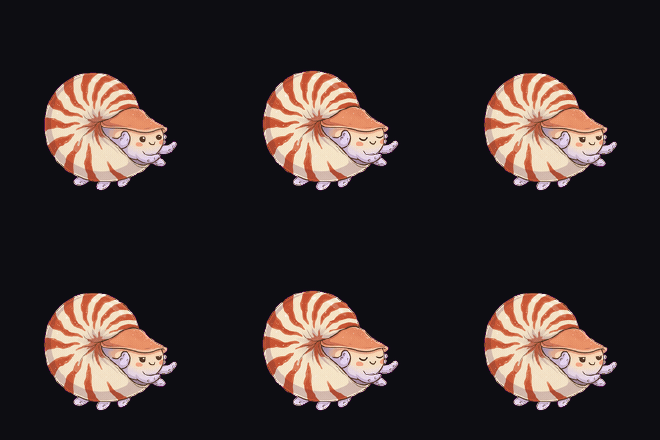
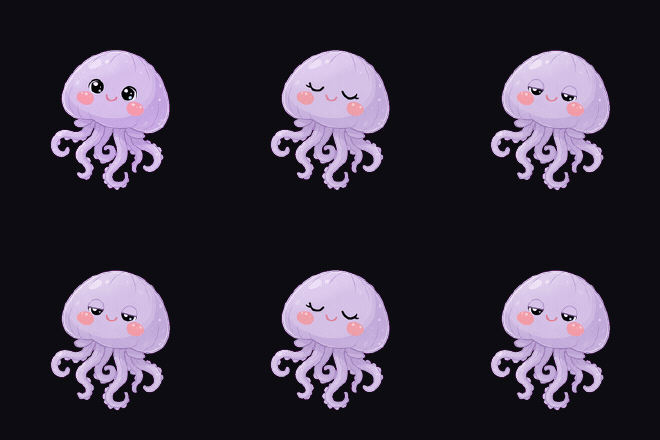
DeepSeek Whale (default) · Blue Whale · Threadcore · Nautilus · Jellyfish

Pick one from the Skin submenu, or start on it with --skin <id>. Every skin has all six states at three frames each.

Make your own from a picture. Hand an image to your agent and ask it to make a desk pet skin. A skill ships with the plugin that turns one image into the eighteen poses a skin needs — six states, three frames each. Your own image tool does the generating, on your own credentials; nothing is sent anywhere by us. Your skins live in ~/.dsh-desk-pet/skins/, outside the package, so upgrading the plugin does not delete them.

The skill stops twice on the way: once after the first pose, so you can throw it away before paying for seventeen more, and once after the second, to check the character survived being redrawn. If a run half-fails it tells you which poses are missing and keeps the ones you already paid for.

Options

./bin/dsh-desk-pet --scale 0.5      # smaller (default 0.7)
./bin/dsh-desk-pet --skin jellyfish # start on a specific skin
./bin/dsh-desk-pet --reset          # forget saved position, size and skin
./bin/dsh-desk-pet --stop           # stop the running pet
./bin/dsh-desk-pet --foreground     # stay attached, log to this terminal
./bin/dsh-desk-pet --probe          # diagnostics, no window
./bin/dsh-desk-pet --inventory      # frames per skin per state

How it works

The pet watches ~/.dsh — running processes, session activity, and an optional hint file — and maps what it finds onto the six states. To drive it by hand:

echo '{"kind":"working"}' > ~/.dsh/pet-activity.json
rm ~/.dsh/pet-activity.json          # back to automatic

The pet publishes what it sees to ~/.dsh-desk-pet/state.json, which is how a second launch knows one is already running and how --stop finds it.

There was briefly a second pet mirrored into the DSH page. It is gone: two pets on one screen read as a bug, and the mirror was where the failures lived. The window that floats over everything is the thing worth having.

Why AppKit and not Tk

macOS ships Tcl/Tk 8.5.9, released in 2010, and on macOS 26 its drawing path no longer reaches the screen: the window maps, the canvas reports itself mapped, viewable, correctly sized and holding an image at the right coordinates — and what appears is an empty grey rectangle.

So the window is built directly on AppKit through ctypes. That is more machinery, and it buys three things Tk could not offer at all: real alpha instead of a 1-bit GIF matte, a window level that clears fullscreen Spaces, and a session panel that travels with the pet as a child window.

Development

/usr/bin/python3 -m unittest discover -t . -s tests -v     # 148 tests, no display needed
DSH_PET_ART_CHECK=1 /usr/bin/python3 -m unittest discover -t . -s tests   # + the pixel gate
node tests/plugin_smoke.mjs                                 # the plugin's HTTP routes

The art pipeline

./scripts/generate_frames.py    # fill in missing poses
./scripts/build_frames.py       # key, align, scale; writes both frame sets
./scripts/check_frames.py       # per-pixel inspection
./scripts/contact_sheet.py      # one reviewable image, no window required

New art goes on a magenta #FF00FF background, and props must not use magenta. The plate has to be a colour the artwork never contains: the first batch was generated on pastel plates — mint green behind the jellyfish — close enough to the characters that no key threshold could separate them, which is how that jellyfish once shipped with its eyes cut out.

generate_frames never redraws a character from scratch; every request is an image-to-image edit of an existing still, because text-to-image cannot hold identity across calls. Frame 00 of a state edits from the skin's idle pose; frame 01 edits from frame 00 of its own state, because a loop needs the same pose an instant later, not two different poses.

check_frames is the only test that looks at pixels. Everything else can only compare filenames — which is how a skin once passed the entire suite with holes punched through its face.

Custom skins

A skin is a folder of frames. Anything at assets/web/<id>/<state>/*.png appears in the cycle on its own, with no code change.

Known limits

  • The window is a rectangle, so clicks landing on the transparent margin around the pet do not reach what is behind it. Per-pixel click-through is written but not yet wired up.
  • A settings window and mini mode are not in this version.
  • Nothing shows progress while a skin generates; your agent's own output is the only feedback during the eighteen images.

What is planned next, and what is deliberately not: docs/ROADMAP.md.

License

MIT.

관련 플러그인