skill-wb-exec
luminousyyh/skill-wb-exec
범위를 제한한 코딩 작업을 헤드리스 CLI 에이전트에 위임하고 구조화된 결과와 실제 diff를 수집합니다. 기본 실행기는 WorkBuddy이며 codex, claude, aider 또는 사용자 지정 명령도 선택할 수 있습니다. 쓰기 허용 경로 목록, 겹치는 경로에 대한 동시 디스패치 잠금, 격리 worktree, 구조화된 needs_human 플래그를 제공합니다. Python 3.10+(표준 라이브러리만 사용)과 설치된 CLI 실행기 하나가 필요합니다.
설치
dsh plugin --profile web add github:luminousyyh/skill-wb-execREADME
wb-exec
Delegate bounded implementation work to another CLI agent; keep planning, supervision and review for yourself.
wb-exec is a DeepSeek Harness plugin (skill bundle): the host agent hands coding / refactoring / test-writing subtasks to a headless CLI executor and gets back a structured result plus the real diff.
The default executor is WorkBuddy / CodeBuddy (DeepSeek V4.1 Flash, effort max), pinned on purpose. If you do not have it, switch backends with --executor — codex, claude, aider, or custom (any CLI, via an argument template). Isolation, supervision, structured capture and the out-of-scope check are identical on every backend.
⚠️ Prerequisite. Whichever backend you pick must be installed on the same machine. Without it the plugin installs but the skill cannot do anything: its first step,
doctor, reportsok=falseand stops. It never installs dependencies or rewrites configuration on its own.
Fits: tasks with a clear boundary that can be finished independently, with an enumerable set of files; using a cheaper executor for volume while the host only plans and reviews; work that deserves an isolated worktree, reviewed by a human before it lands.
Does not fit: exploratory work, requirements still moving, cross-module rewrites, or anything that needs architectural judgement. Keep those in the host.
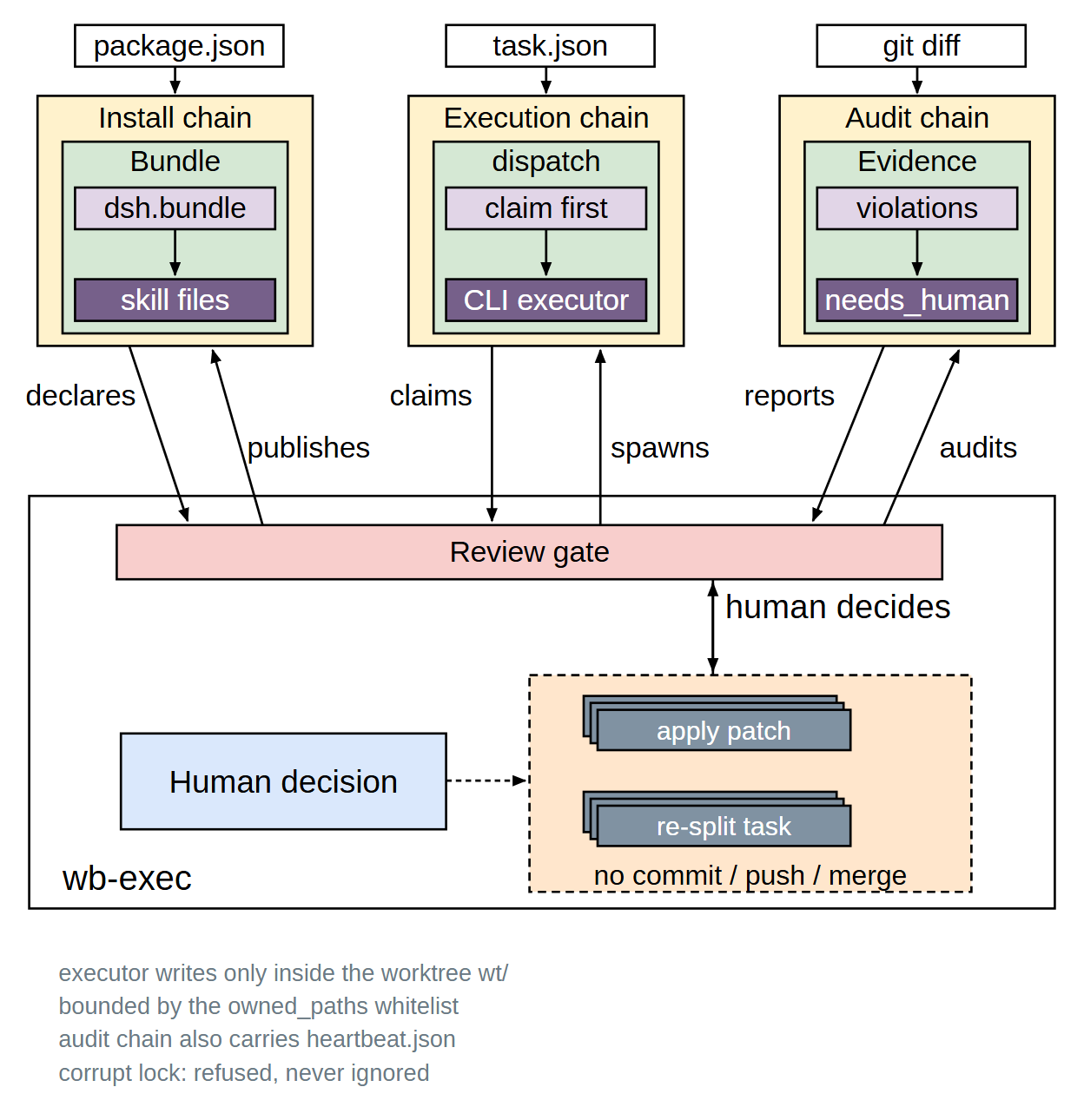
Figure 1. Install-time registration, run-time delegation to the executor, and the audit path that returns artifacts to the review gate — drawn as three columns, read left to right: installation, execution, audit. The execution column shows the ordering that matters: dispatch claims the paths from the lock before it spawns the CLI executor, and the executor edits only the worktree wt/, bounded by the owned_paths whitelist. The footnote restates that bound and records that a corrupt lock is refused rather than treated as empty.
Features
| Feature | What it does |
|---|---|
| Path whitelist | owned_paths in the task package is the set of paths the executor may touch. Changes outside it are detected and reported in result.violations rather than silently accepted. An empty list is enforced as additions only, not as "no check" |
| Failures stay collectable | If dispatch or the supervisor fails, exit.json and result.json are still written, so the job arrives as failed with a blocker instead of vanishing. The CLI is probed before any claim is taken, so a missing executor leaves no live lock |
| Directory isolation | On a Git repository the run happens in a dedicated worktree on a wb-exec/<id8> branch: no commit, no push, no auto-merge |
| Real diff first | The executor's summary is only its own account. change.patch and changed_files_git come from the actual git diff; when the two disagree, the diff wins |
| Structured capture | A --json-schema constraint forces structured output; the script then adds the git diff and the out-of-scope check to produce a machine-readable result.json |
| Recursion guard | The child process gets WB_SUBAGENT=1; the script refuses to dispatch when it sees that variable (exit code 3), so an executor cannot spawn another executor |
| Path-level dispatch lock | A second dispatch whose owned_paths overlap a running job is refused (PATHS_LOCKED, exit code 4) instead of racing it. Disjoint paths still run in parallel. Whether a claim is still alive is decided by the recorded pid, not by a heartbeat age: a supervisor that died before writing its first heartbeat leaves no heartbeat while the executor it spawned may still be editing the claimed paths |
| Failed-closed lock | A dispatch.lock that exists but cannot be parsed is refused rather than treated as "no claims". Coercing a damaged lock to empty would admit every job and then rewrite the file with only the new claim, discarding live holds silently |
| Bounded output | stdout.jsonl plus stderr.log are capped (64 MiB, WB_EXEC_LOG_CAP overrides). Crossing the cap kills the child, marks the job failed and adds a blocker naming the limit, so a truncated transcript can never be read as a finished run |
jobs, read-only | One command prints the live claims (paths, pid, liveness, age) and the recent job history. It never prunes or releases anything, so a refused user has a way to see what is holding the paths instead of deleting the lock by hand |
needs_human, not prose | Every result carries a structured needs_human ({"required": bool, "reasons": [...]}) derived from status, blockers, failing tests and violations. "A person must decide something" is no longer something you infer by reading summary |
| Non-blocking long runs | dispatch returns a job_id immediately; status polls, collect retrieves, and both heartbeat and timeout are observable |
| No dependencies | Python standard library only, Python 3.10+ |
How it works
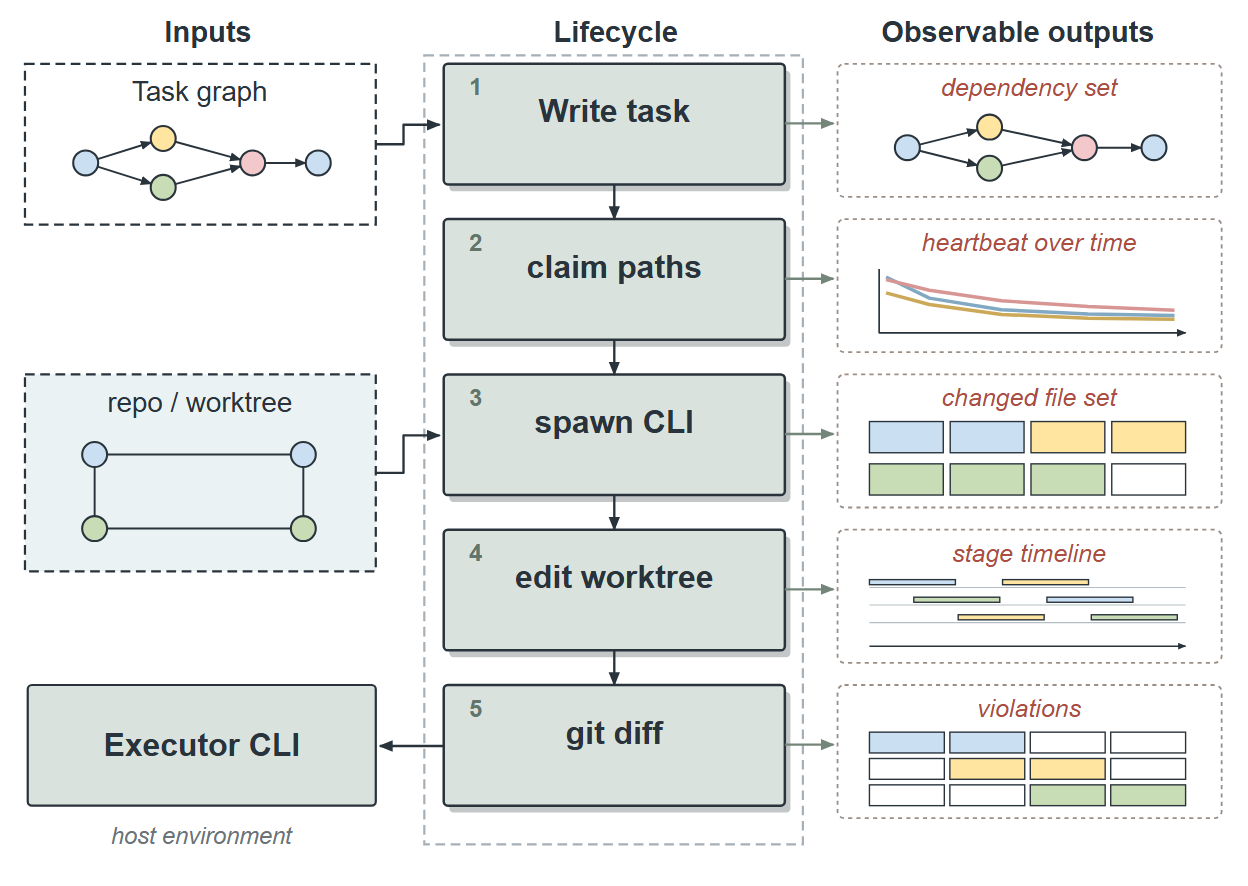
Figure 2. One delegation, drawn as a single unidirectional pass: task authoring, path claim, CLI spawn, worktree edit and git diff, with the observable outputs collected alongside. No cycle is drawn on purpose — a failed review does not re-run the same executor, it re-splits into a smaller package, which is the re-split task edge in Figure 1. The host never merges on its own: review is a separate, mandatory step.
- The host writes the task package to disk as JSON (
goal,owned_paths,acceptance, ...) dispatch(background) orrun(foreground) starts the call; Git repositories get a dedicated worktree by default- The executor works and emits stream-json events; the supervisor writes a heartbeat every 5 seconds
collectparses the structured result and merges in the real diff and the out-of-scope check- The host reads the patch and runs the acceptance commands itself before integrating anything.
wb-execnever integrates for you
Requirements
- Python 3.10+ (standard library only, no
pip install) - One supported CLI executor — pick with
--executororWB_EXECUTOR:workbuddy(default): the script probes for acodebuddyexecutable and for the CLI embedded in a local WorkBuddy install; setWB_CLIto point at one explicitlycodex,claude,aider: found onPATH, or viaWB_CLIcustom:WB_CLI(the executable) plusWB_CLI_ARGV(a JSON array argument template, see below)
- Git — optional. Used for worktree isolation and diff capture; a non-Git directory degrades to in-place execution
- On the
workbuddybackend, an account or plan that is allowed to usedeepseek-v4.1-flash
Check the environment first:
python <SKILL_DIR>/scripts/wb_exec.py doctor
python <SKILL_DIR>/scripts/wb_exec.py doctor --executor codex   # check another backend
It returns JSON with ok / cli (the resolved entry point) / cli_version / executor / available_executors / git / is_git_repo / state_root. When ok=false or cli_error is non-empty, stop and hand the raw output to the user — do not install anything or change configuration.
Install
This repository is a DSH plugin package (package.json declares dsh.bundle). Once installed, a ctx.skills provider publishes skills/wb-exec/ as a skill.
Option 1 — plugin market or CLI (recommended)
Install it from Plugins → Plugin Market in DSH Desktop, or from a terminal:
dsh plugin --profile <profile> add github:Luminousyyh/skill-wb-exec
DSH Desktop manages its own profile. A CLI install may land in
profiles/webinstead of the profile the desktop app uses; on the desktop, install through Settings → Plugins.
Option 2 — use it as a plain skill (no plugin)
Copy skills/wb-exec/ into your agent's skills directory. The loader discovers a skill at <skills-root>/<name>/SKILL.md:
git clone https://github.com/Luminousyyh/skill-wb-exec.git
cp -r skill-wb-exec/skills/wb-exec ~/.agents/skills/wb-exec
Always invoke the script through this skill's absolute path rather than the terminal's current directory:
python <SKILL_DIR>/scripts/wb_exec.py <subcommand> ...
On Windows, if python is not on PATH, use py -3 or the absolute path of a local Python.
Quick start
1. Write the task package (the most important step)
Save it as a file, for example .wb-exec/tasks/001.json:
{
  "goal": "Rate-limit failed logins on /login: lock an account for 10 minutes after 5 consecutive failures within 5 minutes, and return 429",
  "context": "The rate-limiting middleware lives in src/auth/mw.py. A Redis client wrapper already exists in src/common/redis.py; reuse it and do not create a new connection pool.",
  "inputs": ["src/auth/mw.py", "src/common/redis.py", "tests/test_auth.py"],
  "owned_paths": ["src/auth/", "tests/test_auth.py"],
  "acceptance": ["pytest -q tests/test_auth.py"],
  "notes": "Do not add dependencies. Count failures with Redis INCR + EXPIRE under the key auth:fail:<account>."
}
Three hard rules:
goalsays what changed once the work is done, in one sentence — no implementation stepsowned_pathsmust be enumerable; an empty list means the executor may only create new filesacceptanceholds executable commands, never "make sure it works"
2. Inspect the call before making it (optional)
python <SKILL_DIR>/scripts/wb_exec.py dispatch --task .wb-exec/tasks/001.json --cwd <repo> --dry-run
--dry-run prints the argv and starts nothing, which is how you check paths and flags.
3. Dispatch
Long jobs — most of them — go to the background:
python <SKILL_DIR>/scripts/wb_exec.py dispatch --task .wb-exec/tasks/001.json --cwd <repo>
Short jobs can be waited on in the foreground:
python <SKILL_DIR>/scripts/wb_exec.py run --task .wb-exec/tasks/001.json --cwd <repo> --timeout 600
4. Supervise
python <SKILL_DIR>/scripts/wb_exec.py status --job <JOB_ID>
running— normal; look again in 30–60 seconds, never in a tight loopstalled— the heartbeat is more than 90 seconds old.collectfirst to see where it stopped, then decide whether tocanceland re-dispatch a smaller packagecancel_requested— the cancellation flag is written; waiting for the process to exit
python <SKILL_DIR>/scripts/wb_exec.py cancel --job <JOB_ID>
5. Collect and review
python <SKILL_DIR>/scripts/wb_exec.py collect --job <JOB_ID> --wait
The result (excerpt):
{
  "protocol": 1,
  "ok": true,
  "job_id": "3f9c1a7b2e04",
  "status": "done",
  "exit_code": 0,
  "elapsed_s": 42.1,
  "isolated": true,
  "executor": "workbuddy",
  "worktree": ".../wt",
  "result": {
    "summary": "Added token validation middleware and 3 tests",
    "changed_files": ["src/auth/mw.py", "tests/test_mw.py"],
    "tests": [{"cmd": "pytest -q tests/test_mw.py", "status": "pass", "detail": "12 passed"}],
    "blockers": [],
    "artifacts": {"patch": ".../change.patch", "stdout": ".../stdout.jsonl", "stderr": ".../stderr.log"},
    "changed_files_git": ["src/auth/mw.py"],
    "violations": [],
    "needs_human": {"required": false, "reasons": []}
  }
}
needs_human is the field to route on. It is false here because the status is
done, there are no blockers, no failing tests and no out-of-scope writes. It
becomes true with a reason list such as ["failed"], ["out_of_scope_writes"],
["blocked"] or ["failing_tests"] — never by reading the summary's wording.
protocol is the envelope version. It is a plain integer that only changes when
the shape of this envelope changes, so a host written against an older release
can tell what it is reading instead of failing deep inside its own logic after
an upgrade. Unknown keys are safe to ignore; this one is not inferred from text.
Review discipline — none of these is optional:
- Read the patch yourself before judging.
artifacts.patchis the real diff;summaryis only the executor's account. When they disagree, the diff wins - A non-empty
violationsmeans the executor wrote outside its assignment. Do not quietly accept it and do not revert it yourself — report it to the user first - A
passinsidetestsis not independent verification. After integrating, run the acceptance commands yourself in the main working tree - Integration belongs to the host:
git apply --check→git apply→ run acceptance → report. Do not rungit commitorgit pushunless the user explicitly asks for it
Command reference
| Subcommand | Arguments | Purpose |
|---|---|---|
doctor | [--cwd] [--executor] | Self-check: CLI, git, environment, state directory, available backends |
dispatch | --task [--cwd] [--timeout 1800] [--worktree auto|off] [--executor] [--dry-run] | Dispatch in the background, return a job_id immediately |
run | same, minus --dry-run | Run in the foreground and wait for collection |
status | --job | Query the job state |
collect | --job [--wait] [--wait-timeout 1800] | Collect the result; --wait blocks until the job ends |
cancel | --job | Request cancellation (writes a flag file; the supervisor reacts within 0.5 s) |
jobs | [--limit 20] | Read-only listing of the live claims (paths, pid, liveness, age) and the recent job history. It prunes and releases nothing |
General notes:
--timeoutis in seconds and defaults to1800--worktree auto(default) creates a dedicated worktree on a Git repository;offruns in place--executorselects the backend (workbuddyby default; alsocodex,claude,aider,custom).WB_EXECUTORsets the same default through the environment- The
workbuddybackend is pinned: DeepSeek V4.1 Flash at effortmax, hard-coded, with no--modelor--effortflag (passing one is rejected by argparse on purpose). When the account refuses that model the run fails; do not retry with a different model, handstderr.logto the user. Other backends use whatever model their own CLI is configured with —wb-execinjects no model or effort flag for them - On this backend the prompt travels on stdin, not on argv. A multi-line argv prompt is truncated to its first line by the CLI, and the task package is always multi-line, so
-pacts as the read-from-stdin switch.job.jsontherefore stores the prompt itself:argvalone no longer reproduces a run
Choosing a backend
# default: WorkBuddy / CodeBuddy
python <SKILL_DIR>/scripts/wb_exec.py dispatch --task t.json --cwd <repo>

# any other supported CLI
python <SKILL_DIR>/scripts/wb_exec.py dispatch --task t.json --cwd <repo> --executor claude

# anything else, through an argument template
WB_CLI=my-agent WB_CLI_ARGV='["run","--prompt","{prompt}","--dir","{cwd}"]' \
  python <SKILL_DIR>/scripts/wb_exec.py dispatch --task t.json --cwd <repo> --executor custom
The custom template may use {prompt}, {cwd}, {schema}, {session}, {model} and {effort}; each placeholder is expanded for the job before the process starts. A backend name that does not exist fails loudly rather than silently falling back to WorkBuddy.
Task package protocol
| Field | Required | Meaning |
|---|---|---|
goal | yes | The objective, without implementation steps; the script renders it into the executor prompt |
context | no | Background and known constraints |
inputs | no | Read-only reference material; paths are passed to the executor with --add-dir |
owned_paths | no | Whitelist of writable paths; when empty only new files may be created, and edits or deletions of existing files are reported. Always use / as the separator. Entries are resolved against --cwd; one that escapes it, or the repository root itself, is rejected |
acceptance | no | Executable commands; the executor should run them and record the outcome in tests |
notes | no | Catch-all constraints |
owned_paths matching: a path qualifies when it is exactly equal, or starts with the entry plus /. src/auth/ covers src/auth/mw.py; src/auth covers it too. Anything outside the whitelist is recorded in result.violations. An empty list is not "no check": additions pass, but a run that modifies or deletes an existing file shows up there, which is what "new files only" has always meant.
The task file is read as utf-8-sig, so a package written by Windows PowerShell with a BOM loads instead of failing on a stray character.
Full field definitions and the state machine live in protocol.md; a ready-to-edit template is task.example.json.
States and failure handling
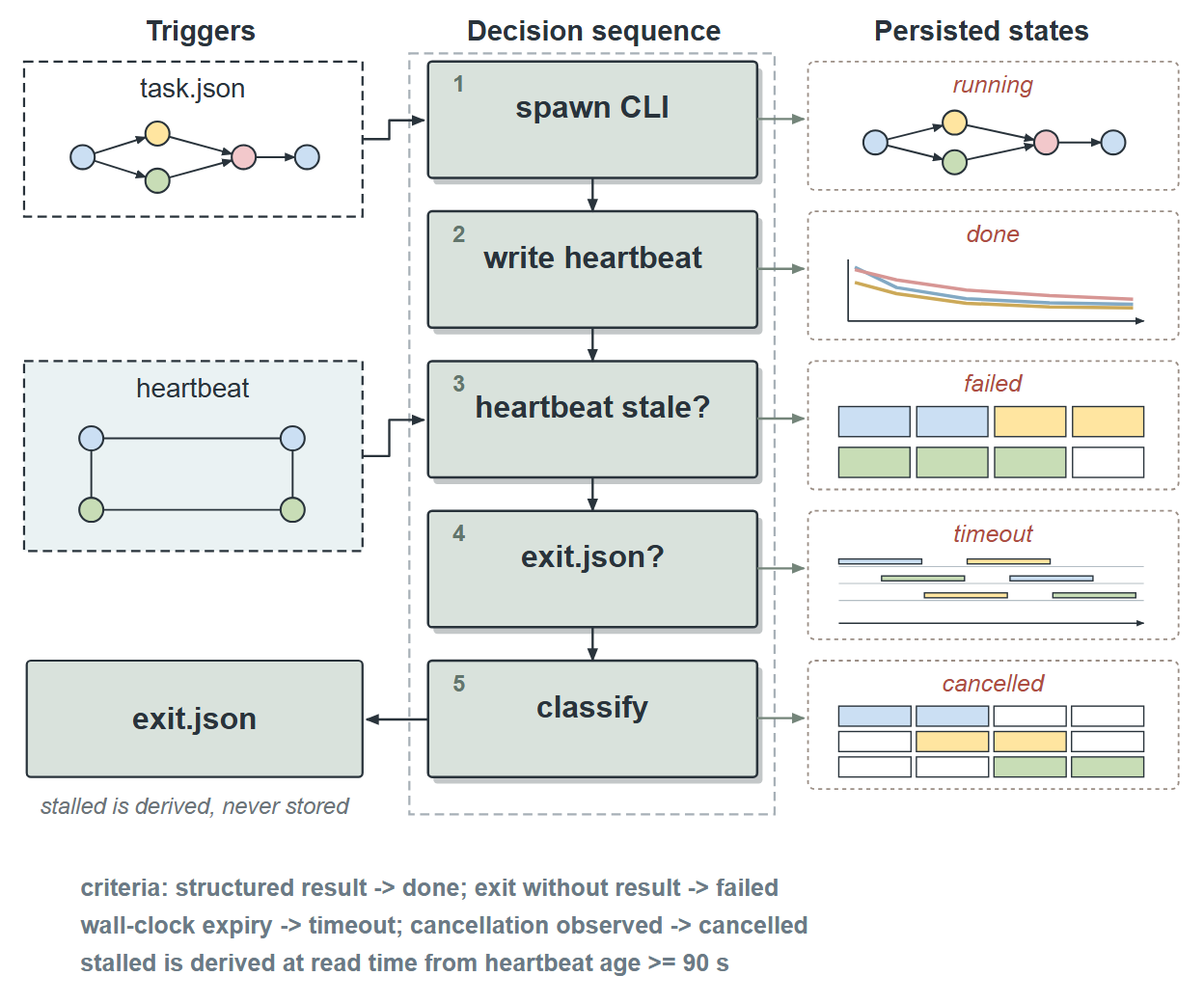
Figure 3. State classification. The decision sequence — spawn, heartbeat write, staleness check, exit.json probe, classify — points at the persisted state it selects; branches are listed beside the sequence rather than drawn as a fan-out. The footnote gives the criteria for the four terminal states and records that stalled is derived at read time from heartbeat age, never stored as a sixth state, and is not reported by the executor.
State machine: running → done | failed | timeout | cancelled | stalled
stalled is derived (exit.json absent and the heartbeat older than 90 seconds). The process may still be alive or already dead — collect first and read the tail of the output.
| Symptom | Action |
|---|---|
exit_code != 0 with a non-empty blockers | Carry the blocker back into planning, narrow or split the package, re-dispatch once |
ok=false, blockers=["could not parse structured result"] | Read the tail of artifacts.stdout; usually the executor did not follow the schema. Add "the last message must be JSON" to notes |
status=timeout | The package is too large. Split it into 2–3 packages whose owned_paths do not overlap |
status=stalled | collect, then cancel; re-dispatch with --worktree auto |
cli_error | Stop and report to the user; do not install dependencies |
Exit codes:
| Code | Meaning |
|---|---|
| 0 | Success |
| 1 | Execution failed, or the result could not be parsed (collect returns ok=false) |
| 3 | Recursion refused (this process is already an executor) |
Safety boundaries
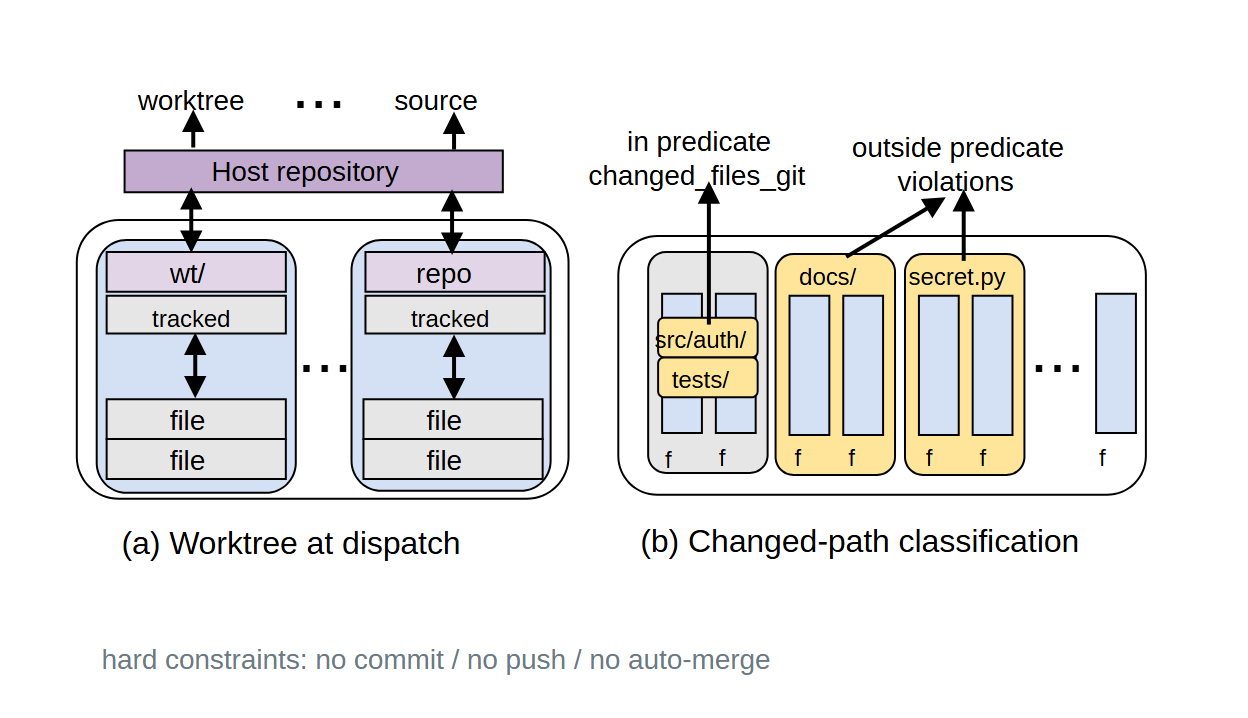
Figure 4. The whitelist and the worktree are enforced in code rather than requested in the prompt. Left: the worktree is cut from HEAD at dispatch, so uncommitted changes do not carry over. Right: every changed path is classified — in-scope paths land in changed_files_git, out-of-scope paths in violations, and they are reported rather than auto-reverted. The footnote states the three hard constraints: no commit, no push, no auto-merge. This is isolation, not confinement: a process that ignores the boundary is not stopped by it.
- Directory isolation and
owned_pathsare the real security boundary, not optional extras. On theworkbuddybackend the child command passes both-yand--permission-mode bypassPermissions.-yalone is documented as "HIGH/CRITICAL still ask", and a non-interactive run has no prompt to answer, soWrite/Edit/Bashwere refused and every task came back with blockers and an untouched worktree at exit code 0. Isolation plus a whitelist is what actually constrains the run - Never recurse: the executor is already forbidden to dispatch. The dispatch lock also refuses a second job whose paths overlap a running one, so the old "do not do this" convention is now enforced rather than remembered
- Isolation failure aborts the dispatch: if the worktree cannot be created, nothing runs. There is no silent fallback to editing the source tree in place, because that would quietly turn an isolation guarantee into no isolation
- An unusable CLI fails loudly: the executor is found and probed before any path is claimed, and an explicit
WB_CLIis authoritative — a broken one fails the run rather than falling back to another installation. A missing CLI therefore leaves no live lock - Never trigger
dispatchfrom inside a WorkBuddy / CodeBuddy session: the child process collides with that session's daemon and hangs silently — measured at 45–300 seconds with no stdout or stderr at all. Call the script from the host agent or a normal terminal - Overlapping work is refused, not queued:
dispatchexits4witherror: PATHS_LOCKEDand names the holding job. Runjobsto see what is holding the paths, then widen the split, wait, or cancel the other job — do not work around it by clearing the lock file - A runaway executor is stopped, not tolerated: the combined
stdout.jsonlandstderr.logsize is checked in the same supervision loop as cancel and timeout. Crossing the cap kills the child and records the cap inblockers, so a truncated transcript is never mistaken for a completed run - Never dump full logs at the user: give
summary, the relevanttestsandviolations; the logs stay in theartifactspaths for on-demand reading - Never re-run by hand with
-y: the script already handles the permission flags; bypassing it bypasses isolation and the out-of-scope check - Never clean up the user's worktree: after
collectthe directory stays in place for review, and removal is the user's decision - In-place execution on a non-Git directory (
isolated=false, no diff capture) leavesowned_pathsas the only defence — it must be written - The lock is not a security boundary either: it stops two cooperating jobs from colliding, not a process that ignores it. Two projects with separate
WB_EXEC_HOMEdo not see each other's claims
What it deliberately does not do
Eleven features were considered and dropped on purpose; the reasoning is in rejected-designs.md. The short version:
| Not a | Because |
|---|---|
| Scheduler | Retrying is a judgement about whether the work is still wanted; a silent retry can duplicate a change you already rejected |
| Auto-merger | An agent that both writes and grades the change has verified nothing |
| Sandbox | A process running as your OS user can reach anything you can. This is isolation, not confinement |
| Model switcher | A pinned executor keeps results comparable, and removes the temptation to "try another model" instead of reading stderr.log |
| Mind reader | needs_human comes from structured fields only, never from the wording of summary |
State directory layout
~/.wb-exec/
  dispatch.lock   claims of every running job: job_id, owned_paths, pid, since
  dispatch.guard  transient mutex held only while dispatch.lock is rewritten
  jobs/<job_id>/
    job.json        task package snapshot, actual argv, cwd, worktree, timeout,
                    the prompt itself and the log cap in force at dispatch time
    heartbeat.json  updated by the supervisor every 5 seconds
    stdout.jsonl    raw executor output (stream-json), capped with stderr.log
    stderr.log      executor log; model and permission errors usually land here
    change.patch    the real diff (Git repository with isolation enabled)
    result.json     parsed structured result
    exit.json       state, exit code, elapsed time
    cancel.request  cancellation flag
    wt/             the dedicated worktree (--worktree auto on a Git repository)
Override the state root with the WB_EXEC_HOME environment variable.
dispatch.lock is advisory between cooperating jobs and scoped to a single WB_EXEC_HOME. It is not a security boundary: a process that ignores it is not stopped by it.
Two properties of the lock are worth knowing before you rely on it. A claim is
considered live while its job has no exit.json and either has a heartbeat
or its recorded pid can still be probed as running; liveness is a fact about the
process, not a guess from a missing file. A lock that cannot be parsed is
refused, never silently replaced — a safety file that disables itself on
corruption is worse than one that blocks and tells you where it is.
Isolation semantics: --worktree auto (default) on a Git repository creates a wb-exec/<id8> branch and a wt/ worktree from the HEAD at dispatch time. Nothing is committed, pushed or auto-merged, and the user's uncommitted changes are not carried over. Removing the worktree is the user's decision; the script never deletes it.
Development and testing
The tests stub the CLI, so they run offline without WorkBuddy installed:
python -m unittest discover -s skills/wb-exec/tests -v
# or one file
python skills/wb-exec/tests/test_wb_exec.py
Nothing calls a model. tests/fake_cli.py replays a stream-json transcript, so the suite runs offline.
- Unit tests cover environment injection, a standalone CLI entry taking precedence over the embedded one, a native error result never being reported as success, plain prose never counting as a structured success, and the executor backends — including a test that pins the WorkBuddy argv so a refactor cannot change it silently.
- Lock tests pin both directions: overlapping and nested paths are refused, a path prefix is not treated as a boundary (
src/auth≠src/authz), Windows separators normalise, disjoint paths still run. Claim liveness is tested from the side that matters: a job directory with no heartbeat but a live pid must still block (that was the crash window where an orphan kept writing), a provably dead pid must be pruned, and an unprobeable pid falls back to the old heuristic so the lock cannot wedge forever. A corrupt lock is asserted to refuse and to be left byte-identical on disk. jobstests pin that the listing reports claims and history, that it is strictly read-only (the lock file is byte-identical before and after), that a dead claim is shown but not removed, and that a corrupt lock is reported with exit code 0.- Desktop-regression tests pin what the Windows installation made easy to get wrong: a UTF-8 BOM package loads,
owned_pathsescaping the working directory is refused, a missing CLI leaves no live claim, an isolation failure never falls back to in-place editing, a spawn failure still produces a collectable terminal result, and a timeout still fires when the executor never reads its stdin needs_humantests pin the derivation: a clean success needs nobody, while failure, out-of-scope writes, blockers and failing tests each raise it — and passing tests alone do not.- End-to-end tests drive the real script through
dispatch→status→collectagainst a temporary Git repo: a run produces a patch, the main working tree is left alone, an out-of-scope write is reported inviolations,--dry-runleaves no job directory behind, a dispatched executor cannot dispatch again (exit code 3), and a chatty executor that exceeds the output cap is stopped with the cap named inblockersrather than reported as done.
Project layout
skill-wb-exec/
├── package.json               # plugin manifest: dsh.bundle.patch -> dsh/cordis.patch.yml
├── dsh/
│   ├── index.js               # server entry: publishes skills/wb-exec/ on ctx.skills (plain ESM, no build)
│   └── cordis.patch.yml       # inserts one row into the profile plugin tree (by package name, no relative path)
├── skills/
│   └── wb-exec/
│       ├── SKILL.md           # skill instructions: self-check, package, dispatch, supervise, collect, boundaries
│       ├── assets/
│       │   └── task.example.json     # task package template
│       ├── references/
│       │   ├── protocol.md           # fields, result shape, state machine, isolation, exit codes
│       │   └── rejected-designs.md   # 11 features considered and dropped, with reasons
│       ├── scripts/
│       │   └── wb_exec.py            # every subcommand (standard library only)
│       └── tests/
│           ├── fake_cli.py                   # stubbed CLI, replays a stream-json transcript
│           ├── test_wb_exec.py               # unit tests
│           ├── test_executor_backends.py     # backend registry, argv pinning
│           ├── test_end_to_end.py            # dispatch -> status -> collect, against a real repo
│           ├── test_repair_regressions.py    # Windows-installation regressions: BOM, spawn, isolation
│           └── test_lock_and_needs_human.py  # lock claims, liveness, jobs listing, needs_human
├── docs/
│   ├── figures/
│   │   ├── pixel_gate.py      # geometric validation: blank-band and ink of the committed PNGs
│   │   └── fig*.{svg,pdf,png} # SVG is the source; PDF to print, PNG (1248 px) to preview
│   ├── design/                # the reasoning behind the mechanism, not a sales page
│   │   ├── protocol.md        #   communication layer: what the contract can and cannot see
│   │   ├── coordination.md    #   concurrency, path granularity, the stated refusals
│   │   ├── stability.md       #   crash, hang, cancel, orphans
│   │   └── rfc.md             #   the three analyses synthesised and ranked
│   └── launch-drafts.md       # ready-to-post copy per channel, with its own fact-check
├── assets/
│   └── icon.png               # plugin-market storefront icon
├── screenshots.json           # market screenshot manifest
├── LICENSE                    # MIT
└── README.md
Design notes
The mechanism is documented layer by layer, including what it refuses to do:
docs/design/protocol.md (host to executor and back), coordination.md
(concurrency and the stated refusals), stability.md (crash, hang, cancel,
orphans) and rfc.md, which ranks the findings and records what was rejected
and why. Several of those notes describe defects that were measured rather than
guessed at, including two hypotheses that the measurement disproved.
Figures
The diagrams are code-native vector files: editable SVG, PDF for print, PNG for preview. The SVG is the source of truth: each figure is edited directly and re-rendered to PDF and to a 1248 px PNG with the architecture renderer.
python docs/figures/pixel_gate.py # blank-band and ink check, no rendering
pixel_gate.py exists because a diagram can be wrong in ways only an eye would
normally catch. The defect that motivated it was a two-panel figure whose panels
were meant to be stacked but never moved: the canvas height had doubled, every
label stayed inside the canvas and the renderer reported zero errors, while 59%
of the image was empty and the panels were still side by side. The check
therefore measures the bounding box of the non-white pixels and refuses a figure
whose blank margin exceeds 35% on any side, or whose content covers less than 55%
of either axis.
They describe the implemented mechanism; they are not a benchmark or a proof of anything.
License
MIT — see LICENSE.