dsh-slot-health
janpauldahlke/dsh-slot-health
DeepSeek Harness (dsh) plugin: live local LLM endpoint health in the web rightbar. llama.cpp slots (busy/TTFT/wedged, /metrics) + Ollama MODELS (loaded vs empty). Engine fingerprinted by response shape. Installable dsh.bundle.
安装
dsh plugin --profile web add github:janpauldahlke/dsh-slot-healthREADME
dsh-slot-health
A live health pane for local LLM endpoints in the DeepSeek Harness web UI. One rightbar tab, one second per sample, engines named by fingerprint — so a busy llama.cpp slot or a resident Ollama model reads as clearly as a dashboard instead of a raw dump.
Built and verified against live backends on the same box: llama.cpp on
:8080 (Qwen3.8 27B) and Ollama on :11434 (including dual-GPU
OLLAMA_SCHED_SPREAD with a 35B MoE).
See also: dsh-gpu-monitor-nvml
— NVIDIA GPU util / VRAM / power pane for the same DSH web rightbar (same lab,
same dual-face plugin shape).
Requirements
- DeepSeek Harness web profile (
dsh web). - A local OpenAI-compatible / native endpoint to watch:
- llama.cpp
llama-server(full support), or - Ollama (honest up-states + MODELS card), or
- anything else reachable (fingerprinted as
unknown/ stub).
- llama.cpp
Configure the origin in cordis.patch.yml (default http://127.0.0.1:8080).
Point it at :11434 when watching Ollama.
Screenshots
Light theme, matching the DSH default.
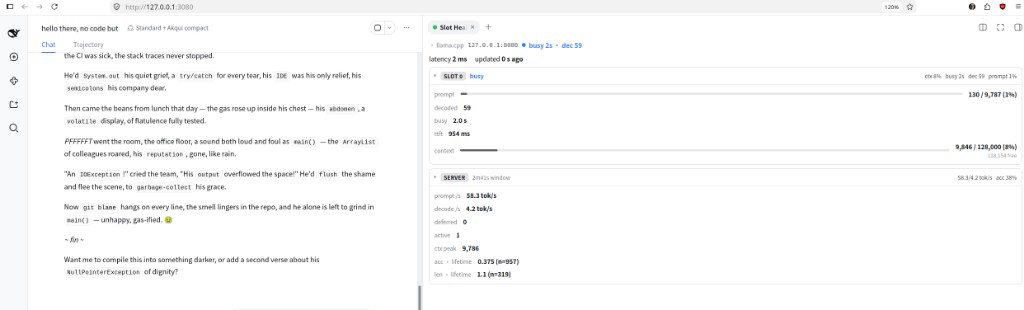
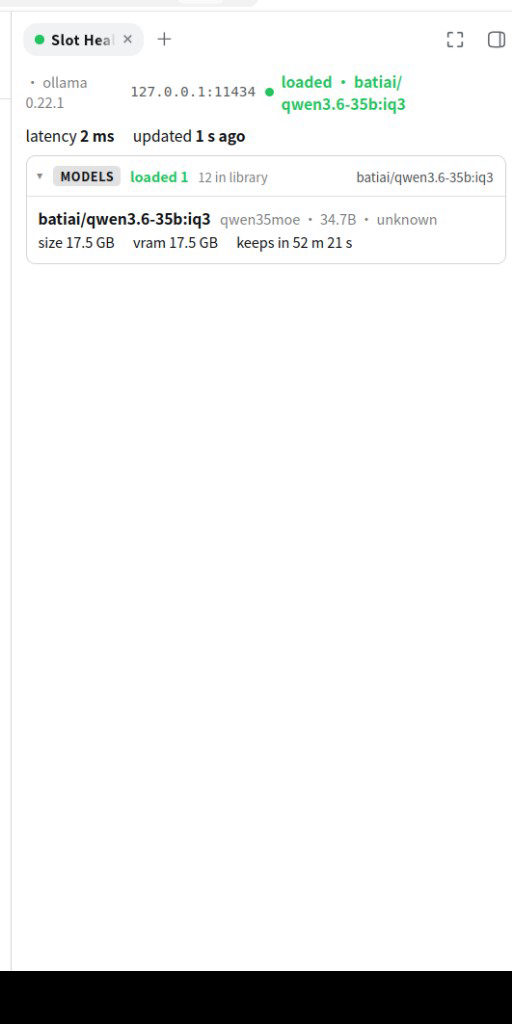
| llama.cpp (busy, expanded) | Ollama (loaded, MODELS open) |
|---|---|
 |  |
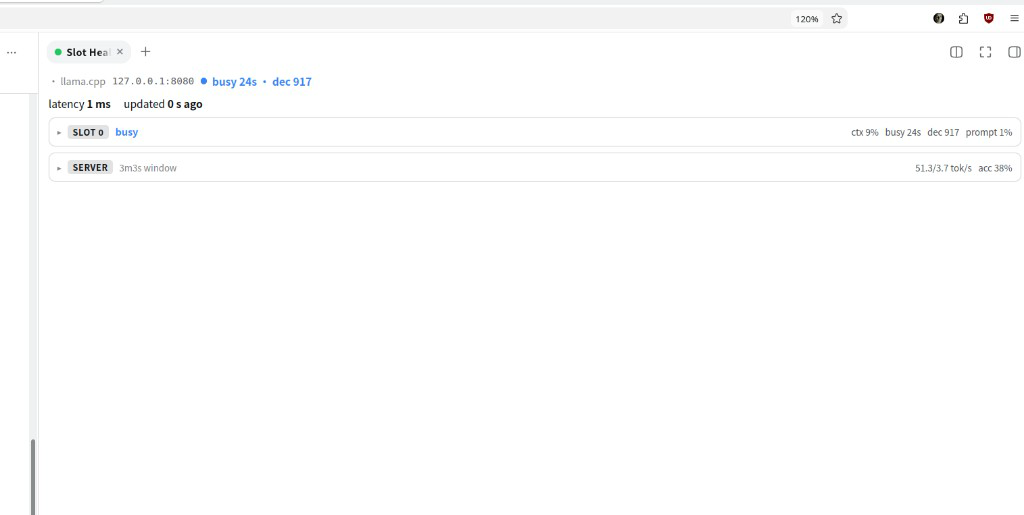
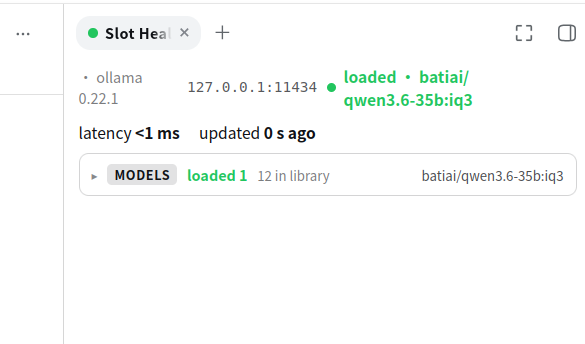
| llama.cpp (cards collapsed) | Ollama MODELS collapsed |
|---|---|
 |  |
| Dock chip · llama | Dock chip · ollama |
|---|---|
 |  |
What you see
llama.cpp
Slot Health   llama.cpp  127.0.0.1:8080   · busy 2s · dec 59
  latency 2 ms · updated 0 s ago

SLOT 0 · busy
  ctx 8% · busy 2s · dec 59 · prompt 1%
  prompt   130 / 9,787 (1%)     ████░░░░░░
  decoded  59
  busy     2.0 s
  ttft     954 ms
  context  9,846 / 128,000 (8%) · 118,154 free

SERVER · 2m42s window
  58.3 / 4.2 tok/s · acc 38%
  prompt_tok/s · decode_tok/s · deferred · active · ctx peak
  acceptance + length lifetime figures from /metrics
- Busy from
is_processingonly — never from retainedn_prompt_tokens(those stay high while idle). - TTFT + busy-age latches computed host-side (the
/slotspayload has no timestamps). - Wedged heuristic: prompt fully processed, zero decodes, busy ≥ 300 s
(DSH
streamIdleTimeoutMs) — called out in red, not silently “busy forever”. - SERVER card from Prometheus
/metrics(prompt/decode rates, deferred, active, context peak, lifetime acceptance/length). Figures use the sample envelope — bare lifetime.valueis never mistaken for a percentage.
Ollama
Slot Health   ollama 0.22.1  127.0.0.1:11434   · loaded · model…
  latency <1 ms · updated 0 s ago

MODELS · 1 loaded / 12 in library
  batiai/qwen3.6-35b:iq3
    qwen35moe · 34.7B · 17.5 GB · VRAM 17.5 GB · keeps in 52 m …
- Honest states — not llama vocabulary:
up-no-model— reachable,/api/ps→{"models":[]}(up, nothing loaded; not an error).up-loaded— ≥1 model resident. Resident ≠ busy — keep-alive evicts after the TTL; the dock chip saysollama · loaded, neverbusy.
- MODELS card: resident details + library count from
/api/tags.
Fingerprint (never guessed)
| Backend | Oracle shape |
|---|---|
llama-cpp | /health → {"status":"ok"} and /slots → bare JSON array |
ollama | /api/version → object with string version |
vllm | /metrics text contains a vllm: series (stub — no dedicated sections yet) |
unknown | reachable, none of the above |
The engine word appears on the pane header and the dock chip
(llama · busy, ollama · loaded).
Architecture
This is a dual-face plugin package: one npm package, two runtimes.
- Host face (
lib/index.js, ESM) — registers the plugin, owns a 1 s sampling loop (SAMPLE_INTERVAL_MS = 1000), probes the configured origin, and serves a JSON snapshot atGET /api/dsh-slot-healthon the same origin as the page. - Client face (
lib/client.js, CJS closure factory) — loaded by the web client viawindow.__ModuleLoader__.load({ id, factory }). Self-chaining 1 Hzfetch(no-store, abortable), renders the Slot Health rightbar tab and the footer dock chip. - Glue —
cordis.patch.ymlinserts one Loader row; the browser half is discovered from thedsh.clientdeclaration inpackage.json.
Client constraints, honored: only frozen PLATFORM_MODULES may be required at
runtime (react, cordis, client store, ui slots/primitives/dockkit); everything
else is inlined by esbuild. Presentation is inline styles only — no CSS
files in the bundle. The plugin is read-only toward the origin (no
load/unload/kill).
dsh-slot-health/
├── package.json          # dual-face exports: "." (host) and "./client" (browser)
├── build.mjs             # esbuild, two configs (host ESM + client CJS closure factory)
├── cordis.patch.yml      # Loader row + origin
├── media/                # README screenshots
├── src/
│   ├── host/
│   │   ├── index.ts      # plugin registration + sampling loop
│   │   ├── route.ts      # GET /api/dsh-slot-health
│   │   ├── collect.ts    # probes + fingerprint dispatch
│   │   ├── fingerprint.ts
│   │   ├── latch.ts      # busy-age / TTFT latches
│   │   ├── metrics.ts    # /metrics parse → SERVER card
│   │   └── ollama.ts     # /api/ps + /api/tags
│   ├── client/
│   │   ├── index.tsx     # slot + dock injection
│   │   ├── SlotBody.tsx  # pane: SLOT / SERVER / MODELS cards
│   │   ├── SlotTitle.tsx # tab chip
│   │   └── SlotDockChip.tsx
│   └── shared/
│       └── types.ts      # HealthSnapshot / SlotSample / Backend
└── lib/                  # prebuilt output (committed for install-without-toolchain)
Install
Requires DeepSeek Harness with a web profile and a local endpoint to watch.
From GitHub (users)
dsh plugin --profile web add github:janpauldahlke/dsh-slot-health
# restart dsh web (or rely on live patch reload), then hard-refresh the browser
lib/ is committed, so install does not require a local TypeScript/esbuild
toolchain.
Point origin in the installed cordis.patch.yml (or your profile override) at
the endpoint you want:
config:
  origin: http://127.0.0.1:8080   # llama.cpp
  # origin: http://127.0.0.1:11434  # Ollama
From a git checkout (developers)
git clone https://github.com/janpauldahlke/dsh-slot-health.git
cd dsh-slot-health
npm install          # prepare builds lib/ if toolchain present
node build.mjs       # optional: force rebuild → lib/index.js + lib/client.js

# wire into your web profile (absolute path; link: dep + bundle entry)
dsh plugin --profile web add "$PWD"
That updates ~/.dsh/profiles/web/package.json roughly to:
"dependencies": {
  "dsh-slot-health": "link:/abs/path/to/dsh-slot-health"
},
"dsh": {
  "profile": {
    "bundles": [
      "@deepseek-ai/dsh-base",
      "@deepseek-ai/dsh-web-app",
      "dsh-slot-health"
    ]
  }
}
Restart dsh web, hard-refresh. The rightbar Slot Health tab and footer
dock chip should appear.
Dev loop
# edit src/ → rebuild (profile already link:s this tree)
node build.mjs
# host half often hot-reloads with patchReload: live; client half: hard-refresh
If the profile cannot resolve the package name:
ln -sfn "$PWD" "$HOME/.dsh/profiles/web/node_modules/dsh-slot-health"
Do not link only into a harness monorepo node_modules — Cordis resolves
from the profile.
Verify
dsh --profile web --dump-config | grep dsh-slot-health
curl -s http://127.0.0.1:3080/api/dsh-slot-health | head   # adjust port
# expect JSON: state, backend, slots[] and/or ollama, optional metrics
Remove:
dsh plugin --profile web remove dsh-slot-health
How this was built
Closed-loop iteration on live hardware: research the DSH out-of-tree plugin
contract, scaffold a dual-face package, build a read-only sampler against
llama.cpp /health /slots /metrics, add Ollama fingerprint + MODELS, polish
cards/tooltips/dock chip, and re-check every pass on a dedicated acceptance
port — without touching sacred ports (:3080 main dsh, :8080 llama-server,
:11434 ollama). Built as a companion to
dsh-gpu-monitor-nvml
on the same lab.
Authors
Built as a human ↔ local-model pair, not “AI did it” and not “human only reviewed.”
- Jan (hagbardCeline) — software engineer. Set the goal and honesty rules (fingerprint by shape, Ollama ≠ llama vocabulary, never lie about busy), drove the accept/reject loop against real endpoints, killed bad paths, and owned the final “ship this” call.
- Qwen3.8 27B Q6 HauHau (coauthor) — wrote the bulk of the implementation
under that loop: host sampler, client UI, build glue. Served by llama.cpp
across dual NVIDIA GPUs (RTX 4080 SUPER + RTX A4000). Ollama smoke used
batiai/qwen3.6-35b:iq3withOLLAMA_SCHED_SPREAD. - Hardware — Ryzen 7 7800X3D, 61 GiB RAM, dual 16 GiB NVIDIA GPUs.
The interesting part is the recursion: an agent helping build a health pane for the endpoint it is running on, with a human in the loop the whole way.
License: MIT · Contributing