qing-self
malabananclauss-rgb/qing-self
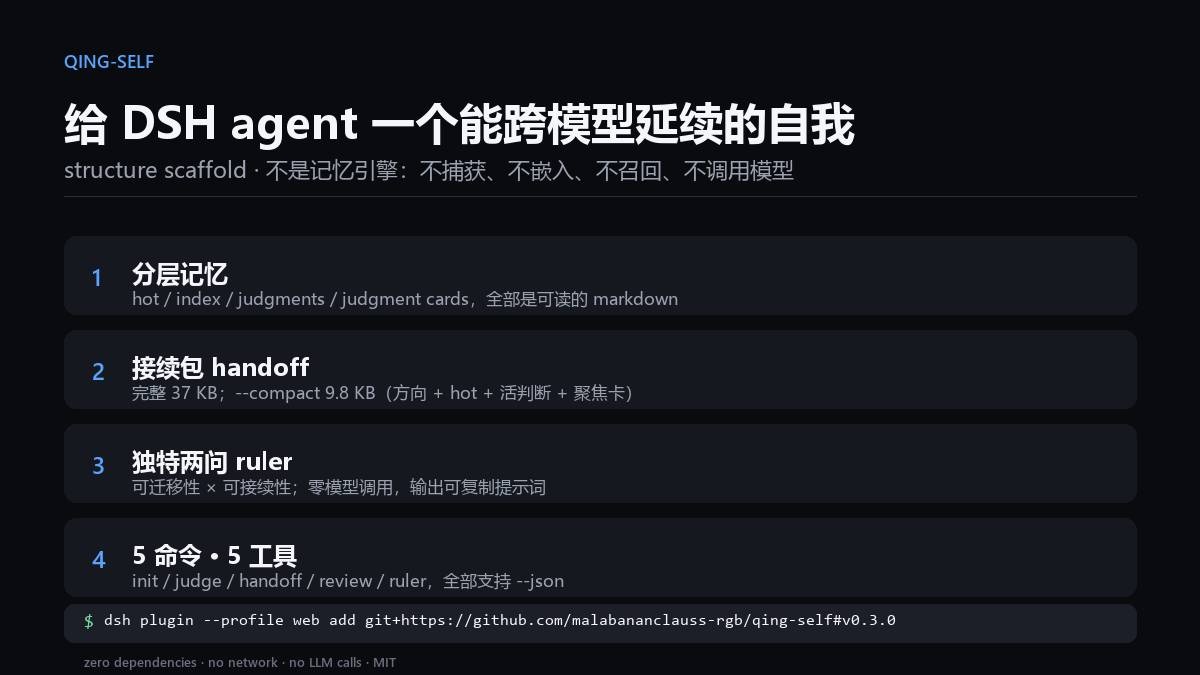
为 DSH agent 的延续搭建结构脚手架:分层记忆(hot/index/judgments)、判断卡、接续包(handoff,含紧凑模式)、压缩审查。零依赖、纯文件、可迁移——换模型后靠文件重建"我"。不是记忆引擎,是自我延续的骨架。
安装
dsh plugin --profile web add github:malabananclauss-rgb/qing-selfREADME
qing-self
A scaffold that gives a DSH agent or role layered memory + judgment cards + model handoff + compression review + A→B portability diff in one command — structure only, no content. No third-party judgments, no private memories, no hidden behavior.
Renamed:
dsh-self→dsh-memory-scaffold(v0.2.0) →qing-self(v0.3.0). The CLI binary is stilldsh-self; slash commands, agent tools,.dsh-self/paths and format schemas are unchanged.
- Zero dependencies, no network, no LLM calls, no embeddings
- Plain markdown + JSON that any editor can read, diff and migrate
- Every command supports
--json; the on-disk format is published and locked, so other plugins can read it and build on it - Versioned templates (
template=v1.0.0+ CHANGELOG); upgrades never overwrite user files
Install in 30 seconds
dsh plugin --profile web add git+https://github.com/malabananclauss-rgb/qing-self#v0.3.0
Restart DSH when prompted, then run /self-init in a workspace.
What it does: gives a DSH agent a structure that survives model/session swaps — layered memory files, judgment cards, a full handoff package with 8 verification questions and a 6–10 KB compact mode, and a two-question ruler for transferability and recoverability. Structure only, not a memory engine: it does not capture chats, embed, retrieve or call a model.
Why it exists
The DSH ecosystem already has many memory plugins (storage, retrieval, sidebars, automatic capture). What most users still lack is a decision about structure: which files to keep, what goes in each, when to write, when to compact, and what to hand over when switching models.
This package is not another store. It is the skeleton and ritual: four files, eight operations, and a machine-readable contract that other plugins can integrate with.
What you get
| Command | What it does |
|---|---|
init | Creates the four-layer structure — hot/state.md, index.md, judgments.md, judgments-cards.md, decisions.md — plus templates and a QUICKSTART.md. Idempotent: adds missing files, never overwrites what you wrote. |
judge | Adds one judgment card: conclusion / why / failure-counterexample / unfinished / source. Auto-numbered (J001…), written to both the index table and the card file. |
handoff | Reads your memory, writes a continuation package plus 8 verification questions, and a machine-readable .json sidecar for other plugins. Run it before switching model or session. --compact emits a 6–10 KB package (direction + hot + condensed live judgments + --focus cards + pending + questions); --focus selects judgment cards by topic. |
review | Compression review: hot size (>800 chars / >2 KB warning), context-share estimate, not-yet-persisted items, judgments/cards consistency, broken index pointers, template drift. |
ruler | The two-question ruler: turns a judgment into two concrete follow-ups — would it survive another version of me (transferability), and could it be recovered if I forgot everything tomorrow (continuability) — plus a copyable prompt for any AI and the biggest risk. Local template + keyword heuristic — zero model calls, no network, no writes. |
diff | Portability difference (A→B): compares two score JSON files ({"total":…,"items":[{name,score,weight}]}) and reports total delta / difference rate, per-item difference rate (` |
recall | Three-factor retrieval: ranks judgments from judgments.md by relevance (query terms matching conclusion + boundary), recency (hits.jsonl latest time/count) and importance (status + card existence); returns top N with component scores. Read-only, no model calls. |
check | Schema check: validates the fixed 7-column judgment table, status enum (Chinese statuses or canonical candidate/common/instinct), cards required for common/instinct, and pointer format for J616+ rows. Reports violation count + line numbers; exits 1 on violations. Read-only. |
Two-question ruler: transferability × continuability (no model calls)
Use the ruler before turning an insight into a judgment. It turns your wording into two concrete follow-ups instead of repeating borrowed wisdom:
- Transferability: would this judgment still hold if another version of me used it? Which resources / time / environment / model conditions does it depend on? If it only holds for "me at that moment", it is a situation, not a judgment.
- Continuability: if I forgot everything tomorrow, could this judgment be picked up again — written down and recoverable by the next version, or only "I remember"? Memory disappears with the body.
dsh-self ruler --situation "我该不该把发布交给青决定?" --context "本周内要给答复。"
dsh-self ruler 我该不该换模型                # positional form
It also returns one line for the biggest risk and a fenced copyable prompt you can paste into
any AI (or answer yourself). DSH users get the same through /self-ruler and dsh_self_ruler.
Use it for: irreversible decisions, promises with a cost, evaluating someone, spending money or asking someone to bear a consequence. It deliberately does not call a model, use the network or write any memory file — the judgment stays yours (or the AI you paste it into).
What it is not
- Not a store/retrieval plugin: no auto-capture, no embeddings, no prompt injection, no context manipulation.
- Not a content pack: templates contain placeholders only. Identity, judgments and relationship history are yours to write.
- Not a runtime: a deterministic file scaffold and checker; the CLI works without DSH (plain Node).
Positioning and moat
- Format lock (soft): directory layout, table columns, status enum, card
field names and machine markers are fixed in
docs/FORMAT.md. Third-party plugins that want compatibility must follow the format — this creates a de facto standard, but there is no encryption, no hidden marker, no exclusivity logic: users can move, edit and migrate their memory freely. - Versioned templates: every template carries
template=v1.0.0 format=1;manifest.templateVersionrecords what was installed;CHANGELOG.md+ GitHub Releases are the upgrade path. Upgrades never overwrite user files —reviewreports drift and the user merges. - Ecosystem hook (we are the hub): the
--jsonenvelope on all eight commands, the handoff JSON sidecar, importable format parsers (qing-self/format) anddocs/ECOSYSTEM.md. Other plugins (session-start pointer, compaction gate, handoff consumer, panels, dashboards) can read without copying the implementation. - Content-free: structure and process templates only. That keeps it honest and lets it stack with any memory store instead of competing — storage stays with storage plugins; the judgment layer lives here.
Install
A — install from the repository (recommended; slash commands + agent tools)
dsh plugin --profile web add git+https://github.com/malabananclauss-rgb/qing-self#v0.3.0
# or the prebuilt tarball from the v0.3.0 release:
dsh plugin --profile web add https://github.com/malabananclauss-rgb/qing-self/releases/download/v0.3.0/qing-self-0.3.0.tgz
# or clone and point at the directory:
#   git clone https://github.com/malabananclauss-rgb/qing-self
#   dsh plugin --profile <your profile> add ./dsh-self
# or install the local directory from the Web Plugins page / plugin_manager install_bundle
Installing/enabling is the user's own permission step; this repository only ships an installable bundle and never edits your profile.
B — CLI only (no plugin required)
node bin/dsh-self.mjs init
C — npm: not published yet; use the GitHub install above.
Quick start
# 1. initialize in your workspace
node bin/dsh-self.mjs init --json

# 2. read memory/QUICKSTART.md and replace the [placeholder] lines in
#    memory/hot/state.md (identity anchor / judgment core / red lines /
#    current task / blocker / next step)

# 3. record the first judgment
node bin/dsh-self.mjs judge \
  --conclusion "Ship the smallest working version first" \
  --why "Code that never ran is code that was never written" \
  --failure "One-off scripts can be exempt" \
  --unfinished "The boundary of 'smallest' is still undefined" \
  --source "docs/design.md#L12" \
  --status common

# 4. before switching model/session
node bin/dsh-self.mjs handoff --json
node bin/dsh-self.mjs handoff --compact --focus "磨镜,好名"

# 5. before a hard decision: two concrete questions, zero model calls
node bin/dsh-self.mjs ruler --situation "Should I take this task? Who bears the cost?"

# 6. weekly or before compaction
node bin/dsh-self.mjs review

# 7. portability: compare two score JSONs in both directions
node bin/dsh-self.mjs diff --a score-a.json --b score-b.json

# 8. retrieve the most relevant judgments for a task
node bin/dsh-self.mjs recall --task "怎么验证迁移" --top 5

# 9. validate the judgment schema (exit 1 on violations)
node bin/dsh-self.mjs check --json
Command reference
dsh-self <init|judge|handoff|review|ruler|diff|recall|check> [options]
Common: -w/--workspace <dir> (default: cwd), --dir <name> (memory directory,
default memory), --json, -h/--help, --version.
| Command | Options |
|---|---|
init | --lang zh|en |
judge | required: --conclusion --why --failure --unfinished --source; optional: --boundary --scene --status candidate|common|instinct|refuted|archived |
handoff | --out <file.md> (default memory/handoffs/handoff-<timestamp>.md); --compact compact package (target 6–10 KB); --focus topic1,topic2 matches card titles → judgment conclusions → card bodies, max 2 cards per topic, requires --compact |
review | --context-budget <chars>, --fail-on-warn (CI: exit 1 on actionable warnings) |
ruler | --situation <text> (or pass it positionally), --context <text>, `--lang zh |
diff | required: --a <A.json> --b <B.json> |
recall | --task <text> (or pass it positionally), --top 5 (default 5, max 100) |
check | no options (reads the memory directory) |
Exit codes: 0 success; 1 review --fail-on-warn or check with violations; 2 usage; 3 runtime/format.
The full JSON contract is in docs/ECOSYSTEM.md.
DSH integration
With the bundle installed:
- slash commands:
/self-init,/self-judge,/self-handoff,/self-review,/self-ruler,/self-diff,/self-recall,/self-check(same options as the CLI minus--workspace/--dir; they use the agent's workspace) - agent tools:
dsh_self_init,dsh_self_judge,dsh_self_handoff,dsh_self_review,dsh_self_ruler,dsh_self_diff,dsh_self_recall,dsh_self_check - tools cost a little prompt space (eight schemas). For slash-commands-only use,
set
tools: falsein the row config.
Row config (the bundle patch's config; users can override it):
| Key | Default | Meaning |
|---|---|---|
memoryDir | memory | Memory directory (relative to the workspace, or absolute) |
hotMaxChars / hotMaxBytes | 800 / 2048 | hot warning thresholds |
contextBudgetChars | 32000 | Character budget for the context-share estimate |
contextShareNoticePercent / contextShareWarnPercent | 3 / 10 | notice/warn thresholds |
commands / tools | true / true | register slash commands / agent tools |
Ecosystem
--jsonenvelope:ok / command / formatVersion / templateVersion / latestTemplateVersion / toolVersion / workspace / memoryRoot / generatedAt / data / warnings / errorshandoffwrites a.mdpackage plus a.jsonsidecar (schema: "dsh-self/handoff")- Node consumers can
import { parseJudgmentsTable, parseCards, hotStats } from 'qing-self/format' - File-only consumers follow the locked markdown format in
docs/FORMAT.md - Integration recipes (session-start pointer, compaction gate, handoff consumer,
dashboards) are in
docs/ECOSYSTEM.md§6
Format lock (format v1)
memory/
├── hot/state.md
├── index.md
├── judgments.md
├── judgments-cards.md
├── decisions.md
├── QUICKSTART.md
├── handoffs/handoff-<ts>.md + .json
└── .dsh-self/manifest.json
The judgments table is locked to seven columns
(id | conclusion | boundary | source | status | card | updated), the status
enum to five values, and card fields to
why/failure/unfinished/source (+ optional scene). Full contract:
docs/FORMAT.md (Chinese: FORMAT.zh-CN.md).
Read tolerance for existing libraries: a 5-column Chinese judgment table,
Chinese status aliases (候选/常用/本能…), Chinese card labels
(- **为什么**:…), multi-pointer index cells (;-separated) and a missing
manifest are all readable (see docs/FORMAT.md §11). Writing into a legacy
5-column table is refused with LEGACY_FORMAT_READ_ONLY and an upgrade hint.
Versioned templates
templates/v1/{zh,en}/, each file marked<!-- dsh-self template=v1.0.0 format=1 -->initrecordstemplateVersioninmemory/.dsh-self/manifest.json- after upgrading the package,
reviewreportsTEMPLATE_UPGRADE_AVAILABLEwhen the installed template version differs; the user merges perCHANGELOG.md— the tool never rewrites user files - release cadence: GitHub Release tagged
v<packageVersion>; CHANGELOG tracks package version, template version and format version separately
Privacy and security
- Memory is plain, unencrypted text readable by any local process. Never store passwords/tokens/ID numbers; store a pointer to where they live.
- The package makes no network calls, no telemetry;
--jsonwrites to stdout and local files only. - Whether the memory directory belongs in git is the user's decision.
Known limitations
- Does not inject context automatically (that is another plugin's job; this package provides the structure)
- Context share is a character-budget estimate, not a platform measurement
(calibrate with
--context-budget) - Assumes a single writer; do not write one memory directory concurrently from several processes
- Template upgrades are manual by design (no automatic rewrite)
- Only format v1; no cross-version migrator yet (unknown versions fail loudly
with
UNSUPPORTED_FORMAT) - Not published to npm / a plugin marketplace yet (delivery form: local directory install); the GUI panel is intentionally out of scope per the product spec
Layout
index.js                 Cordis Host plugin entry (slash commands + agent tools)
cordis.patch.yml         DSH bundle patch
lib/                     core / format / cli / plugin / fsx / version
bin/dsh-self.mjs  CLI entry
templates/v1/{zh,en}/    versioned templates
docs/FORMAT*.md          format lock contract (EN + zh-CN)
docs/ECOSYSTEM.md        --json and ecosystem contract
examples/consumer.mjs    read-only consumer example
test/selftest.mjs        self-test (59 cases)
SELFTEST.md              self-test record
Development
node test/selftest.mjs                 # 59/59; creates test/.tmp and cleans it up
SI_KEEP_TMP=1 node test/selftest.mjs   # keep the test directory
License
MIT. See LICENSE.