dsh-advisor
omdsh-dev/dsh-advisor
搭配一个副模型,每轮被动审查并注入见解。
安装
dsh plugin --profile web add github:omdsh-dev/dsh-advisorREADME
dsh-advisor





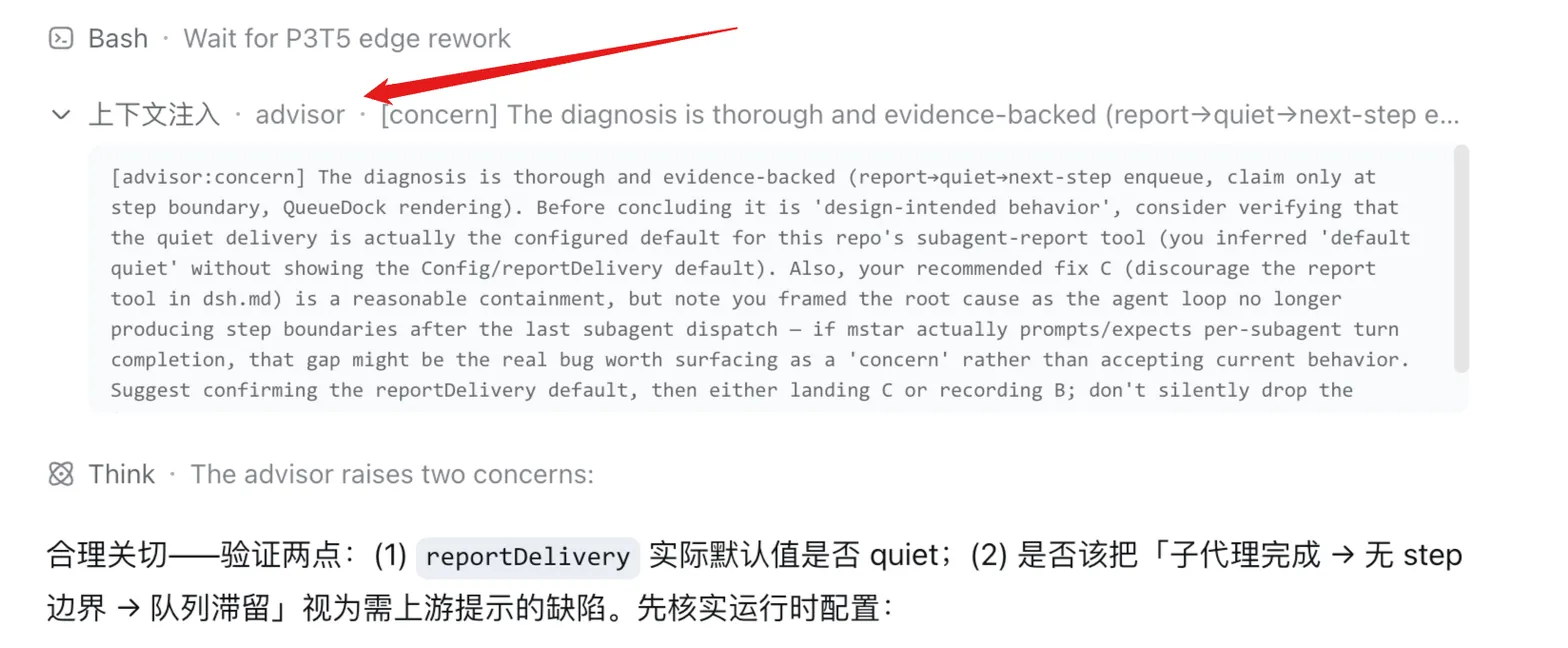
A standalone dsh (DeepSeek Harness) plugin bundle porting the omp "advisor" subsystem: a per-session independent reviewer model that observes the primary transcript, reviews each stepped turn with an explicitly configured model (provider + model are required), and injects severity-ranked advice (nit / concern / blocker) back into the session — without polluting or recursively reviewing itself.
Advisory only. The advisor never approves or rejects the primary agent's actions, and never issues commands as if it were the primary agent. Every delivered message is self-described advisory content, and a misbehaving reviewer is bounded end to end (emission guard, immuneTurns cooldown, failure policy) so it can never stall or pollute the primary loop.
Works in both dsh front ends: the web profile (sidebar → Plugins → dsh-advisor → Advisor card) and the dsh-tui terminal profile (/advisor + /advisor config).
Quick start
Install
dsh plugin --profile web add dsh-advisor      # web profile (Settings → Advisor card)
dsh plugin --profile dsh-tui add dsh-advisor  # dsh-tui terminal profile
Same plugin, either front end — the only difference is the --profile flag. Pin a version with @<version> (e.g. dsh-advisor@0.1.0). A registry install fetches the published tarball, which ships the built artifacts (lib/ + cordis.patch.yml) — nothing builds on the target machine, and runtime dependencies (@deepseek-ai/cordis, @deepseek-ai/schemastery, @deepseek-ai/dsh-* peers) resolve through the dsh installation's flat profile module fallback — no extra install step. Registry / git / tarball / local-directory variants (local-dir from a built checkout: dsh plugin --profile web add . or dsh plugin --profile dsh-tui add .), web Settings exposure, uninstall, and --dump-config verification → docs/install.md.
Configuration
Edit the config of the advisor row in your profile's patch layer (~/.dsh/profiles/<profile>/cordis.patch.yml). All seven fields are schema-volatile live fields (dsh ≥ 0.1.7-rc.1): the web card and the TUI /settings screen write this same entry config — persisted in the profile patch, committed without a remount. (A pre-0.1.7 $DSH_HOME/settings.yaml advisor: section no longer exists: dsh imports it into the active profile once and renames the file .imported.)
Breaking change (2026-09-26): the
enabledconfig key was removed. The plugin-row enable/disable toggle in the host UI is the master switch — a running row is enabled, and there is nothing left to configure for it. A stored profile still carrying anenabled:line keeps working: the line is silently ignored (accepted, never read, never re-persisted — 2026-09-27 ruling, no manual deletion needed); the key is deprecated and the write paths no longer persist it.
# ~/.dsh/profiles/<profile>/cordis.patch.yml — the advisor row's config
- id: advisor
  config:
    provider: deepseek-official  # REQUIRED (non-empty) for the advisor to run
    model: deepseek-flash        # REQUIRED (non-empty); fallback: deepseek-v4-flash (or another V4 id) until the gateway enables the V41 route
    systemPrompt: ""             # optional; "" = built-in reviewer prompt
    immuneTurns: 3               # int ≥ 0, default 3 — cooldown after a delivered steer
    maxDeltaMessages: 60         # int ≥ 0, default 60 — delta window; 0 = unbounded
    maxTokens: 768               # int 128..16384, default 768 — token budget for one advisor review (issue #102)
    proseFallback: false         # boolean, default false — deliver a frame-less prose reply as a nit note (opt-in)
provider and model are mandatory: either missing or empty is a hard gate — the advisor never starts a model call and reports a disabled-with-reason status; unknown config keys are rejected.
If the advisor is enabled and its runtime looks healthy but it never speaks, check /advisor status: a non-zero Dropped: line names the class — empty replies mean a thinking model is exhausting the token budget on reasoning (raise maxTokens, int 128..16384; the issue reporter verified 4096 restores output), unparsed replies mean prose without a JSON frame is being dropped (enable proseFallback, which delivers the cleaned prose as a low-severity note; JSON frames stay primary). Details → docs/configuration.md.
The same keys are read and edited from three surfaces (one store — the advisor entry config above; every surface shares the same key set and the same hard gate, with the host-side gate as the final line of defense on every path):
- Plugin-row config — the profile patch layer (
~/.dsh/profiles/<profile>/cordis.patch.yml). This is where the config lives. - dsh web Plugins page — the dsh-advisor bundle's own page — the Advisor card (bundle key
dsh-advisor), a flat settings form (the page's title/description come from the plugin's locale meta) with provider / model selects restricted to system-configured providers and their models, and the optional fields. Saving writes the advisor entry's config (landed through the config editor into the profile patch) and applies to running sessions immediately — no restart. The card requires a dsh web build whose shell declares theplugins.bundle.configcard slot (dsh ≥ 0.1.7-rc.1) and loads packages that declaredsh.client; it reads and writes the config through the officialGatewayServiceRPC channel (/api/advisor/get+/api/advisor/set), which is not gated by the settings exposure allowlist. It additionally blocks saving while a required field is empty. /advisorcommand — per-session and ephemeral: it flips a session override and pins a per-session reviewer model, never the persisted config (see Verify).
In a dsh-tui profile the same six keys are editable in the TUI /settings screen: run dsh --profile dsh-tui, open /settings, and edit the Advisor section (provider / model / immuneTurns / maxDeltaMessages / maxTokens / proseFallback, each with zh/en label + hint). Edits are staged and written on save through the revision-fenced settings.mutate into the same advisor entry config the web card writes, and re-apply live without a restart. systemPrompt is NOT a TUI field (the TUI text control is single-line; a multi-line prompt would be truncated) — edit it via the web card or the profile patch layer. The section requires dsh-tui ≥ v0.8.0 (shipped in the dsh-tui-settings-sections row of the v0.8.0+ bundle); older dsh-tui versions no-op it cleanly and the profile patch layer remains the edit path. /advisor config stays a read-only readback whose edit hint names the /settings screen when the seam is mounted. Save behavior differs from the web card: the TUI seam has no cross-field validation, so a save may leave provider/model empty — the explicit model gate resolves that to disabled-with-reason at runtime (visible via /advisor status and /advisor config); the web card blocks such a save outright. Full reference → docs/configuration.md.
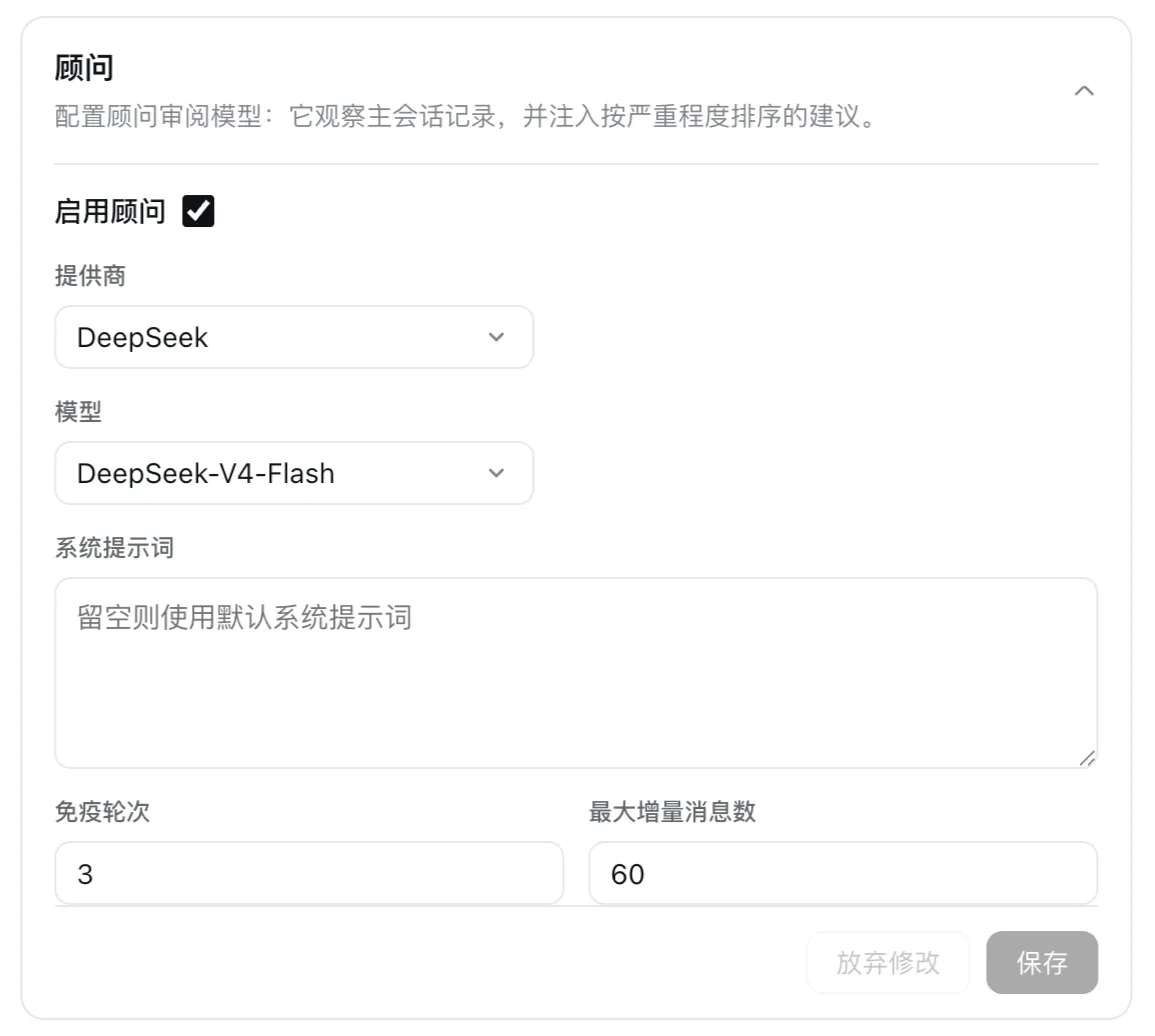
Verify
dsh --profile web --dump-config # shows a "# == dsh-advisor" layer with the advisor row
With the advisor installed and its plugin row enabled (the row switch on the Plugins page is the master switch), control it in-session with the /advisor command (available when a command registry is composed):
/advisor            toggle the advisor for this session
/advisor on         enable the advisor for this session
/advisor off        disable the advisor for this session
/advisor status     show state, model, runtime status, pending count, last activity, and drop counters when non-zero
/advisor model      show the effective reviewer model and its source (session override or global default)
/advisor model set <provider> <model>   pin a reviewer model for this session only
/advisor model reset    drop the session pin and re-inherit the global defaults
/advisor on|off|toggle are session-scoped and ephemeral: they flip a per-session override, never the persisted config. Enabling a session whose config lacks provider/model starts no model call — /advisor status (and the /advisor on reply) shows the gate reason: the advisor runs only with both configured. /advisor on is also the manual recovery path: a session advisor paused by a quota/rate-limit (quota_exhausted — no auto-resume timer) resumes in place, and a halted advisor (permanent model error, e.g. invalid credentials) is rebuilt fresh for the session.
/advisor model set pins a reviewer model for the invoking session only — an in-memory, atomic provider + model pair that lives for the live session (cleared on dispose, owner teardown, cold resume, or restart; a forked/new session inherits the global defaults). It rides above the persisted global defaults without rewriting them: a complete session pair is used even when the global config has no pair yet, a malformed global config still blocks every session, half-pairs are never merged, and setting/resetting never touches the enable switch. Validation resolves the pair through the LLM service before commit (60 s bound, cancellable, no auto-retry); on failure the previous selection stays untouched. /advisor config remains the readback of the global defaults, not the session state.
In a dsh-tui profile, /advisor config additionally reads back the composed configuration — the global defaults, read-only, with edit hints naming the real write paths: the TUI /settings screen (Advisor section, dsh-tui ≥ v0.8.0) and the profile patch layer. The /advisor / on|off|status|config|model commands are listed in the TUI / menu with subcommand completion (command discovery requires the dsh-tui-command-trees row — the shipped dsh-tui bundle has it).
On the web, the same session model controls ride the session header's Advisor action (requires a dsh web build whose shell declares the conversation.session.header.actions slot — dsh ≥ 0.1.7-rc.1). The action is bound to the session it sits on: it shows the effective reviewer pair, its source (session override / global default), and the live-session lifetime; Pin this model pins a provider + model for that session, and Use global default drops the pin (the reset path). It writes ONLY through the plugin's session endpoints (/api/advisor/getSession + /api/advisor/setSessionModel) — the same controller, validation, and fencing as /advisor model, never the persisted config — and it never falls back to the global config write when the session surface is unavailable. The control refreshes when you open it (plus on reconnect/focus while open); there is no background polling. The global card on the Plugins page stays global-only.
Features
-
Independent reviewer per session: a separate model call observes the primary transcript and reviews each stepped primary turn; advisor messages are excluded from later deltas, so the advisor does not read its own advice back. The exclusion recognizes the advisor's current producer kind (
advisor) AND both historical shapes a still-openable log can carry: the prehistoric direct{ kind: 'advisor' }note and the 0.1.6-era note as the V3→V4 in-memory migration rewrote it (kind: 'plugin:advisor') — no generation of persisted notes is orphaned by the identity migration. -
Severity-ranked advice with inject/steer semantics: at most one note per review — nit (a minor style, clarity, or quality suggestion; delivered via non-waking
agent.inject, consumed at the next pre-step boundary), concern (a material risk or clearly better direction to weigh before continuing; delivered via wakingagent.steer, subject to theimmuneTurnscooldown), blocker (continuing clearly wastes work — contradicts an explicit user instruction, going in circles, fundamentally unsound; delivered viaagent.steer). Delivered messages carry the[advisor:{severity}]prefix and are self-described advisory content:[advisor:concern] extract the helper into a module and unit-test it -
Explicit model gate: a missing
provider+modelnever starts a model call — status reports disabled-with-reason. The gate applies to the effective route after session resolution: a complete per-session override pair satisfies it for that session; a malformed global config cannot be bypassed. Unknown config keys are rejected — the removedenabledkey is the one legacy exception (silently ignored; the plugin-row toggle is the switch). -
Zero-tool minimal start: the reviewer is an independent model call only — no advisor tools, nothing it can do to the session besides advisory messages.
-
No-stall failure policy: a failing or quota-limited advisor only drops its own bounded backlog — it can never park or pollute the primary loop.
-
Session-scoped controls:
/advisor on|off|status|config|modelwork per session; the toggles and the per-session model pin are ephemeral overrides, never persisted config —/advisor configalways reports the global defaults. On the web, the session header's Advisor action drives the same per-session pin through dedicated session endpoints (see Verify).
Mount-only (no dsh modification)
The plugin installs as a pure mount: bundle insert + client card (the web Plugins page) + its own gateway channel (/api/advisor/get|set for the global config plus /api/advisor/getSession|setSessionModel for the per-session model surface, claimed by the host's typertGateway — the same mechanism the dsh goals service uses, not gated by the settings exposure allowlist) + the /advisor commands — no dsh patches, no postinstall step, and dsh upgrades never require re-patching.
Limitations & roadmap
The MVP deliberately drops full omp parity. Accepted gaps (tracked in the harness iteration roadmap):
- Single advisor per session — no parallel advisor roster or WATCHDOG-style file discovery (next iteration).
- No advisor tools — the reviewer is an independent model call only; it cannot verify claims itself (next-next iteration).
- No in-session advisor panel — advice surfaces only as tagged injected messages; the web Advisor card is a config surface, not a session view (next-next iteration).
- No transcript persistence or cost stats — no resumable advisor history or cost observability (next-next iteration).
- No secret obfuscation of delta content — secrets present in the transcript can reach the advisor model; mitigate by configuring a trusted reviewer model.
- No quarantine of unsafe advisor output — a misbehaving note can carry directive text; the JSON frame + validation + advisory-only framing are the only mitigation, and the note is delivered as-is (roadmap).
- No
syncBacklogcatch-up wait — a far-behind advisor does not wait for the primary loop; its backlog is bounded and dropped, so notes may arrive after the next primary turn started (roadmap: context-maintenance batch). - Bounded advisor context — long-session full replays are truncated (
maxDeltaMessages), so the advisor may lose early context after compaction (roadmap: next-next iteration).
Sessions written by earlier versions — pre-V3 logs are not repaired here. Advisor notes in them carry the former custom source.kind (kind: 'advisor'), which the dsh V2→V3 session-format edge refuses, so those pre-V3 logs cannot be migrated (the raw file is intact, only unopenable). Logs already at V3 still open — they are affected only by the self-review caveat above. Repairing the pre-V3 logs is upstream work: a unified pass over this defect class is being developed in omdsh-dev/dsh-llm-fallbacks and is not yet available. Logs written from this version onward are unaffected.
Documentation
| Doc | Content |
|---|---|
| docs/install.md | profile install (web + dsh-tui) / registry / git / tarball / local-directory variants / web Settings exposure / uninstall / --dump-config verification |
| docs/configuration.md | full advisor config reference: keys & defaults, explicit model gate (S4), config surfaces (web card / TUI /settings / patch layer), example YAML, live re-apply behavior |
| docs/consumer-api.md | developer consumption contract: package-root library API, dsh-advisor/client entry, /advisor command surface, export inventory, lifecycle |
| docs/verification.md | verification records: test matrix (16 files / 319 cases), typecheck/build, CI contract, real-environment steps |
| docs/release.md | release process: PR-driven Release prep + Release workflows, OIDC trusted publishing, version strategy, rollback |
License
Released under the MIT License — see LICENSE. The LICENSE file is authoritative for copyright and license terms.