mneme
slow-stack/mneme
Plugin de mémoire intersessions pour DeepSeek Harness avec consolidation autoDream : stockage SQLite, miroirs Markdown, 10 outils de modèle, injection automatique, résumés de session, profil/règles utilisateur, commandes slash personnalisées, recherche vectorielle (sémantique) et Web GUI.
Installer
dsh plugin --profile web add github:slow-stack/mnemeREADME

$ whoami
mneme — the memory that dreams

$ cat /etc/mneme
cross-session memory for DeepSeek Harness
every memory keeps its provenance
conflicts freeze until you decide
the only copy stays on your machine

$ ls ~/.dsh/memory
memory.db  constraints.md  decisions.md  documents.md  history.md
patterns.md  pitfalls.md  preferences.md  projects.md
rejected-solutions.md  summary.md



中文 · English
01 · 它是什么
每次新开对话,AI 都像第一次认识你。
dsh-mneme 给 DeepSeek Harness 装上跨会话记忆。聊过的项目、提过的偏好、做过的决定——关掉窗口再打开,它还记得。
它不是一个向量库。记忆落在你本机的一份 SQLite 里,旁边配一份 Markdown 镜像:那个文件你随时能打开、能改,改完不会被机器盖掉。
02 · 凭什么信它
看不见的地方,才决定它能不能长期用。
- 每条记忆都带着来历 — 从哪段对话来的、什么时候改过、被谁动过。自动整理同样留账:输入快照、决策明细、结果哈希,同一次整理可以复现回放。
- 矛盾不替你做主 — 两条记忆打架时先冻结,并排摆在状态页,等你说保留哪条。
- 你改的优先 — 记忆就是本地 Markdown;手改过的内容在合并回库时优先保留。
- 空闲时才动手 — 常看的留在热区,久不用的压成摘要,陈旧的归档。越用越精炼,不是越堆越大。
- 隔离与离线 — 可按 agent / 工作区隔离;把嵌入换成本地模型后,语义检索完全离线,不需要任何 API Key。
- 删对话 ≠ 删记忆 — 记忆是跨会话的全局知识,清空聊天窗口不影响已经存下的部分。
它和 Zep / Mem0 / Letta / Hindsight 各差在哪?有一张 11 行的逐项对照——存储、检索、写入时抽取、离线巩固、冲突处理、遗忘、作用域、可审计性、多宿主、离线、许可证。「—」不等于「差」:能力对比。
03 · 装
dsh plugin --profile web add @modusensus/dsh-mneme
dsh web
两条硬要求,不满足装不上:
- Node 24+ —— 记忆库用的是
node:sqlite,Node 22 起不来库。 - DSH 0.1.x 或 0.2.x —— 两条线都在兼容范围内;CI 对 0.2 线全绿。
本仓库是单仓多包:可安装的本体在
dsh-mneme/,根目录那份package.json只是仓库壳(private、无dsh字段)。走 Git 或 tarball 时路径必须指到子目录,否则装到的是壳本身。四种安装来源的写法见完整文档。
它落在你机器的哪几个地方:
| 目录 | 是什么 |
|---|---|
~/.dsh/memory | 记忆库本体:SQLite 正本,加十份可手改的 Markdown 镜像 |
~/.dsh/mneme | 本地嵌入模型与运行时缓存,删掉会自动重下 |
~/.dsh-mneme | CLI / MCP 的连接配置(url 与 token) |
想卸掉:
dsh plugin --profile web remove @modusensus/dsh-mneme
插件目录没了,~/.dsh/memory 里的记忆还在——想清干净就自己删这个目录。三个目录名字很像,别认错:目录说明。
04 · 面板
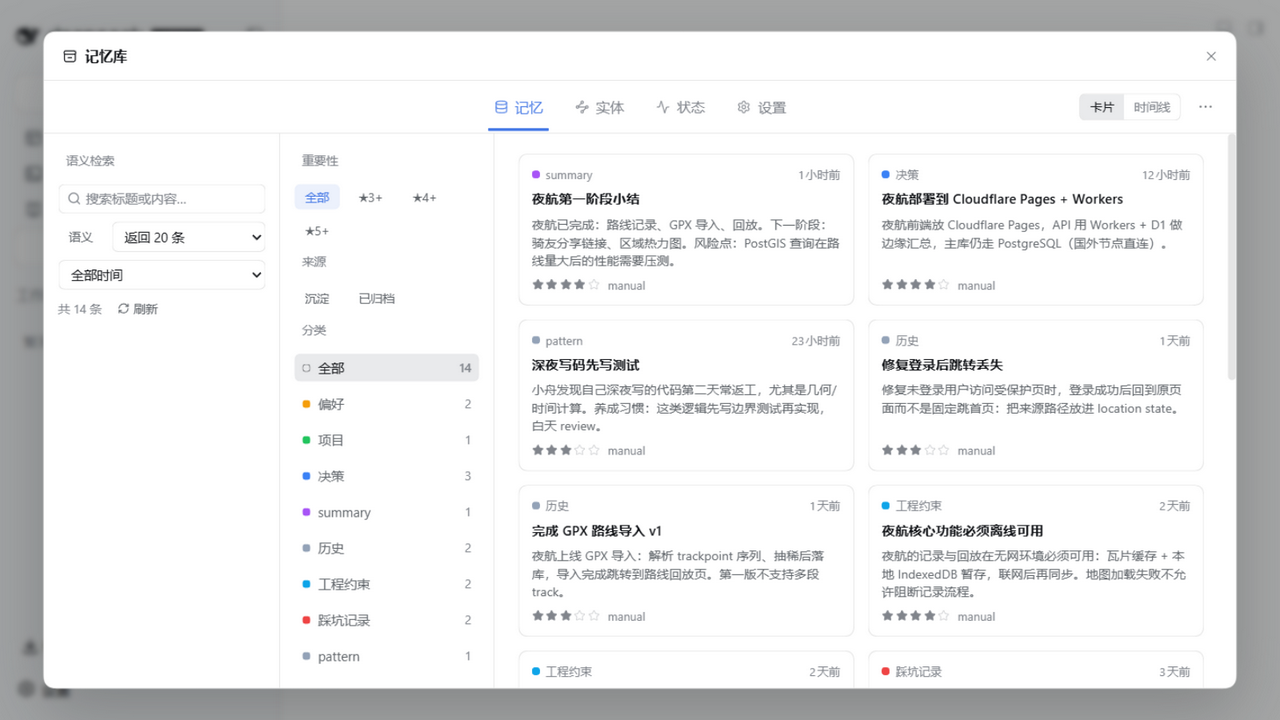
记录、浏览与筛选你的记忆。
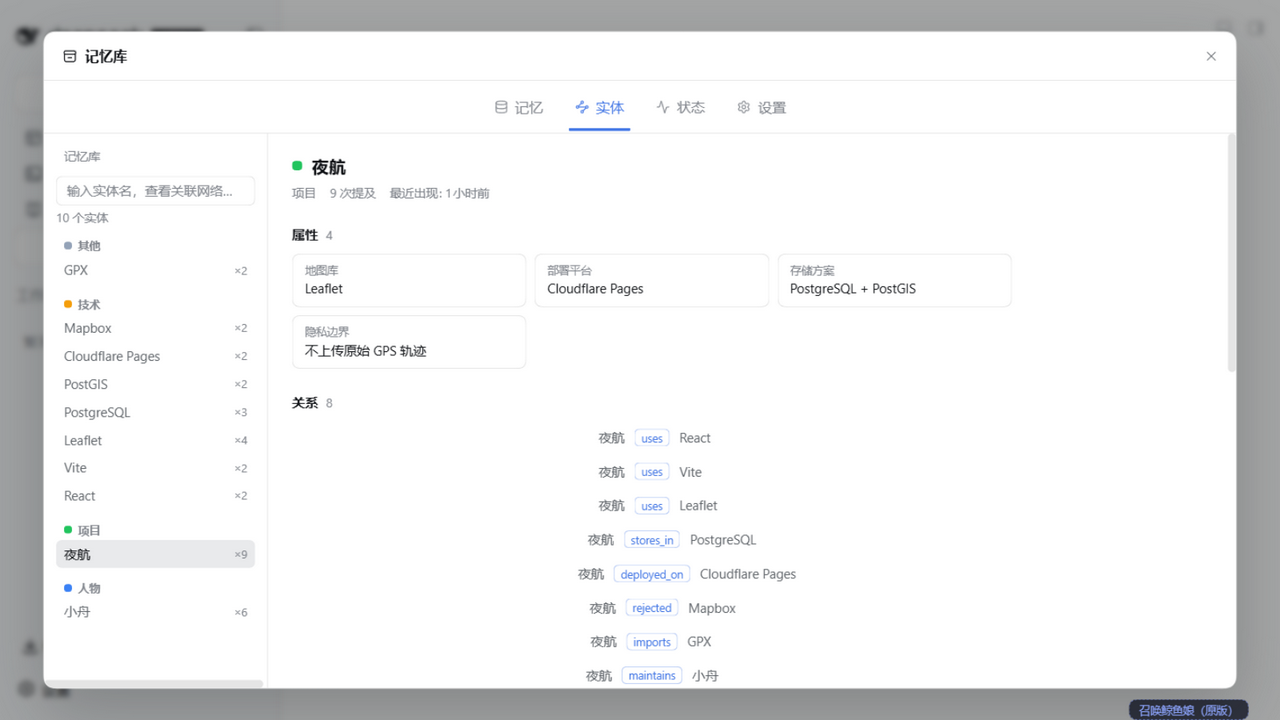
从记忆里提炼实体,构建带属性的关系图谱。
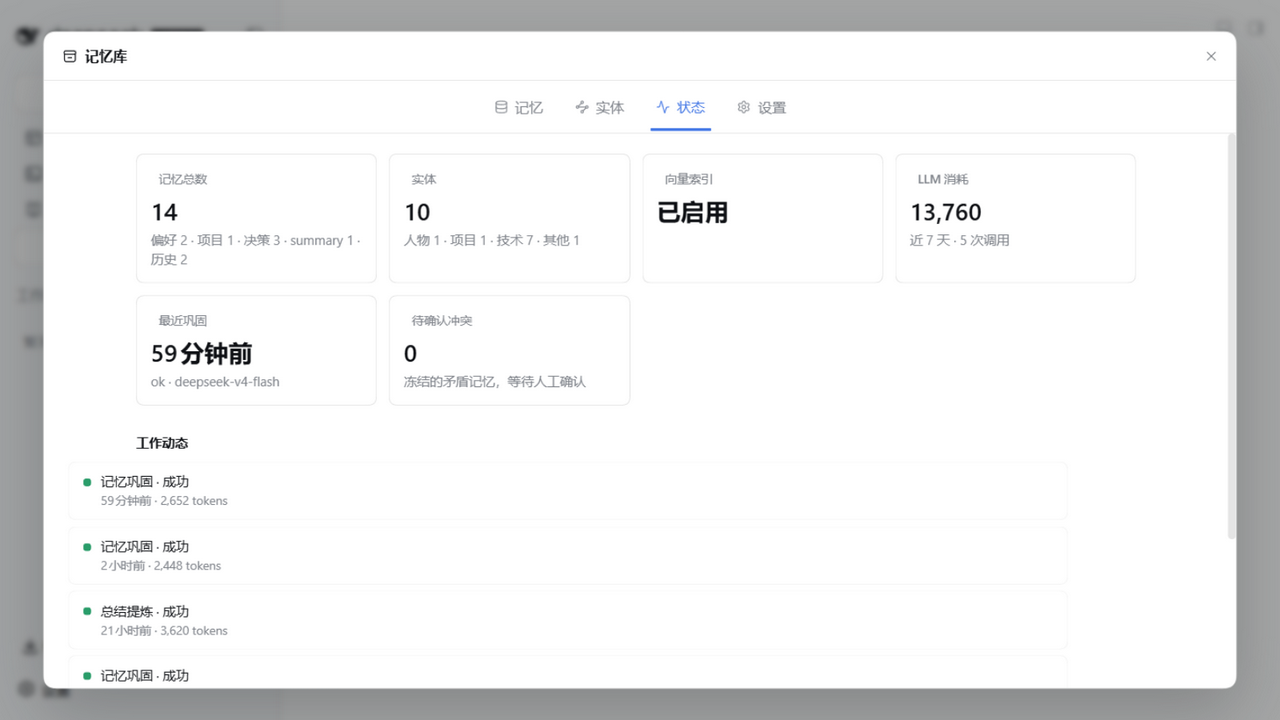
向量索引、LLM 消耗、自动巩固记录,一眼看完。
05 · 接到别处
| 方式 | 你能得到什么 |
|---|---|
| MCP | 零依赖 stdio 服务端(独立包 mneme-memory),Claude Code / Cursor / Codex / OpenCode 等任意 MCP 客户端都能挂上记忆六件套 |
| 独立 daemon | dsh-mneme-serve 让记忆库常驻:DSH 关着,脚本、网页桥接、自有面板照样读写同一份记忆 |
| 社区适配器 | 比如 Mneme-Bridge,把 DeepSeek 网页端也接进同一个记忆库 |
06 · 文档
| 想了解 | 去哪 |
|---|---|
| 功能、安装、配置、架构(完整) | dsh-mneme/README.md |
| 全部配置键 | 配置说明 |
目录归属:~/.dsh/memory ≠ ~/.dsh/mneme | 目录说明 |
| 与 Zep / Mem0 / Letta / Hindsight 的对照 | 能力对比 |
| 版本历史 | CHANGELOG |
07 · 一路走来
版本表由发版准备脚本维护,当前版本行随 tag 更新。
| 版本 | 主题 | 状态 |
|---|---|---|
| v0.14 | 图像与情绪都成了记忆;修掉两处静默召回截断(词法语料 500 行、注入候选池 200 行) | ✅ 已发布(v0.14.0) |
| v0.13 | 情绪终于有地方可放:单次场合与稳定倾向在存储上分开 | ✅ 已发布(v0.13.0) |
| v0.12 | pin 显式化(memory_pin),并上下文本地自适应 | ✅ 已发布(v0.12.0) |
| v0.9 / v0.10 | 归因与闸门:蒸馏归因落到运行身份、会话级无痕闸门、防谄媚补到写入面 | ✅ 已发布 |
隐私承诺
- 只落在本机。 SQLite 存储加一份可手工编辑的 Markdown 镜像,中间没有任何 mneme 服务器。
- 记忆是你能打开的文件。 Markdown,人类可读、可手改,手改过的内容在合并回库时优先保留。
- 不需要 mneme 自己的 API Key。 巩固与摘要走你已配置的宿主模型(
autoDream/autoSummarize默认开)。 - 想连巩固也完全离线:把宿主换成本地模型,并清空
dreamProvider/dreamModel与summarizeProvider/summarizeModel(配了这两组会绕过宿主直连,只换宿主不生效),或直接关掉这两个开关。 - 无遥测、无分析、无远程日志。
"记忆不是把对话存下来,是让下一次对话从上次继续。"
© 2026 MODUSENSUS · MIT
$ whoami
mneme — the memory that dreams

$ cat /etc/mneme
cross-session memory for DeepSeek Harness
every memory keeps its provenance
conflicts freeze until you decide
the only copy stays on your machine
01 · What it is
Every new chat, the AI meets you for the first time.
dsh-mneme gives DeepSeek Harness cross-session memory. Projects you discussed, preferences you mentioned, decisions you made — close the window, open it later, and it still remembers.
It is not a vector store. Memories live in a local SQLite file, with a Markdown mirror beside it: a file you can open, read, and edit, and your edits are not overwritten by the machine.
02 · Why you can trust it
The parts you never see decide whether it holds up over months.
- Every memory carries its provenance — which conversation it came from, when it changed, who touched it. Consolidation leaves a receipt too: input snapshot, decision detail, result hash, so the same run can be replayed.
- Conflicts are not decided for you — when two memories disagree, both are frozen and shown side by side, and you pick which one stays.
- Your edits win — memories are local Markdown; hand-edited text is kept when it is merged back into the store.
- It works when you are idle — frequently used memories stay hot, stale ones compress into summaries, old ones archive. The store gets leaner, not fatter.
- Isolation and offline — memories can be scoped per agent and workspace; point the embedder at a local model and semantic search runs fully offline, with no API key.
- Delete the session ≠ delete the memory — memories are cross-session knowledge; clearing a chat window leaves what was saved alone.
How does it compare with Zep / Mem0 / Letta / Hindsight? There is an 11-row table — storage, retrieval, write-time extraction, offline consolidation, conflicts, forgetting, scoping, auditability, multi-host, offline, license. "—" does not mean "worse": capability comparison (Chinese).
03 · Install
dsh plugin --profile web add @modusensus/dsh-mneme
dsh web
Two hard requirements — without them it will not install:
- Node 24+ — the store uses
node:sqlite; on Node 22 the database will not open. - DSH 0.1.x or 0.2.x — both lines are in range, and CI is green on the 0.2 line.
This repository is a multi-package repo: the installable plugin lives in
dsh-mneme/, and the rootpackage.jsonis only a repo shell (private, nodshfield). Git and tarball specs must point at the subdirectory, or you install the shell itself. All four install sources are in the full docs (Chinese).
Where it lands on your machine:
| Path | What it is |
|---|---|
~/.dsh/memory | The store itself: the SQLite original plus ten hand-editable Markdown mirrors |
~/.dsh/mneme | Local embedding model and runtime cache; delete it and it refetches |
~/.dsh-mneme | CLI / MCP connection settings (url and token) |
To remove it:
dsh plugin --profile web remove @modusensus/dsh-mneme
The plugin directory goes away, the memories in ~/.dsh/memory stay — delete that directory yourself if you want them gone. The three names are easy to mix up: directories.
04 · The panel
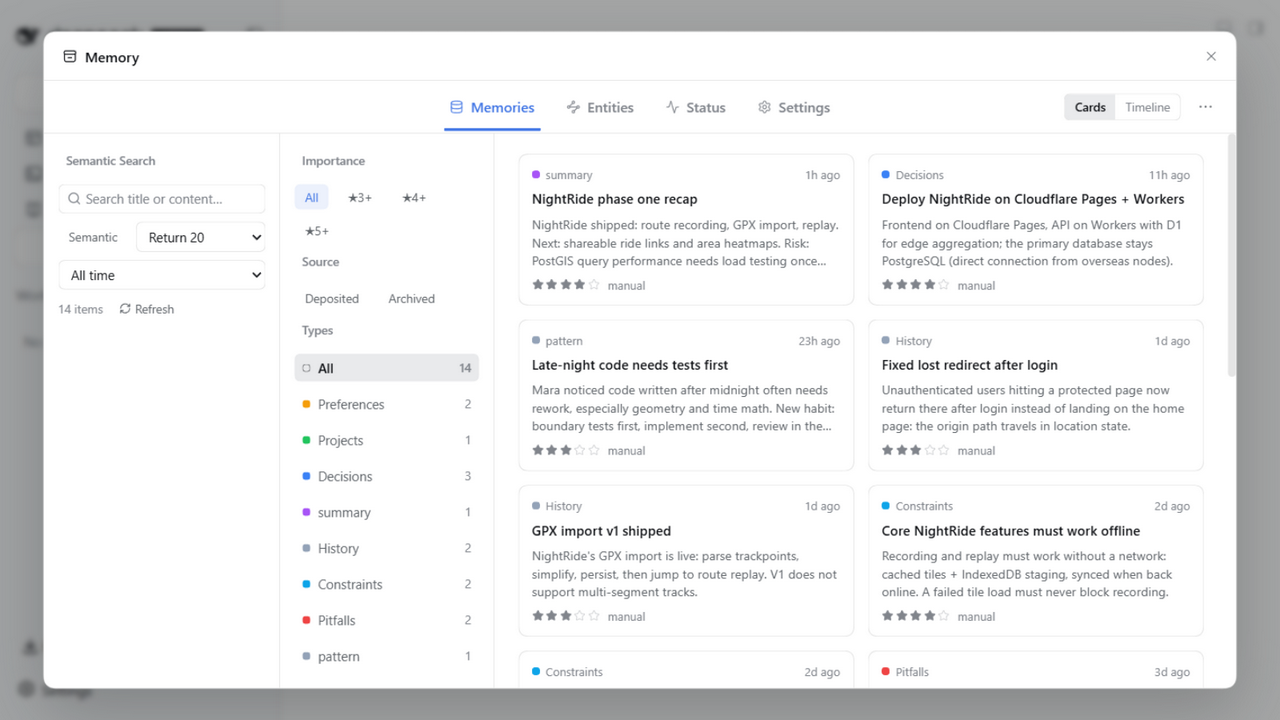
Record, browse and filter your memories.
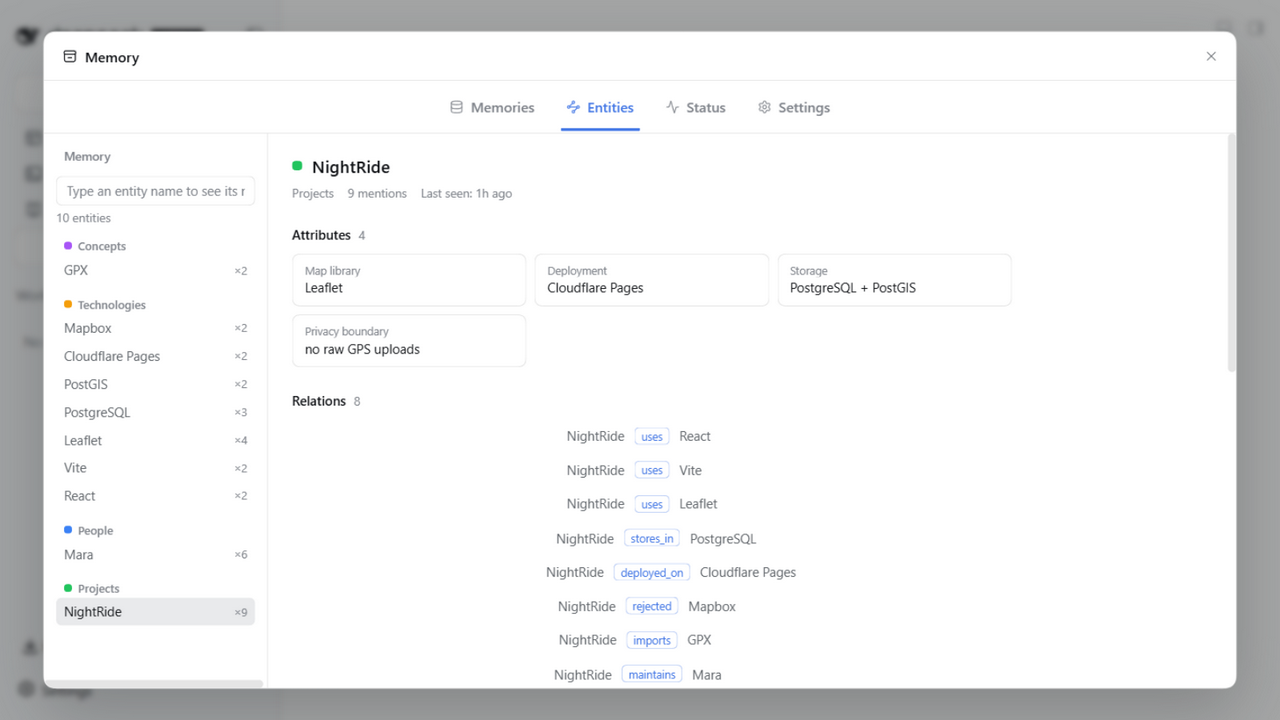
Entities are distilled from your memories into a relation graph with attributes.
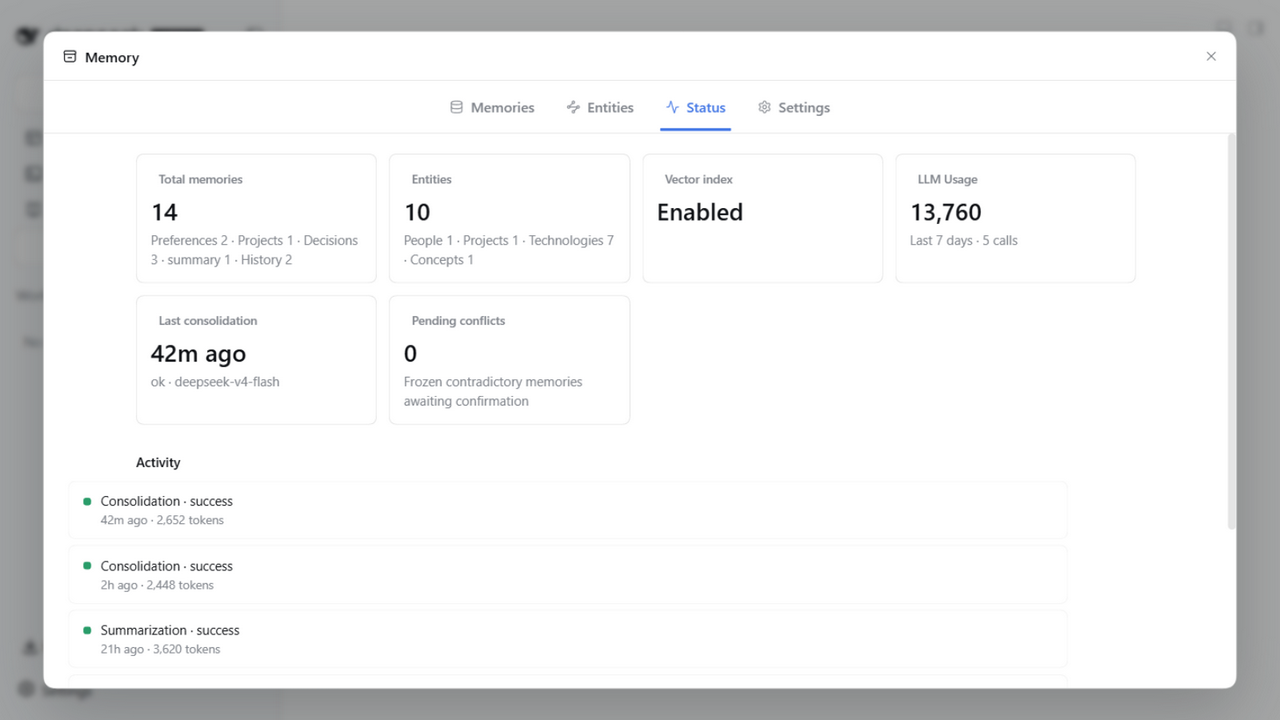
Vector index, LLM spend and consolidation activity at a glance.
05 · Elsewhere
| Way in | What you get |
|---|---|
| MCP | A zero-dependency stdio server (standalone package mneme-memory); Claude Code / Cursor / Codex / OpenCode and any other MCP client can mount the six memory tools |
| Standalone daemon | dsh-mneme-serve keeps the store running: with DSH closed, scripts, web bridges and your own panels read and write the same memories |
| Community adapters | Such as Mneme-Bridge, which brings the DeepSeek web chat into the same store |
06 · Docs
| To learn | Where |
|---|---|
| Features, install, config, architecture (full) | dsh-mneme/README.md |
| Every configuration key | Configuration |
Which directory is which: ~/.dsh/memory ≠ ~/.dsh/mneme | Directories |
| Head-to-head with Zep / Mem0 / Letta / Hindsight | Comparison |
| Version history | CHANGELOG |
07 · The road here
Rows are maintained by the release-prep script; the current one is updated with the tag.
| Version | Theme | Status |
|---|---|---|
| v0.14 | Images and moods became memories; two silent recall truncations removed (500-row lexical corpus, 200-row injection pool) | ✅ Released (v0.14.0) |
| v0.13 | Moods finally had somewhere to live: one-off occasions kept apart from stable tendencies | ✅ Released (v0.13.0) |
| v0.12 | Explicit pins (memory_pin) and an adaptive context budget | ✅ Released (v0.12.0) |
| v0.9 / v0.10 | Attribution and gates: distillation runs carry an identity, session-level no-trace gate, anti-sycophancy on the write path | ✅ Released |
Privacy
- Local only. A SQLite store plus an editable Markdown mirror, with no mneme server in the path.
- Memory is a file you can open. Markdown, human-readable and hand-editable; your edits win when it merges back.
- No mneme API key of its own. Consolidation and summarization use the host model you already configured (
autoDream/autoSummarizeare on by default). - Fully offline if you want it — point the host at a local model and clear
dreamProvider/dreamModelplussummarizeProvider/summarizeModel(setting those routes talks straight to that provider, so switching the host alone will not help), or just turn both switches off. - No telemetry, no analytics, no remote logging.
"Memory is not what you save from a conversation. It is what lets the next one continue."
© 2026 MODUSENSUS · MIT
Plugins associés
hindsight (coding-agents)
vectorize-io/hindsight
OpenViking (dsh-memory-plugin)
volcengine/openviking
MemOS (memos-local-plugin)
memtensor/memos
ReMe (dsh)
agentscope-ai/reme