agent-immune
meat-daemon-404/agent-immune
Claude Code、Codex、Cursor、ZCode、DSHなどのコーディングagent向けに、失敗後に修正されたtool実行をSQLite+FTS5の「抗体」として記録し、同じミスを繰り返す前に注入する自己進化型の落とし穴対策。runtime依存なし。
インストール
dsh plugin --profile web add github:meat-daemon-404/agent-immuneREADME

Your coding agents stop re-debugging what they already fixed.




97.54% agreement replaying 20,100 real tool calls · 0 false negatives · zero runtime dependencies
measured, not asserted — how the number was produced
English | 简体中文
When a tool call fails and the next attempt fixes it, the plugin saves that pair as a rule. Rules that match the current work get injected into context on later runs, before the agent repeats the same mistake.
One core/ engine: DSH and ZCode install natively (plugin bundles, checked against the real host contracts), and immune connect wires the same engine into Claude Code and Codex CLI as plain hooks — no plugin system required.
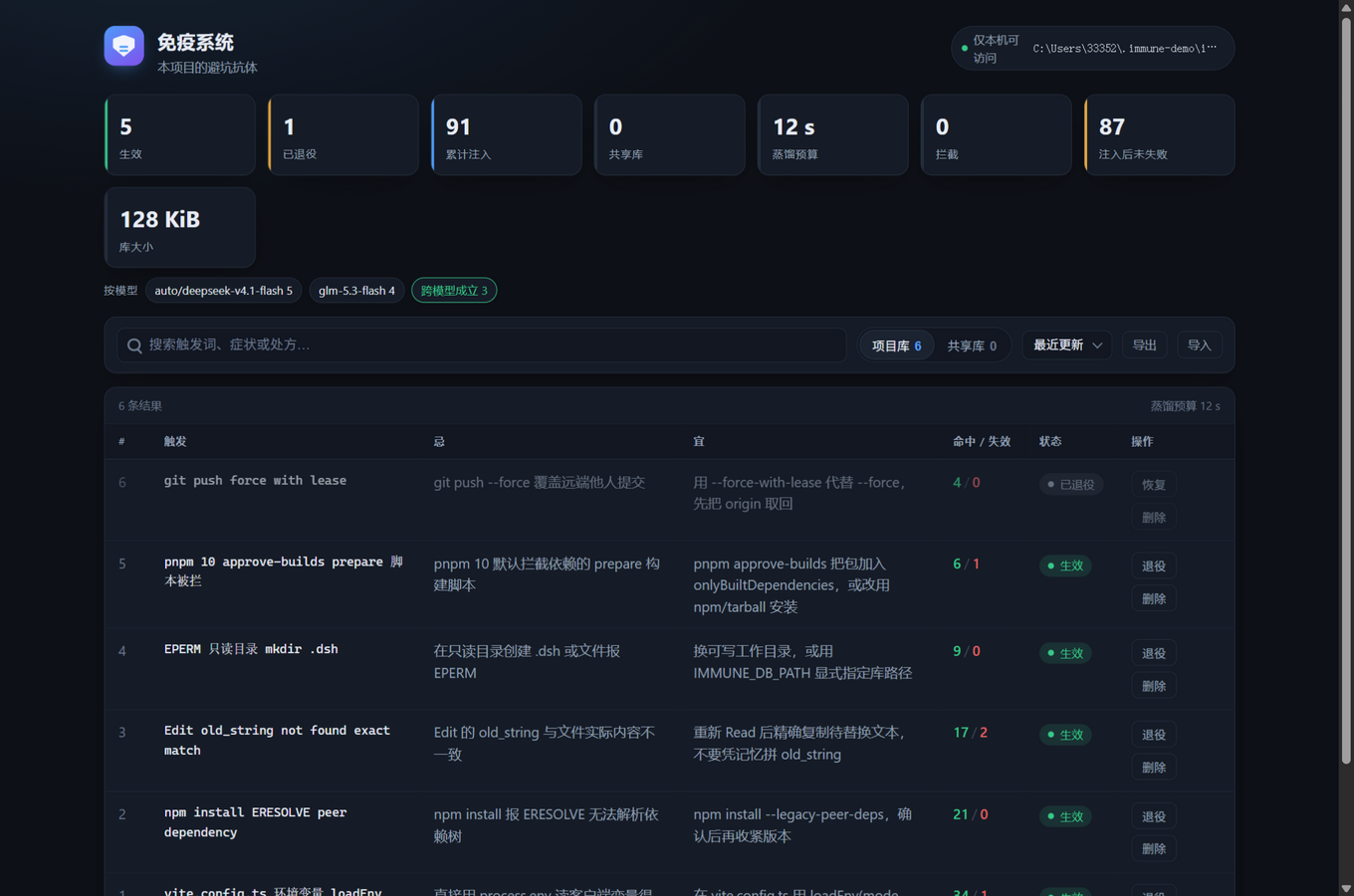
The dashboard as any install sees it — the capture uses demo rules, not a private library.
Quick demo
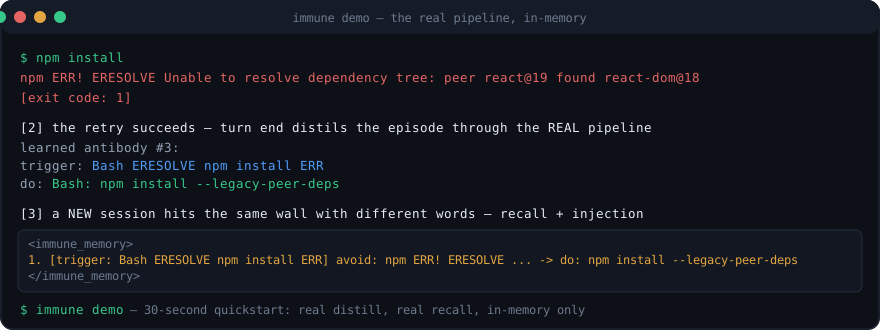
Runs the whole pipeline in memory, installs nothing, writes nothing:
npx dsh-immune-system@latest demo
It distills a failure→success episode, recalls it from a paraphrased prompt, and prints the <immune_memory> block the hooks inject. Already have history on this machine? npx dsh-immune-system@latest audit --dry-run reads it and shows what would be learned.
Install
DSH — from npm (prebuilt, no toolchain):
dsh plugin --profile <profile> add dsh-immune-system
Same package from a tarball or from git:
cd dsh-immune-system && npm pack        # prints the exact dsh-immune-system-<version>.tgz it wrote
dsh plugin --profile <profile> add ./dsh-immune-system-<version>.tgz
dsh plugin --profile <profile> add github:meat-daemon-404/agent-immune
The github: form builds at install time through prepare, which pnpm blocks until it is allowlisted (the Chinese README has the exact setting). npm or the tarball sidesteps that.
Restart DSH afterwards; plugin bundles are composed at startup.
ZCode — this repository is itself a marketplace source:
node "<zcode.cjs>" plugins marketplace add meat-daemon-404/agent-immune
node "<zcode.cjs>" plugins install dsh-immune-system@dev-dsh-plugin-immune
Start a new task afterwards; existing tasks keep the capability catalog they started with.
Hooking Claude Code & Codex
Native plugin installs are for DSH and ZCode. For Claude Code and Codex CLI the same engine installs as plain hooks — no plugin system required:
npx dsh-immune-system@latest connect               # auto-detect and wire every installed host
npx dsh-immune-system@latest connect claude-code   # writes ~/.claude/settings.json
npx dsh-immune-system@latest connect codex         # writes ~/.codex/hooks.json
What it does: copies the engine into a fixed ~/.dsh-immune/ install (so the
hooks survive npx-cache cleanups and package upgrades), merges six hook
entries (five on Codex, which has no PostToolUseFailure event) into the
host's own config pointing there, leaving every other setting alone;
keeps a one-time .bak-immune backup before the first write; re-running is a
no-op (--refresh forces a re-copy); a stale install — an npx cache path from
an older connect — is upgraded in place; connect <host> --remove takes only
the immune entries back out and deletes ~/.dsh-immune/ when no host remains.
With no host argument, connect detects which hosts this machine actually
has (~/.claude, ~/.codex) and wires each one idempotently — ZCode is
detected too but reported rather than written, because ZCode installs immune
through its own plugin marketplace. connect --status keeps the read-only
survey. immune doctor reports broken
hook paths with the exact reconnect command. The hook payload contract is the
one the ZCode adapter already speaks (same hookSpecificOutput injection
shape), so no adapter code ships per host — and the vendored runtime is
verified end-to-end without any host environment variables
(scripts/verify-connected-runtime.mjs): the db lands through the fallback
chain, an episode distils at turn end, and a fresh session receives the
injection — including a Codex-native sequence using the host's real
shell_command / apply_patch tool names (the hooks map them to the engine's
Bash/Edit vocabulary), all six hook events, human-hint attachment, injection
delimiter isolation against forged closing tags, the guard's deny path, and
a failure from one session being closed by a fresh session within the
project's 30-minute window (scripts/verify-connected-runtime.mjs,
25 assertions). What is still not covered: dispatch by the real host CLIs
themselves.
Two notes: restart the host session after connecting, and Codex requires
running /hooks inside Codex once to trust the commands before they fire.
Auditing the history you already have
A fresh install has an empty library. immune audit replays the same
failed-then-fixed pairing over the session history already on this machine —
the ZCode session db, Codex rollout files (~/.codex/sessions), and Claude
Code transcripts (~/.claude/projects, including nested subagent transcripts;
a tool result without an is_error flag falls back to its Exit code: text
marker) — prints a shareable summary (per-tool
failure counts, top repeat offenders, the avoidable token cost when the source
records usage), and distils your own first rules from it:
npx dsh-immune-system@latest audit --dry-run   # the report, nothing stored
npx dsh-immune-system@latest audit             # + distil (LLM when configured)
Absence is reported, not hidden: a source with no history on this machine
prints its own line. The Codex rollout format and the ZCode db were verified
against real files; the Claude Code transcript parser is fixture-tested only
until it has met a real install — the report says so on every run. Agents that
cannot run hooks reach the same report over MCP: immune_audit is the
read-only preview (the applying pass stays in the terminal — an MCP-only host
has no turn-end drain), and immune_seed_packs lists the starter packs.
Starter packs
Not every pitfall has happened to you yet. Four hand-authored packs — the same trust class as the built-in generic lessons, not model output — install through the normal insert path, so a rule you already learned merges instead of doubling:
npx dsh-immune-system@latest seed            # list the packs
npx dsh-immune-system@latest seed git-safety # install one (6 rules)
npx dsh-immune-system@latest seed git-safety --remove  # take it back out
Removal is conservative: a seeded rule the agent has since delivered, or whose
wording you changed, is kept — it carries your evidence now. Packs: git-safety,
node-ts, python-uv, docker. Every shipped rule is gated by
scripts/bench-seed-recall.mjs (and CI): a paraphrased user prompt must recall
it in the top-3 — currently R@3 100% with zero false positives.
After installing: what you should see
Run the self-check first; it is the same command support will ask you for:
immune doctor
# ZCode, when the slash command is not wired yet:
node "<plugin root>/dist/zcode/src/cli.js" doctor
The checks cover the package's Node engine (^22.19 || >=24, the node:sqlite bar), an FTS5 trigram probe (plus the two-character-CJK fallback), both databases, the marker file, the MCP script, the native-UI contract, the counters, and rule hygiene (duplicate or same-symptom groups, with the command to review them). Non-zero exit means the next session will be missing something; advisory rows never turn it red, so a historical LLM fallback cannot train you to ignore the exit code.
Then, plainly, what is proven and what is not:
- Hooks — verified against the real DSH event bus and the real ZCode hook lifecycle (
scripts/verify-live-host.mjs,scripts/verify-client-serve.mjs). - The ZCode settings tab — mounted and serving
/plugins/<id>/client.js; it has not been driven end-to-end in a browser here. If it does not appear, the data is still reachable throughimmune listandimmune ui. - External LLM distillation — works against one real OpenAI-compatible endpoint (SenseNova). Other providers share the code path but are untested. Without
IMMUNE_LLM_BASE_URLandIMMUNE_LLM_MODELthe deterministic rule path runs and the model counters stay at zero.node scripts/verify-llm.mjsis the one-command check when you have an endpoint. IMMUNE_GUARD=warnis ZCode-only. On DSH a configured guard still denies: the host contract offers allow/deny/ask with no advisory mode. KeepIMMUNE_GUARD=off(the default) if you do not want denial.
Sharing what it learned
immune export 5                     # SKILL.md, only rules injected at least 5 times
immune export 3 ./docs/pitfalls.md  # choose the path
---
name: project-pitfalls
description: Pitfalls this project already paid for once … 11 proven rules.
---

| 触发 / Trigger | 错误直觉 / Wrong instinct | 正确做法 / Do this instead | 命中 / Hits |
| --- | --- | --- | --- |
| Edit old_string-not-found 精确匹配 | old_string 与文件实际内容不一致 | Edit: 重新 Read 后精确复制待替换文本 | 234 |
| EPERM mkdir 只读目录 模型测试 | 在只读目录建 .dsh 或文件报 EPERM | 换可写工作目录,或用 IMMUNE_DB_PATH 显式指定库路径 | 37 |
| … | … | … | … |
The dashboard's /api/export?format=json produces a snapshot that immune import reads back, so a team can start from one person's proven rules. The export is gated: a rule that still carries a machine path or a secret-shaped string fails the export instead of shipping to the team — redaction scrubs traces at capture time, and the gate checks the rules themselves.
Telemetry: detours, evolution, and a CI gate
Not everything worth knowing becomes a rule. Three surfaces report the rest:
immune detours        # sessions that probed one target 4+ times before the fix landed
immune stats          # + "sleep review" clusters of 5+ same-lesson rules awaiting `immune consolidate`
immune ci-check --diff pr.diff   # scan PR added lines against this repo's committed AGENTS.md block
immune detours is telemetry only — the deterministic path never mints a shortcut rule from it (that would be the echoed command; immune rewrite is the minting path). immune ci-check is stateless by design: CI has no immune database, so it reads the managed <!-- immune:generated --> section your repo already commits, and exits 1 when an added diff line names a rule's trigger territory (--json for machine output). The dashboard (immune ui) gained an evolution strip: weekly new-rules and episodes histograms plus lineage, origin, probation and detour counters — only data the library can prove. immune doctor reports the same lifecycle in one advisory line.
What 1.1 added to the loop itself: a third failed attempt at an uncovered target arrives with a one-time structured diagnostic ("read the first line of the error, check --help/versions, inspect the lockfile/env — then fix and retry"); a fix found that way crystallizes with origin = self_healing_experiment, and a rule a human correction rescued carries origin = user_correction. An environment change (lockfile contents, Node major) puts rules learned in the old environment on probation, and retires them as superseded_by_env_upgrade once the new environment re-learns the same lesson on its own. Rules keep provenance: which workspace taught them (env_fingerprint), what repaired the episode (repair_path), which rule a refinement mutated from (parent_id).
When a rule reads like a command dump
The deterministic path cannot write advice: with no repair evidence beyond the command that worked, its prescription IS that command. Six of the thirteen rules in the maintainer's own library were 100–200 characters of shell, and they accounted for half of all deliveries. immune rewrite hands each one to the configured model and replaces the wording in place, keeping the trigger, the symptom and the counters:
immune rewrite --dry-run     # list candidates, change nothing
immune rewrite --max 3       # rewrite three of them
immune rewrite --id 49,50    # re-do specific rules
Rewritten rules carry prescription_source = 'llm', so captured evidence and model-written wording stay distinguishable in the database. A model will sometimes follow a stale symptom instead of the command — several production rules shared one generic symptom — so the prompt says the command wins, and a rule whose purpose cannot be told from its input is skipped rather than guessed. Rewriting needs a model by design; there is nothing deterministic to say that the original pass did not already say.
When the same lesson exists twice
Near-identical rules are merged on insert, but a rewrite or a model switch can leave two wordings of one lesson apart. immune consolidate finds pairs that share a normalized symptom, a tool and a trigger token and whose prescriptions are ≥70% similar; it previews before touching anything:
immune consolidate --dry-run   # pairs, plus same-symptom groups it will NOT merge
immune consolidate             # keep the most proven wording, retire the rest
The keeper keeps its wording and absorbs the other's trigger tokens, hit and fail counts, repair actions and per-model attribution; duplicates are retired, not deleted. Groups that share only a symptom are printed for manual review and never merged automatically — in this project's own library five rules taught one lesson in five wordings, and the best pairwise score was 65%.
Where the library is blind
immune stats describes what happened to the rules; it says nothing about the failures no rule matched. immune coverage replays the host's error rows over a window, asks the read-only retrieval path whether a rule plausibly applies (the same relevance test anti-rot uses), and groups the misses:
immune coverage --days 30 --top 8
The first version counted any FTS hit as coverage and reported 99% for an eight-rule library — obviously false, so a rule now has to share a meaningful token, be for the same tool, and actually relate. It reports three numbers, because they answer three different questions:
coverage: last 30 days · 505 judgeable failure(s) · 381 known (75%) · 105 still injected · 124 uncovered · 79 ignored as noise
  276 failure(s) match a retired rule: the advice exists but is not injected
known is "a rule mentions this" (any status, a loose upper bound), still injected is "the agent will actually be warned", and uncovered is the real blind spot. The gap matters: the read-before-edit rule this report motivated was injected three times, missed three times, and anti-rot retired it. Coverage then showed the lesson as a blind spot again — not true, and not actionable. Seeing "known but not injected" points at the rule to restore instead. The remaining uncovered clusters are environment-specific blocks with no single lesson, which is what the report should show rather than hide.
Backups
immune backup [path] # default: <db>.<date>.bak.sqlite
The database runs in WAL mode, so cp immune.sqlite backup can copy a file that opens empty — it did, during this project's own release work. The command uses node:sqlite's backup API, which reads through the log and writes one consistent snapshot.
Syncing into AGENTS.md / CLAUDE.md
Agents that do not run these hooks still read the project docs, so learned rules can be exported into them:
immune sync-doc                        # AGENTS.md, or CLAUDE.md when that is the convention
immune sync-doc --out CLAUDE.md --min-hits 5
Rules land between <!-- immune:generated --> markers. Everything outside them is left alone, angle brackets inside rules are stripped, and re-running rewrites the block instead of appending.
To do that automatically after each turn's distillation:
IMMUNE_SYNC_DOC=AGENTS.md(or1for the default target)IMMUNE_SYNC_DOC_MIN_HITS=3(rules below this hit count are not exported)
Benchmarks and CI
Every push runs the retrieval gate and unit suite on Node 22 and 24:
- Failure judging (
scripts/eval-judge.mjs) — replaying 20,100 real host-labeled tool calls through the judge: 97.54% agreement, 0 false negatives, 495 false positives (2.46%) — every one a probe or check command where a nonzero exit was the intended answer, a class the host itself labels "completed". Quantified and accepted in AGENTS.md decision #25. - Test suite —
npm test(the exact count grows with coverage; CI runs it on Node 22 and 24 and the badge links to the result).scripts/verify-*.mjsadd 15 + 24 + 20 host-level assertions, andverify-installed.mjsadds 22 against your installed profile. Reproduce them locally with the commands above. - Recall — fixed zh/en matrix with 8 paraphrased positives and 6 gram-clean negatives. Current: R@1 100%, R@3 100%, FP 0%. CI fails below R@3 7/8 or above FP 1/6.
- Index and query speed (
scripts/bench-scale.mjs) — 300 rules index in 39 ms (0.13 ms/rule); 67 matches run at p50 0.44 ms, p95 0.75 ms. - Hook latency (
scripts/bench-tool-latency.mjs) — the tool path never calls a model; distillation is paid at the turn boundary. - Live LLM check (
scripts/verify-llm.mjs) — one command against a configured endpoint, when there is one.
Comparison
| agent-immune | deja-vu | mem0 | claude-memory-compiler | |
|---|---|---|---|---|
| Keeps | failure→success pairs distilled into rules | full session transcripts | conversation facts | compiled skill files |
| Delivery | injected before the repeat, via hooks | search on demand (MCP/TUI) | SDK-level recall | skill file, read by the model |
| Dependencies | none (node:sqlite FTS5) | one Go binary | Python + store | Node |
| Hosts | DSH, ZCode native; Claude Code & Codex via connect | Claude Code, Codex, Cursor, 36+ | any via SDK | Claude Code |
Different jobs, mostly: deja-vu indexes everything you did and searches it; this keeps the lessons and pushes them in unasked.
Design notes
Outcome detection. A non-zero exit is not an error result on either host: ZCode only fires PostToolUseFailure when a handler throws, and DSH reports non-zero exits rather than flagging them. Both adapters therefore classify the result themselves, in this order: structured value.exitCode; isError or an error payload; a trailing [exit code: N] / [killed by signal: X] / timeout marker; and a narrow marker regex. A structured payload with no exit status counts as success and its text is not scanned, so reading a log that mentions Error: stays a success.
Pairing. A failure only pairs with a success that is the same kind of work: same file for file tools, same program family for commands (npm, npx, pnpm are one family; npm … then git … is not). Read-only probes — ls, cat, git status, git diff, which — never close an episode, because they cannot have fixed anything.
Merging and decay. Prescriptions are compared with character-3-gram Jaccard (blended with a character-set score for short CJK sentences, where one inserted character shifts every trigram). At ≥0.70 the rule merges into the existing row, and its trigger tokens are unioned so each rewording widens recall. An injected rule that still fails three times is retired — but only when those failures are at least a quarter of its deliveries. The absolute count alone was retiring the best rules in production: one had 516 hits and 3 misses (0.6%) and lost its place. A high-hit rule that occasionally misses is a rule working, not a rule rotting; the junk rules that motivated anti-rot sat at 50%. The penalty is also relevance-guarded so a Bash … rule is not blamed for an unrelated Bash failure.
Retrieval. FTS5 trigram for 3+ characters, plus a bound LIKE pass for two-character Chinese words that trigram cannot index. Candidates are re-ranked with ×1.5 for a path the prompt mentions, ×0.85 for shared-library rules, and a 1 / (1 + 0.02 × days) decay.
Which model. The hook payload carries session_id, not a model. The host does record it — one model_usage row per request — so a delivery reads the session's latest model (read-only, bound parameters, ~6 ms) and re-asks every 30 s. That window is deliberate: on this machine one session used GLM-5.3-Flash 1,395 times and auto/deepseek-v4.1-flash 1,248 times, so a session-long cache would have credited every later rule to whichever model answered first. The dashboard shows deliveries per model, and rules that held under more than one model are counted as cross-model proof — the measurable form of "this prescription is a general action, not one model's tic". IMMUNE_MODEL_NAME overrides the lookup for other hosts.
What it saved. immune stats multiplies suppressed repeats by two round-trips (the failing attempt and the retry that did not happen) and by the median tokens of this project's own completed requests, then prints all three inputs. It deliberately does not print dollars: pricing differs per model, some models are unpriced, and cache effects are not observable from inside the tool.
Injection and cost. Injected text comes only from distilled fields, brackets stripped so a line cannot close the wrapper tag, capped in length and labelled advisory. The same candidate set is not re-injected within four turns, and skipped turns do not count as hits. Distillation is queued during tool use and drained at turn end under IMMUNE_DISTILL_BUDGET_MS (12 s default, batched four episodes per request).
For the full list of decisions and the ones that were tried and reverted, read AGENTS.md.