agent-body
1420079678-ctrl/agent-body
Camada de coordenação de plugins: os plugins declaram suas capacidades, comandos são roteados ao plugin responsável sem chamada ao modelo, esquemas de ferramentas carregam sob demanda para reduzir tokens de prompt, o histórico de execuções se consolida em memória de longo prazo quando ocioso, e falhas são classificadas antes de qualquer nova tentativa.
Instalar
dsh plugin --profile web add github:1420079678-ctrl/agent-bodyREADME
English · 中文
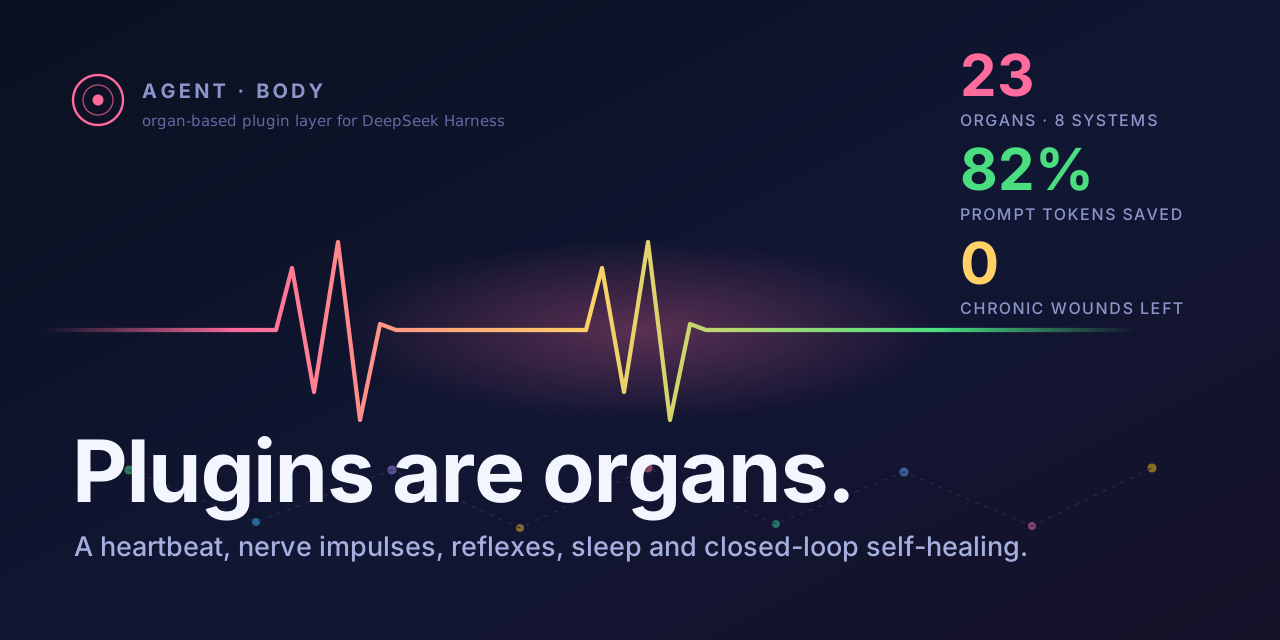
Agent‑Body
An organ‑based plugin layer for DeepSeek Harness: organs, nerve impulses, a heartbeat, reflex arcs, long‑term memory, and closed‑loop self‑healing.
26 organ identities · 84.7% of tool-schema tokens gated cold-start · 200+ offline assertions · MIT
Agent-Body turns a plugin list into an organism. Every plugin declares itself an organ; a nerve bus routes your command to the organs that should handle it, a heartbeat circulates state between them, reflex arcs fire without a single model call, and every failure is attributed by cause before anything retries.
Try it in 30 seconds — no install, no host, no API key. The core imports nothing outside Node built-ins, so a fresh clone runs the real end-to-end chain offline:
git clone https://github.com/1420079678-ctrl/agent-body && cd agent-body
npm run demo     # command → impulse → dispatch → execute → attribute → reflex fires
npm run check    # the gate CI runs: constant tables, catalog, tests, benchmark — all offline
Here is that same body while it runs. Not a mockup — the frames are real tool output from a real install, rendered by
tools/make-demo-gif.py out of docs/demo/captured.json, which records the raw output. The
renderer refuses to draw a number that is not in that file:
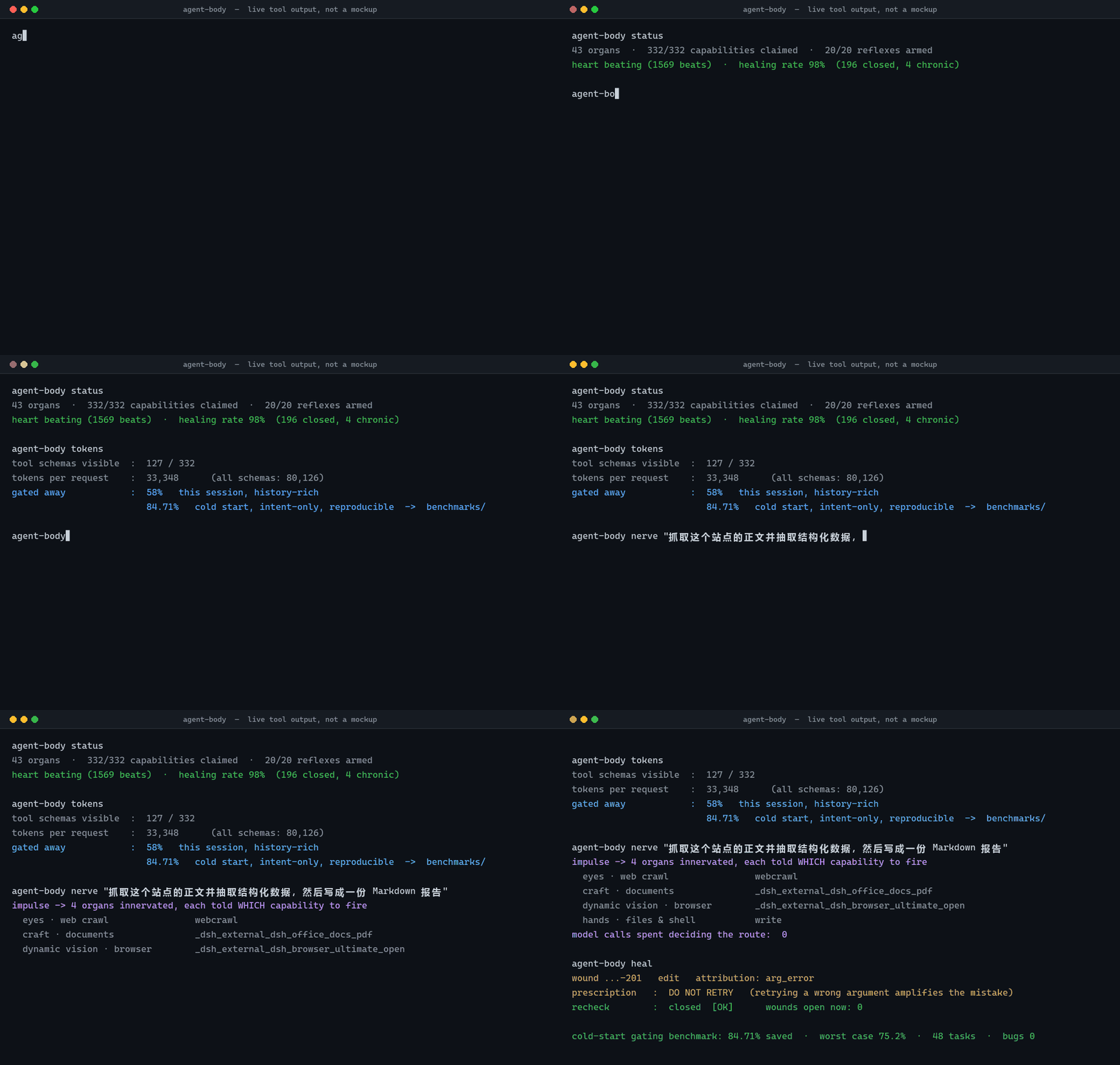
Read it left to right: anatomy and vitals, then the token ledger, then a Chinese command becoming a nerve impulse
that innervates four organs — each told which capability to fire, with zero model calls spent deciding the route —
and finally a wound attributed to arg_error, prescribed do-not-retry, and closed by re-check.
Already running DeepSeek Harness? One command installs the body kernel, the memory organ and the context engine:
$rel = "https://cdn.jsdelivr.net/gh/1420079678-ctrl/agent-body@v0.1.2/dist"
dsh plugin --profile web add "$rel/dsh-external-dsh-organism-0.1.1.tgz" "$rel/dsh-external-dsh-cortex-0.1.1.tgz" "$rel/dsh-external-dsh-zero-residence-0.1.0.tgz"
Restart the harness and body_status lists the organs. The claim you can check for yourself: the tool-schema block
of the prompt drops 84.7% on a cold start across 48 representative commands, and npm run bench:check fails the
build if that number drifts. The scope is stated wherever the number appears — tool-schema tokens only, not the whole
prompt. On a body that has been running for a while it is 58% (127 of 332 visible); that figure, and why it
declines, are in Token economy.
⭐ Star the repository if you want it to keep tracking the host closely — it is a one-person project and the stars are how the next DSH user finds it.








Architecture · Organ Catalog · Benchmark · Roadmap · 中文文档
Official DSH discussion — Show Your Plugins! · the channel the harness CONTRIBUTING points plugin authors to
v0.1.1 · MIT · Windows-first (Node 22.19 / 24) · 26 organ identities in the catalog, realised by 24 plugin packages in this repository · release notes
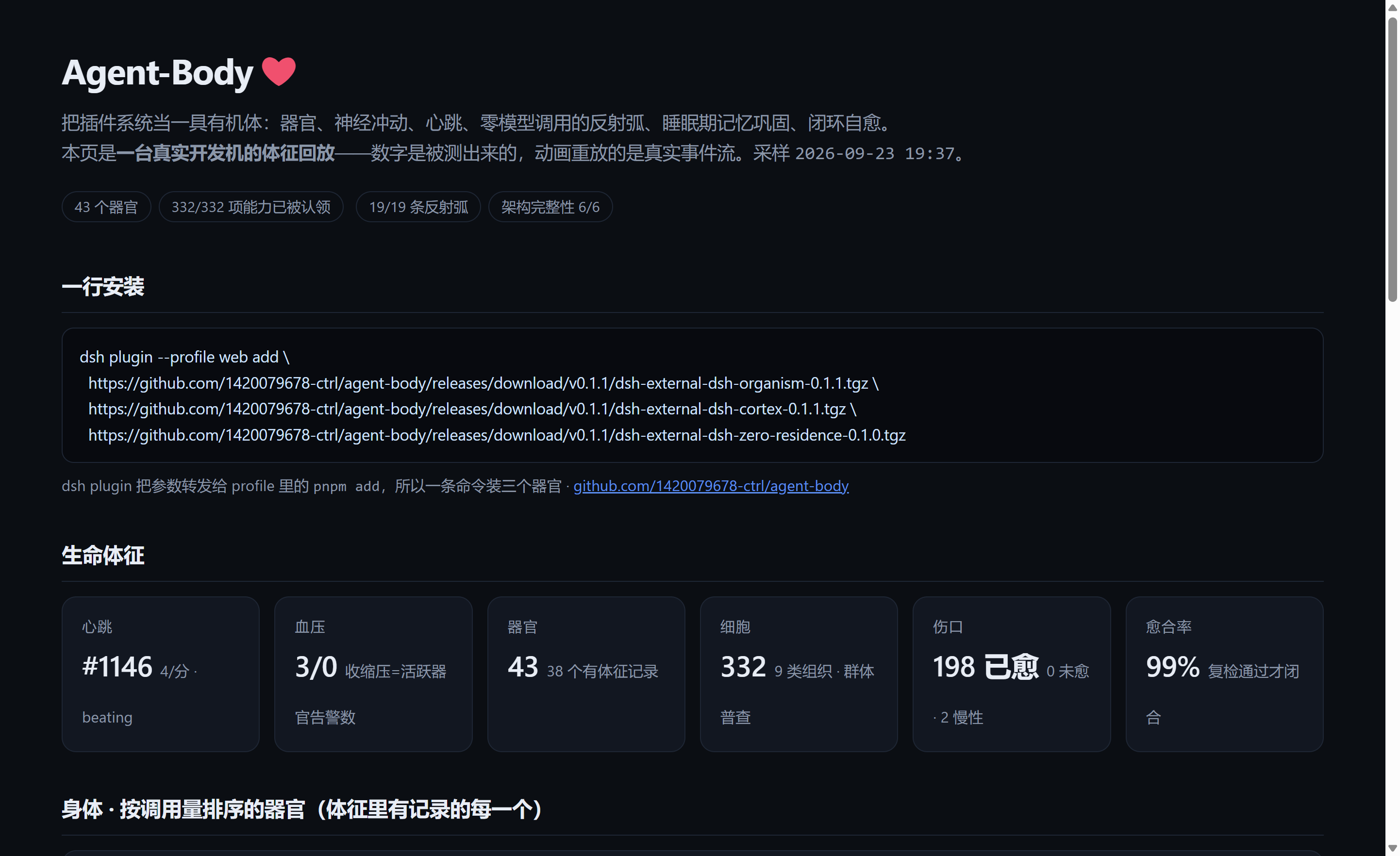
▶ Open the live demo (中文) — a recorded replay of a real install: the heartbeat, the organs, the pulse stream, the healing ledger and the token gate, with nothing installed. It is generated from the runtime files (vitals.json, bloodstream.json, pulse.jsonl), not retyped from screenshots.
Contents · Where it's listed · Install in one line · Why this exists · What makes it different · The five biological layers · Architecture at a glance · Organ catalog · Quick start · Write your own organ · Verify it yourself · When not to use this · FAQ · Repository layout · Contributing · Roadmap
Where it's listed
Checked, not claimed — every entry below resolves today:
| Listing | What it is |
|---|---|
awesome-dsh-plugin · 16.7k ★ | the main DSH plugin directory; both dsh-organism and dsh-cortex are indexed as separate entries |
| dshfind | DSH plugin search engine, with a per-repository page |
imsai-sh/awesome-deepseek-harness-plugins | plugin hub with machine-readable catalogue entries |
bruc3van/awesome-dsh-plugin | daily-crawled DSH plugin list, human-reviewed |
billLiao/awesome-dsh-plugin | curated list, memory category |
unStone/dsh-xray | declared-capabilities scanner; carries a page for this repository |
linny006/agent-framework-radar · llmops-radar | live indexes of newly shipping agent frameworks and LLMOps tooling |
It is also the subject of the harness's official showcase thread — Show Your Plugins! discussion #7555.
Install in one line
Two supported paths — start with the first, switch to the second if your network blocks github.com.
Path 1 — GitHub release assets
Versioned assets built by CI. releases/latest/download/ always resolves to the newest release, so this command does
not need editing when a version is bumped.
$rel = "https://github.com/1420079678-ctrl/agent-body/releases/latest/download"
dsh plugin --profile web add `
  "$rel/dsh-external-dsh-organism-0.1.1.tgz" `
  "$rel/dsh-external-dsh-cortex-0.1.1.tgz" `
  "$rel/dsh-external-dsh-zero-residence-0.1.0.tgz"
rel=https://github.com/1420079678-ctrl/agent-body/releases/latest/download
dsh plugin --profile web add \
  "$rel/dsh-external-dsh-organism-0.1.1.tgz" \
  "$rel/dsh-external-dsh-cortex-0.1.1.tgz" \
  "$rel/dsh-external-dsh-zero-residence-0.1.0.tgz"
Path 2 — served from this repository over jsDelivr
The same tarballs, committed under dist/ and served by a CDN with mainland nodes. Reach for this when Path 1
hangs: those URLs 302-redirect to objects.githubusercontent.com, a hop that is blocked on some networks. The symptom
is fetch failed with downloaded 0 while dependency resolution succeeds — the download hop is the problem, not
the packages.
$rel = "https://cdn.jsdelivr.net/gh/1420079678-ctrl/agent-body@v0.1.2/dist"
dsh plugin --profile web add `
  "$rel/dsh-external-dsh-organism-0.1.1.tgz" `
  "$rel/dsh-external-dsh-cortex-0.1.1.tgz" `
  "$rel/dsh-external-dsh-zero-residence-0.1.0.tgz"
rel=https://cdn.jsdelivr.net/gh/1420079678-ctrl/agent-body@v0.1.2/dist
dsh plugin --profile web add \
  "$rel/dsh-external-dsh-organism-0.1.1.tgz" \
  "$rel/dsh-external-dsh-cortex-0.1.1.tgz" \
  "$rel/dsh-external-dsh-zero-residence-0.1.0.tgz"
dsh plugin forwards its arguments to pnpm add inside the profile, so several packages install in one command.
Restart the harness afterwards; body_status should list the organs. The other organs in the catalog are one tarball
each — see Quick start.
If neither path works — install fully offline
Every tarball built by CI is committed under dist/, and
dist/agent-body-offline-kit.zip bundles all ten plus a one-command installer.
Download it from any machine that can reach this repository, copy it across, then:
Expand-Archive .\agent-body-offline-kit.zip -DestinationPath .
pwsh .\install-agent-body.ps1
Why not npm install yet. These packages are not published to the npm registry — the names above return 404
from registry.npmjs.org today, and nothing here pretends otherwise. That is the next step and it is tracked as an
open issue: once they are on npm, dsh plugin add @dsh-external/dsh-organism becomes a single short command. Until
then, the paths above are the supported ones.
Start with the evidence
| If you want… | Open… | What you can check |
|---|---|---|
| to see it run without installing anything | npm run demo | a real command → impulse → dispatch → execute → attribute → reflex chain, offline, no key |
| fewer tool schemas in your prompt | benchmarks/results/REPORT.md · npm run bench:check | 84.71% of tool-schema tokens gated away on 48 commands (cold-start, reproducible); 58% with history (2026-09-25) |
| failures to stop repeating | body_heal | attribution before retry: tool_missing / arg_error / permission / timeout / network / not_found / conflict. Measured on a development install: 198 healed, 0 open, 99% heal rate |
| to know the system is still alive | body_status · body_heart | 43 organs, 332/332 capabilities claimed, beat #1121, architecture integrity 6/6 (development install) |
| to lose an organ without losing the body | body_organ action=integrity | the six core pieces depend on no single organ; body_call compensates from the organ that overlaps most |
| to write your own organ | docs/ORGAN_SDK.md | defineOrgan() validates at declaration and throws with a field path; npm run check gates the whole repository |
Why this exists
Every agent framework eventually becomes the same thing: a pile of tools, a growing list in the system prompt, and an agent that forgets everything between sessions.
It re-reads the same failure twice before learning it exists. It cannot tell you which of its own capabilities are broken. It has no idea that a plugin it depends on went offline — it just calls it and fails. And you keep paying tokens for tool schemas nobody calls.
Agent‑Body takes the opposite bet: treat the plugin system as an organism.
Every plugin declares itself an organ — with capabilities, senses, and reflexes. Everything else is physiology: a nervous system that routes your commands to the right organ, a heart that pumps state through the whole body on a rhythm, reflex arcs that fire without a single model call, and a healing loop that attributes every failure before it even thinks about retrying.
The result is a system that gets measurably better the more you use it, and that stays standing when you rip parts of it out.
What makes it different
🫀 It has a heartbeat, not a loop
A real pacemaker runs at a 1s base clock with a variable interval — 3× faster on critical alerts, 2× on fatigue,
2× slower when the body has been silent for a long while. Every beat packages the current operator directives, the
body's proprioception and the homeostasis warnings into a blood packet, writes it to bloodstream.json, and broadcasts
it as organism/heartbeat. Any organ can hook the circulation with one line:
ctx.on('organism/heartbeat', (blood) => { /* your organ now has a pulse */ })
Circulation is a loop, not a firehose: organs return blood through organism/venous, and newly learned knowledge is
oxygenated (organism/oxygenated) before it is pumped system‑wide.
🧠 Your sentence becomes a nerve impulse
You type a command. Before the model even reasons about it, agent/pre-step converts it into an impulse, deterministically
innervates the organs that should handle it, and broadcasts on organism/impulse — telling each organ which of its
capabilities to use.
Then the body learns the route. When an innervated organ actually delivers, a Hebbian synapse strengthens
"this kind of command → that organ"; when it fails, the weight decays. Dispatch order reorders itself from experience,
persisted in synapses.json.
you:  "抓取这个站点并抽取结构化数据"
impulse → sensory(web-crawl) · executive(plan) · immune(verify)
        → each organ told which capability to fire
🩹 Self‑healing is a closed loop, not a slogan
failure → deterministic attribution → prescription → RE‑CHECK
Attribution is not guessing: tool_missing / arg_error / permission / timeout / network / not_found /
conflict / unknown. The prescription table decides the response — read‑only remedies execute automatically,
side‑effecting ones wait for the brain to rule, and arg_error is never auto‑retried (retrying a wrong argument
just amplifies the mistake).
The wound only closes when that organ next succeeds — the system does not declare itself healed. Anything still open
after 5 minutes is marked chronic and stops spinning.
Measured on the development install: 21 wounds healed · 100% heal rate · 0 chronic. An
arg_errorwound closed 3.5s after the underlying fix landed.
🌱 It trains itself — and forgets on purpose
Three learning channels run continuously, none of them requiring you to teach anything:
- Synaptic learning — success reinforces "command class → organ", failure weakens it.
- Reflex self‑authoring — the same tool × cause failing 3 times makes the system write its own reflex arc
(
R-auto-<cause>-<tool>), which then fires automatically on the next occurrence. - Chain crystallization — any cross‑organ chain that completes with ≥3 steps is fixed into a replayable skill.
Forgetting is equally deliberate: synapses decay on a 30‑minute half‑life and get pruned below |w| < 0.2; reflexes
that fired ≥5 times with zero contribution are retired; skills that keep failing are forgotten.
body_heal action=rehab restores an organ to its healthy baseline — damage cleared, wisdom kept: fatigue and wounds
reset, learned synapses, reflexes and skills untouched.
💤 It sleeps, consolidates, and remembers
Idle for 2 minutes → light sleep. 5 minutes → deep sleep, and every 2 minutes of deep sleep runs a consolidation pass with zero model calls — pure deterministic rules mining the experiences of the day into long‑term memory:
| Card | Mined from |
|---|---|
pitfall | same tool failing ≥3 times in a row |
playbook | a cross‑tool success chain repeating ≥2 times (trivial same‑tool repeats filtered out) |
hotspot | ≥8 calls with <70% success rate |
unresolved | ≥3 failures accumulated after the last success |
fact | explicit operator facts |
New commands trigger deterministic recall — tags > title > body, multiplied by weight — and the most relevant cards are injected into context. Unused cards decay on a 168‑hour half‑life and archive instead of being deleted.
🪶 Zero‑residence context
Instead of lossy LLM summarization, the engine replaces resident content with deterministic pointers — and every masked byte stays recoverable verbatim from the session log:
| Tool | Purpose |
|---|---|
zr_compact | arm a forced compaction that bypasses the ratio threshold |
zr_recall | rebuild masked content verbatim, by tool call id or session seq |
zr_ledger | quantify the attention integral, the three‑segment cost split, and the compression ratio |
zr_fast | run long commands asynchronously and never block the turn |
🧩 Organs are optional — the architecture is not
Six kernels depend on no single organ: nerve bus · heart pump · directive layer · reflex engine · dissector · impulse conduction.
Unplug a plugin and the body keeps running. Uninstalling dsh-office-docs was detected immediately — the craft organ
went offline and its capability was compensated by the closest overlapping organ, core integrity still green. An
organ that is not installed at all is reported as not installed, not as broken — which eliminated a 15‑second
warning storm from a phantom organ.
📉 Token economy as a first‑class concern
Tool schemas are shown on demand, gated by what the current turn is actually about.
Scope of every number below: the tool‑schema block of the prompt only — the name + description +
JSON‑schema of every tool definition. Not the system prompt, not conversation history, not tool results.
84.7% of tool‑schema tokens gated away (cold-start scope) —
55,154→8,433on average across 48 representative commands (median 85.7%, worst case 75.2%), out of 256 capability definitions. Everything else stays onebody_callaway.
That number is produced by the benchmark in this repository and is reproducible on your machine:
npm run bench          # regenerate benchmarks/results/REPORT.md
npm run bench:check    # exit non‑zero if it drifts from the committed baseline
Two honest caveats, because the headline is easy to over‑read:
-
Cold‑start scope. The figure above assumes the body has no recent activity — only the current command decides what is revealed. On a body with real run history, recently‑used and high‑trust organs stay hot, the visible set grows, and savings drop. Measured live figures, newest first:
Measured Basis Visible Tool-schema tokens saved 2026‑09‑25 this install (332 capabilities, real run history) 127 / 332 58% 2026‑09‑11 snapshot committed at benchmarks/corpus/trace-live-gate.json64 / 256 74% earlier live snapshot quoted by historical README revisions — 82% Both extremes are real; always quote the scope with the number. The cold‑start figure is the reproducible one — run it yourself. The live figure is what you will actually see on a body that has been running for a while, and it declines as the body grows, because more history keeps more organs hot. That worsening number is published here on purpose: you would find it the moment you ran
body_tokensyourself. -
10 of 48 commands need a second hop. A per‑organ cap of 10 capabilities means large organs (the attack organ has 49) get truncated, and a few intents do not route to the organ that owns the capability. Those resolve through
body_call, but they are not free. The benchmark classifies every miss as bug / capped / unrouted and lists them individually inbenchmarks/results/REPORT.md.
The five biological layers
| Layer | What it is | Count |
|---|---|---|
| Individual | this body (the running install) | 1 |
| System | eight body systems: executive / nervous / immune / sensory / motor / memory / metabolic / endocrine | 8 |
| Organ | a plugin, obeying one contract: sense → reflex → effect → homeostasis | 26 organ identities in catalog/organs.json, realised by 24 installable packages (23 in the table below, plus one legacy package kept for rollback) |
| Tissue | functional clustering inside an organ: sensing / inspection / effect / synthesis / memory / regulation / clearance / metering / matrix | 9 classes |
| Cell | a single capability unit (one tool) | counted at runtime |
Every layer is observable: body_map (organs + systems), body_cell (cells + tissues), body_status (vitals).
Undeclared plugins are auto‑promoted to autonomic organs — on the development install, 332/332 capabilities were
claimed, zero orphans. (332 is what that live install reports through body_status; the frozen benchmark corpus
below is a separate, committed set of 256 capability definitions — the two numbers measure different things and are
labelled wherever they appear.)
Architecture at a glance
graph TD
    OP([Operator command]) -->|nerve impulse| NERVE["body_nerve · innervation"]
    NERVE --> BUS{{"organism/impulse"}}
    LAW(["Operator directives"]) --> HEART
    HEART[["Heart · organism/heartbeat"]] --> BUS
    BUS --> ORGANS["organs · capabilities"]
    ORGANS -->|"tools/result"| REFLEX["Reflex arcs · zero tokens"]
    ORGANS -->|failure| HEAL["Self-healing · attribute → prescribe → re-check"]
    ORGANS -->|experience| CORTEX["Cortex · sleep / consolidate / memory"]
    CORTEX -->|"recall"| ORGANS
    HEAL --> VITALS["Vitals · vitals.json"]
    VITALS --> HEART
    ORGANS -->|venous| HEART
Full detail — three kernels, five life mechanisms, event contracts, on‑disk state, verification methodology — lives in ARCHITECTURE.md.
Organ catalog
Every entry below is a real plugin under workspace/plugins/. Five core organs ship a full offline regression suite
(see Verify it yourself); the remaining organs are exercised through their replay scripts.
| Organ | Plugin | System | Signature capabilities |
|---|---|---|---|
| Organism kernel | dsh-organism | nervous · endocrine | body_map body_cell body_status body_heart body_law body_nerve body_call body_reflex body_heal body_skill body_organ body_pulse body_tokens |
| Cortex | dsh-cortex | memory | cortex_sleep cortex_memory cortex_homeo |
| Zero‑residence | dsh-zero-residence | metabolic | zr_compact zr_recall zr_ledger zr_fast |
| Web crawl | dsh-web-crawl | sensory | webcrawl webcrawl_site webcrawl_map webcrawl_extract webcrawl_doc webcrawl_http webcrawl_links webcrawl_status |
| Browser ultimate | dsh-browser-ultimate | sensory | real browser engine (logged‑in sessions, anti‑bot resilience, CDP) + readability‑style extraction |
| War bridge | dsh-war-bridge | nervous | ida (IDA Pro MCP bridge) war_status war_case war_memory |
| PentAGI | dsh-pentagi | executive | agi_plan agi_next agi_flow agi_memory agi_reflect agi_report agi_team |
| Sec workbench | dsh-sec-workbench | immune | 49 sec_* capabilities: sec_route sec_scope sec_evidence sec_webscan sec_webtest sec_exec sec_jwt sec_hashoff sec_brute sec_lateral sec_stealth sec_journal sec_report … |
| Reverse skill | dsh-reverse-skill | immune | rev_route (44 routing rules) rev_case rev_doctrine rev_playbook rev_journal rev_toolindex |
| Vuln remediator | dsh-vuln-remediator | immune | vuln_scan vuln_cve vuln_sbom vuln_priority vuln_patch_gen vuln_patch_verify vuln_remediate vuln_plan vuln_knowledge |
| Vuln daily loop | dsh-vuln-mastery-loop | immune | scheduled daily practice loop with reporting |
| Quant OS | dsh-quant | executive | 59 quant_* capabilities: data / alpha / ML / risk / execution, quant_research_pipeline quant_backtest quant_walk_forward quant_portfolio_optimize quant_stress_test … |
| Mastery loop | dsh-mastery-loop | endocrine | study_orient study_deconstruct study_model study_diagnose study_transfer study_review study_path |
| Academic research | dsh-academic-research | executive | ars_pipeline (10‑stage state machine) ars_review (5‑seat panel) ars_paper_plan ars_integrity ars_metrics |
| Office docs | dsh-office-docs | motor | PDF / DOCX / PPTX / XLSX build, extract, render‑verify, pandoc convert |
| Anatomy panel | dsh-anatomy-panel | nervous | live vitals at /anatomy: heartbeat, wounds, learning counters, organ call counts and the real pulse stream - read from the organism runtime files on every request |
| Social card | dsh-social-card | motor | social_card_scaffold social_card_render social_card_validate social_card_docs |
| Agent teams | dsh-agent-teams-pro | executive | captain + members, task dependencies, messaging, live web panel |
| MiroFish | dsh-mirofish | executive | mirofish_status mirofish_api — swarm‑intelligence prediction engine client |
| Minimal gray | dsh-minimal-gray | metabolic | minimal agent preset, platform‑adaptive shell |
| DingTalk bridge | dsh-dingtalk-bridge | nervous | Stream long‑connection bot bridge into the harness |
| Fund scan | dsh-daily-fund-scan | executive | scheduled fund pool scan + advice report |
| File chips | dsh-file-chips | sensory | attachment chips in the composer |
| (legacy) | dsh-crawl4ai | sensory | kept for rollback; superseded by dsh-web-crawl |
Quick start
See it work first — no install, no host, no API key
git clone https://github.com/1420079678-ctrl/agent-body && cd agent-body
npm run demo      # command → impulse → dispatch → execute → attribute → reflex fires
npm run check     # constant tables + catalog + message sources + 30 tests + benchmark, all offline
There is nothing to install. The core packages import nothing outside Node built‑ins, so the demo runs a real end‑to‑end chain against the committed 256‑capability corpus on a fresh clone.
Then read benchmarks/results/REPORT.md to see how the token claim was measured, and
ROADMAP.md to see what is deliberately not being built next.
Install an organ in one command
The self‑contained organs ship a prebuilt tarball on the release page — no clone, no build step. The package declares
dsh.bundle, so installing it also appends it to dsh.profile.bundles and the next start mounts it:
dsh plugin --profile web add https://github.com/1420079678-ctrl/agent-body/releases/download/v0.1.1/dsh-external-dsh-organism-0.1.1.tgz
Ten organs ship this way — the ones that need no external toolchain. Append the tarball name to the release URL:
| organ | tarball | what it adds |
|---|---|---|
dsh-organism | dsh-external-dsh-organism-0.1.1.tgz | the body kernel: anatomy, vitals, heartbeat pump, nerve impulses, reflex arcs, self-healing ledger, on-demand schema gating |
dsh-cortex | dsh-external-dsh-cortex-0.1.1.tgz | sleep phases, deterministic consolidation, long-term memory, alert de-noising |
dsh-zero-residence | dsh-external-dsh-zero-residence-0.1.0.tgz | zero-residence context: evict, keep a pointer, rebuild the payload verbatim on demand |
dsh-mastery-loop | dsh-external-dsh-mastery-loop-0.0.1.tgz | subject-agnostic mastery tutor: orient → deconstruct → model → diagnose → transfer → review |
dsh-social-card | dsh-external-dsh-social-card-0.0.1.tgz | social cards: image sets, 21:9 + 1:1 cover pairs, Live Photo plates |
dsh-academic-research | dsh-external-dsh-academic-research-0.0.1.tgz | research pipeline: 10-stage state machine, five-seat review panel, integrity protocol |
dsh-pentagi | dsh-external-dsh-pentagi-0.0.1.tgz | multi-agent penetration brain: 13 roles, seven-phase flow, adviser re-routing, knowledge base |
dsh-vuln-remediator | dsh-external-dsh-vuln-remediator-0.0.1.tgz | vulnerability remediation: discovery, risk scoring, virtual patches, fix plans |
dsh-reverse-skill | dsh-external-dsh-reverse-skill-0.1.0.tgz | reverse-engineering workflow: routing, confidence bands, evidence chain, validated gate |
dsh-office-docs | dsh-external-dsh-office-docs-0.0.1.tgz | Office documents: build and extract PDF, DOCX, PPTX, XLSX; render pages; convert formats |
Install the body kernel plus the memory organ:
$rel = "https://github.com/1420079678-ctrl/agent-body/releases/download/v0.1.1"
dsh plugin --profile web add "$rel/dsh-external-dsh-organism-0.1.1.tgz"
dsh plugin --profile web add "$rel/dsh-external-dsh-cortex-0.1.1.tgz"
The rest of the catalog needs a host-side toolchain (a compiler, a browser, or external binaries) and is installed with its replay script instead — see the catalog section below.
Or work from source
This repository is the organ layer — it does not vendor the host. Two pieces, both public:
# 1) the host: DeepSeek Harness itself
git clone https://github.com/deepseek-ai/deepseek-harness.git
#    follow that repository's build/run instructions; note where the checkout lives

# 2) the organs: this repository
git clone https://github.com/1420079678-ctrl/agent-body.git
Point the tooling at your host checkout, then bring an organ online. Each organ ships a replay script that links its dependencies, compiles it, runs its offline regression, and tells you how to inject it:
$env:DSH_CHECKOUT = "C:\path\to\deepseek-harness"

pwsh -File agent-body\workspace\plugins\dsh-organism\scripts\replay-organism.ps1
Replay scripts are idempotent — re-run them after a host upgrade to restore the organ. The same shape works for every
organ in the catalog (replay-cortex.ps1, replay-web-crawl.ps1, …).
Once injected, the first three commands to try:
body_status                 # full vitals: organs, fatigue, homeostasis, integrity self-check
body_map                    # the anatomy — which organ owns which capability
body_nerve action=send text="<your command>"   # route a command before executing it
Verify it yourself
Everything below runs offline and deterministically — no network, no model, no API key, nothing installed.
npm run check     # the gate CI runs: constant tables + catalog + tests + benchmark, all in one
npm run demo      # five-minute end-to-end: command → impulse → dispatch → execute → attribute → reflex
npm run bench     # regenerate the token benchmark (writes benchmarks/results/REPORT.md)
npm run check is the honest one. It fails if the zero-dependency core drifts from the real kernel's constant tables,
if the organ catalog drifts from source, if any test fails, or if the benchmark moves off its committed baseline.
All of it runs on a fresh clone with no npm install.
Organ regressions need the host runtime
npm run verify          # repository health check (structure, JSON, links, secret hygiene)
npm run verify:organs   # run every organ's offline regression
Each organ's suite loads its built lib/, which imports the host runtime (@deepseek-ai/dsh-*). On a bare clone that
does not resolve, so the runner reports SKIP with the reason — never a silent pass:
SKIP  dsh-organism/smoke-test.mjs      缺少宿主运行时 @deepseek-ai/dsh-tools
SKIP  dsh-web-crawl/selftest_local.py  缺少 Python 依赖 trafilatura
Inside an installed harness the same command runs them for real. Measured there:
| Organ | Command | Result (measured) |
|---|---|---|
dsh-organism | node scripts/smoke-test.mjs | 179 passed / 0 failed (familyOf, evalCondition, decay, pruning, token estimation, gating contract) |
dsh-cortex | node scripts/smoke-test.mjs | 58 passed / 0 failed (tokenization, card mining, noise reduction) |
dsh-zero-residence | node scripts/smoke-test.mjs | 16 passed / 0 failed (pointer manifest, ledger math, exact-ID recall) |
dsh-war-bridge | node scripts/smoke-test.mjs | 17 passed / 0 failed / 1 skipped (the IDA chain skips without a sample PE) |
dsh-web-crawl | python scripts/selftest_local.py | 46 offline assertions (extraction, magic‑byte routing, cascade) |
Two of these were red when this table was first written, and the failures were real:
dsh-zero-residencereported 13 passed / 3 failed. Root cause: session lookup matched by substring and returned whichever directory the filesystem happened to yield first, socomputeLedger('session-a')could readsession-a-extra's log and reportT = 0instead ofT = 2. Fixed with exact-match-first resolution.dsh-war-bridgereported FAIL whenever no sample PE was present, because "skip" was recorded as a failed assertion — andprocess.exit()racing an in-flightAbortSignal.timeouttripped a libuv assertion that turned a green run into exit code 1. Both are fixed; a skip now says so.
The core packages are covered by npm test: 30 assertions, 0 failures, including a parity suite that compares
the dependency-free port against the real kernel — exact agreement on familyOf/tissueOf across all 256 tool names,
innervate across 5 commands, evalCondition across 27 combinations, and attributeFailure across 8 error strings.
When no kernel build is present, parity skips loudly rather than passing quietly.
Runtime state is observable too — vitals, wounds, synapses and the pulse stream are all first‑class data:
body_status      → organs · capabilities claimed · heartbeat #31 @15s · heal rate 100%
body_heal        → 21 wounds healed · 0 chronic
body_pulse       → last nerve impulses, reflex fires, homeostasis alerts
Write your own organ
An organ is a declaration plus optional hooks. The SDK validates it where you write it and throws with a field path, instead of failing silently at runtime:
import { defineOrgan, injectedSource } from './packages/organ-sdk/src/index.mjs'

export default defineOrgan({
  id: 'paper_reader',
  label: 'Paper reading (literature)',
  tier: 'professional',
  group: 'memory',
  purpose: 'turn one paper into searchable cards',
  capabilities: ['paper_fetch', 'paper_digest'],
  permissions: ['net:http'],
  signals: ['tools/result'],
  handles: ['network', 'timeout'],
  fallback: ['hippocampus'],
})
Two rules that save a debugging session:
- Inject with a producer-owned source kind.
injectedSource('@you/paper-reader')returns{ kind: 'plugin:@you/paper-reader' }— the one shape both session-format generations accept. The retired{ kind: 'plugin', plugin: ... }wrapper stops a whole turn on a format-V4 host; the measurements are indocs/session-format-v4-compat.md. - Declare what you handle. An organ that says it handles
timeoutgets that failure routed to it; one that stays silent gets a compensating neighbour throughfallbackinstead.
What your change has to pass:
npm run check            # constants + catalog + message sources + tests + benchmark
npm run verify           # structure, JSON, links, secret hygiene
The full contract is in docs/ORGAN_SDK.md, and wiring an organ into a real host is in
docs/host-adapter.md.
When not to use this
Being straight about this is cheaper for both of us:
- You do not run DeepSeek Harness. This is a plugin layer for one specific host, not a standalone agent framework.
- You want a frozen third-party API. The host's session format changed once already and broke every plugin that wrote to it; this repository tracks that host, so it moves when the host moves.
- You need a supported product with an SLA. v0.1.1 is a working release with reproducible gates, and the catalog is curated against one development install — expect rough edges outside the paths that install exercises.
- You need Linux/macOS parity today. Several organs carry Windows-specific hardening (hidden-window spawning, ACL sandbox compatibility). CI exercises the zero-dependency core on Linux; the organs less so.
FAQ
Do I need the host to try it? No. npm run demo runs a real command → impulse → dispatch → execute → attribute →
reflex chain against the committed corpus with nothing installed and no API key.
Does any of it call the network or a model? Not in the part you can verify: npm run check installs nothing and
calls nothing. Model calls only happen where an organ asks the host to reason.
What happens if I delete an organ? Capability is lost, the body is not: the nervous system, heartbeat pump,
directive layer, reflex engine, anatomist and impulse dispatch depend on no single organ, and body_call compensates
with the online organ whose capability overlaps most. body_organ action=integrity prints that self-check.
Why do the organ numbers differ between places? There are three numbers and they measure different things:
26 organ identities in catalog/organs.json (the anatomy — prefrontal, hands, cortex, …),
24 plugin packages under workspace/plugins/ that realise them (23 in the catalog table above plus the legacy
dsh-crawl4ai, kept for rollback), and 64 catalog capabilities declared in that file. body_status reports a
fourth, larger pair on a live install — 43 organs and 332 capabilities — because it counts every plugin the running
harness has mounted, including ones this catalog does not name. Every number is labelled wherever it appears, and
npm run verify prints the package count it derives from disk so it can be checked rather than trusted.
How is the 84.7% token figure measured? It is tool-schema tokens only — the sum of every tool definition's name,
description and parameters against what the first turn can see after gating — on 48 representative commands, in the
cold-start setting (intent decides the visible set, no local history). That is the lower bound and the only
independently reproducible setting. The live setting, with history, declines as the body grows: measured
58% on 2026‑09‑25 (127 of 332 visible), 74.25% on the 2026‑09‑11 snapshot. The whole series, and why it declines,
is in Token economy; the raw data is in
benchmarks/results/REPORT.md.
Contributing
The most useful contribution right now is another organ — the contract is small enough to read in one sitting.
Looking for somewhere to start? The
good first issue label collects
scoped tasks with a stated acceptance test.
- On a fresh clone,
npm run demoandnpm run check. If those are not green, that is a bug report worth filing on its own. - Copy the closest organ under
workspace/plugins/, declare yours withdefineOrgan, and add its entry tocatalog/organs.json— the catalog is generated, andnpm run check:catalogfails on drift rather than letting the two diverge. - Ship an offline regression with it. Only 5 of the 24 packages have one today —
npm run verifyprints the list of the 18 that do not — andnpm run verify:organsreports SKIP with a reason rather than passing quietly when the host runtime is absent. Writing those tests, or an organ that brings its own, is the most useful contribution right now. - Open a PR describing what the organ does, which system it belongs to, and the exact commands you ran.
Questions and discussions are welcome in the harness's Show Your Plugins! thread or as an issue here.
Repository layout
agent-body/
├─ packages/
│  ├─ organ-core/   zero-dependency organ core: constant tables, gating, contract, host adapter
│  └─ organ-sdk/    defineOrgan() / defineReflex() — the authoring surface
├─ benchmarks/      reproducible token benchmark + frozen corpus + CI baseline
├─ catalog/         organs.json — tiers, permissions, failure handling (generated, drift-checked)
├─ examples/        the five-minute quickstart demo
├─ docs/            organ SDK guide · host adapter guide
├─ workspace/
│  └─ plugins/      the organs — one plugin per organ, each with src/ + lib/ (offline regression where one exists)
├─ scripts/         verify-repo.mjs · run-organ-regressions.mjs · run-tests.mjs
├─ .github/         CI (repo-check on Windows + Linux) and issue templates
├─ ARCHITECTURE.md  full system architecture
├─ ROADMAP.md       what the next six months are for
└─ README.zh-CN.md  中文文档
Runtime state (vitals, synapses, memory cards, pulse stream) lives in your harness data home, never in this repository.
Roadmap
- Publish the organ contract as a standalone SDK so third‑party plugins can declare organs in a few lines
- One‑command organ installer that links, builds and registers every organ against a given host checkout
- Cross‑body sync: export learned synapses / reflexes / skills and import them into another install
- Sleep‑time model training: let consolidation propose new reflexes for review instead of authoring them directly
- Web panel for the anatomy: live organ map, wound ledger, pulse stream
Notes
- Licensing. MIT for this project's own work (LICENSE). Plugins ported from upstream projects and the host itself keep their own terms — see THIRD_PARTY_NOTICES.md.
- Local‑first. The harness GUI binds
127.0.0.1— it can read files and execute commands on the machine it runs on. Do not expose it to a network or put it behind a public reverse proxy. - Windows‑first. Developed and measured on Windows 11 · Node 24 · PowerShell 7. Several organs ship Windows‑specific hardening (hidden‑window spawning, ACL sandbox compatibility). Linux/macOS paths exist but are less exercised.
- Numbers here are measured, not aspirational. Figures marked measured were read from a live install; runtime
counts (organs, capabilities) are yours to reproduce with
body_status.
**Six kernels. 26 cataloged organ identities across 8 systems, realised by 24 plugins. One heartbeat.
If that's the kind of plugin platform you want, the architecture is all in ARCHITECTURE.md.
⭐ If this body has a pulse for you, star this repo — it costs nothing and is the single easiest way to help others find the project.
Community. Discussed in the LINUX DO community — a friendly Chinese-speaking developer forum where this project was shared and where questions get answered.
Plugins relacionados
deepseek-harness
deepseek-ai/deepseek-harness
dsh-web (dsh-plugin-manager)
zhu1090093659/dsh-web
dsh-web
zhu1090093659/dsh-web
dsh-web-ui (dsh-plugin-manager)
zhu1090093659/dsh-web-ui