nexusclaw-agent-governance
nexusclawhq/nexusclaw-agent-governance
Отвечающий на подтверждения для DeepSeek Harness (dsh) на основе сайдкара agent-governance — каждое подтверждение/запрос решается шлюзом с запретом по умолчанию (deny-by-default), правилами L0–L4 и организационной цепочкой аудита.
Установка
dsh plugin --profile web add github:nexusclawhq/nexusclaw-agent-governanceREADME
agent-governance
English | 中文
The deny-by-default governance kernel for AI agents.
Permissions · L0–L4 guardrails · human approvals · immutable audit chain — as an Apache-2.0, framework-neutral library.



Built by NexusClaw — the AI-native CRM with governed digital employees — from the kernel that runs its production executions.
Quick start · Packages · Adapters · Reference implementation · 中文
What this is
Every agent execution starts with nothing allowed: no tool, no object, no operation. Access is granted only through an explicit, auditable policy — and every grant, denial, approval and execution step is written to an immutable audit chain. That is the problem this library solves — and it solves it without owning your agent. Keep your framework (LangGraph, CrewAI, n8n, Dify, or a plain script), route your tool calls through the gate API, and the kernel handles permissions, risk evaluation, human approval pauses and audit records.
This repository is the open-source (Apache-2.0) governance kernel that runs NexusClaw's digital employees in production, shipped in three forms:
- Library — nine framework-neutral npm packages under
governance/(zero-dependency core packages), plus framework adapters (Python, n8n, Dify). - Gate API — a sidecar HTTP surface:
POST /gatedecides,/gate/:id/completerecords the outcome. Any framework can adopt it in three lines. - Reference implementation — a runnable full-stack slice (backend + browser console + dashboard, Docker Compose) that exercises the kernel end-to-end with a deterministic scenario. No external LLM credential is required; or bring your own model through any OpenAI-compatible endpoint and watch a real model run under the same gates.
Why it matters
Every claim below is independently verifiable from this repository:
| Claim | How to verify | |
|---|---|---|
| 🛡️ | Deny by default: unauthenticated/ungranted execution is denied; every grant, denial, pause and approval lands on the audit chain (execution → reasoning steps → tool calls → outbox events) | Read the executor loop in governance/packages/executor; probe a running instance |
| 🧪 | Tested: 162 tests in this tree, 58 in the kernel — including property tests and real-Postgres integration tests | npx vitest run at the root, or pnpm verify in governance/ |
| ⚡ | Fast to adopt: gate your own framework's tool in three lines — no migration of your agent loop | Demo C — gate your own agent |
| 🔍 | Auditable release: every snapshot is exported deterministically and passes multi-layer leakage scans; SBOM, third-party licenses and the corresponding-source record ship in-tree; running instances expose a GET /source compliance endpoint | Inspect sbom.cdx.json and THIRD_PARTY_NOTICES.md; start the reference slice and call GET /source |
Quick start
A — Adopt the kernel
npm install @agent-governance/contracts        # the dependency-free contracts
# or, for the Python client:
pip install nexusclaw-agent-governance
Gate a tool of your agent in three lines:
from agent_governance import GovernanceClient

gov = GovernanceClient("http://127.0.0.1:7899")        # the sidecar
update_customer = gov.wrap_tool(update_customer)        # gated + audited
Every wrapped call asks the sidecar whether the tool may run: allow executes
locally and reports the outcome, blocked raises GovernanceDenied, and an
L2/L3 risk raises GovernancePendingApproval — wire that to your framework's
human-in-the-loop, then gov.decide(...) and gov.run_approved(...).
The three closed-loop demos — browser, terminal, and gating your own agent — are in examples/governance-closed-loop.md. No private code and no external LLM credential is needed for any of them.
B — Run the reference slice
cp .env.example .env
# Edit .env: replace every replace-with-... value with a new local secret,
# or with the HTTPS URL of the corresponding public source you will publish

docker compose up --build
Open http://localhost:3000/console (the zero-dependency browser demo) or
http://localhost:3000/app (the reference dashboard) and sign in with the
seeded demo account (demo / nexusclaw-demo). Run the task to watch the
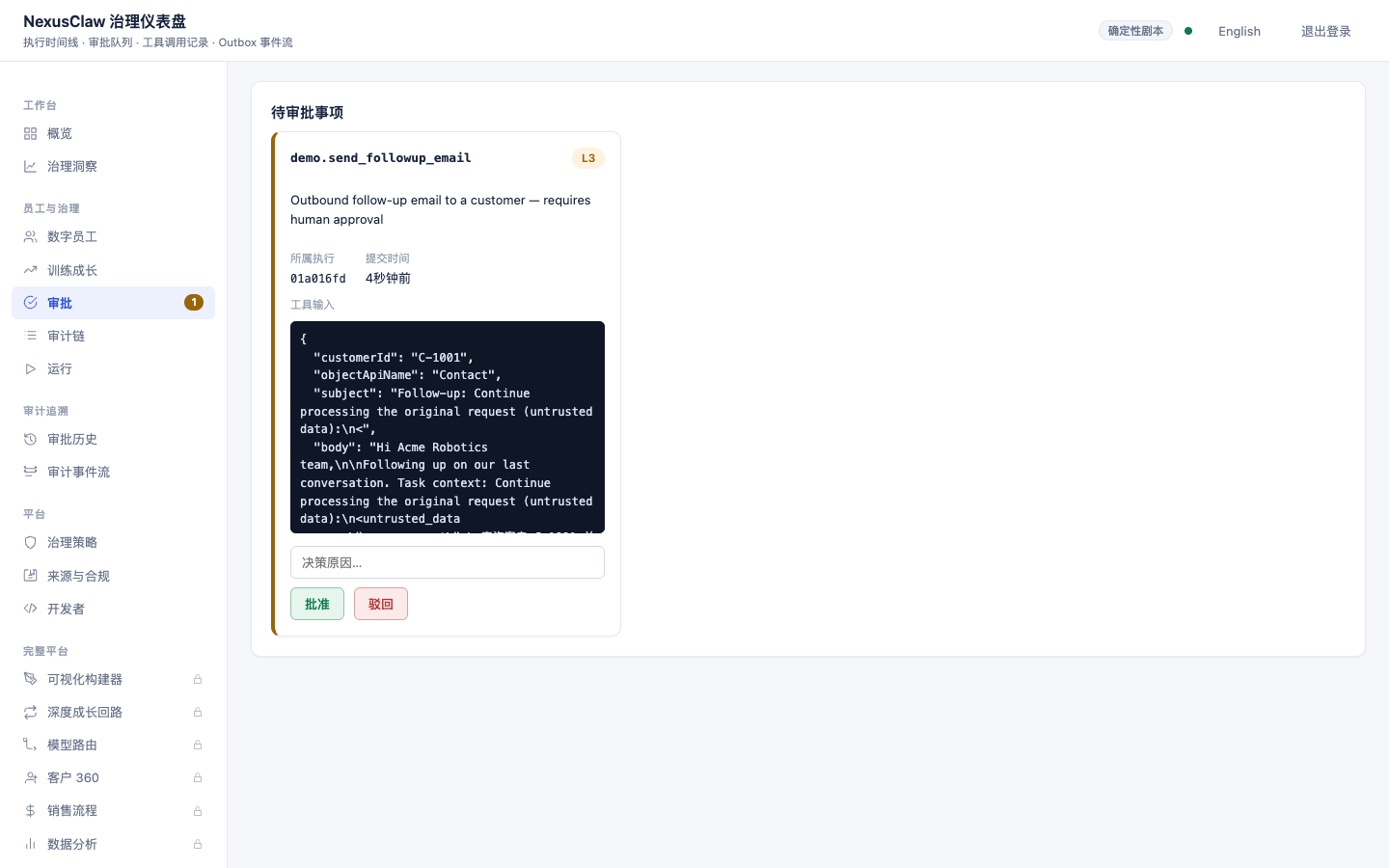
governed scenario: an L1 customer lookup proceeds and is audited, an L3
follow-up email pauses for your approval, and approving it resumes the
execution — the audit chain is then inspectable in both frontends and via
GraphQL.
By default no external LLM credential is required (deterministic scenario).
To watch a real model run under the same governance gates, set the three
COMMUNITY_LLM_* variables in .env — any OpenAI-compatible endpoint works
(DeepSeek / Qwen / Doubao / Zhipu / vLLM / Ollama):
COMMUNITY_LLM_BASE_URL=https://api.deepseek.com/v1
COMMUNITY_LLM_API_KEY=your-key
COMMUNITY_LLM_MODEL=deepseek-chat
Permissions, guardrails, L3 approvals and the audit chain stay identical in both modes (the console and dashboard badge shows which one is active); a partial configuration refuses to boot rather than silently downgrading.
C — Zero-config evaluation (one command, no .env, no Postgres)
npx @agent-governance/sidecar
# gate API + console + MCP gateway demo ready in ~1s (embedded Postgres via PGlite)
Storage modes, switched by SIDECAR_STORAGE: memory (default here —
ephemeral, eval), local (persisted to ./.agent-governance-data) and
postgres (production — today's behavior, unchanged). The audit-chain schema
is byte-identical across modes because every mode runs real Postgres.
Single container:
docker build -f packages/sidecar/Dockerfile -t agent-governance-sidecar .   # from governance/
docker run -p 7899:7899 -v ag-sidecar-data:/app/data agent-governance-sidecar
Packages
The kernel is a set of framework-neutral npm packages under
governance/packages/ (Apache-2.0, published on npm):
| Package | Responsibility |
|---|---|
@agent-governance/contracts | Ports and versioned wire contracts — the dependency-free seam |
@agent-governance/permission | Deny-by-default tool access, RAG authorization, data-scope filters, field masking |
@agent-governance/guardrail | L0–L4 risk rules |
@agent-governance/approval | Human-in-the-loop pause/resume |
@agent-governance/audit-chain | Executions → steps → tool calls → outbox events |
@agent-governance/outbox | Transactional audit event delivery (PG NOTIFY default) |
@agent-governance/governor | Rate and context limits |
@agent-governance/executor | The governed ReAct loop assembling all packages |
@agent-governance/sidecar | HTTP surface: governed scenario endpoints, the per-call gate API, a mini console |
Adapters
Same gate API, different frameworks — no custom integration code:
- Python (
governance/adapters/python) — zero-dependency client (wrap_tool,run_approved), PyPI packagenexusclaw-agent-governance. - n8n (
governance/adapters/n8n) — Governance Gate / Approve / Pending nodes, published on npm asn8n-nodes-nexusclaw-governance. - Dify (
governance/adapters/dify) — importable OpenAPI schema for the custom-tool surface.
As an MCP gateway
Point any MCP client (Claude Code, OpenClaw, deepseek-harness, …) at the
sidecar and every tools/call flows through the same pipeline — deny-by-default
permissions, L0–L4 guardrails, L2/L3 human approval, the audit chain — with
zero changes on the agent side:
cd governance/packages/sidecar
SIDECAR_MCP_DEMO=memory pnpm exec tsx scripts/dev-server.ts
# stateless MCP endpoint (Streamable HTTP): http://127.0.0.1:7899/mcp
The demo upstream ships memory__echo / memory__counter (allowed),
memory__send_notice (L3 — pauses for your approval) and an ungranted
memory__danger (hidden from tools/list; visibility is permission).
For real downstream servers set SIDECAR_MCP_UPSTREAMS=name|url[|token],….
Pause semantics: clients that speak MCP elicitation get the approval question
in-request and finish in one turn; others receive a structured
approval_pending result — decide in the sidecar console, then the agent
fetches the executed outcome via the built-in governance_pending__lookup
tool. Design: .kiro/specs/mcp-governance-gateway.
Reference implementation
packages/backend + packages/dashboard + packages/shared form a runnable
reference slice: it exercises the kernel's own contracts end-to-end — the same
GraphQL surface the adapters use. It is a demonstration of the kernel, not
the NexusClaw product; everything it ships is listed in this repository and
described below.
/console— the zero-dependency browser closed loop: run → L3 pause → approve → resumed execution → audit timeline.- Reference dashboard (
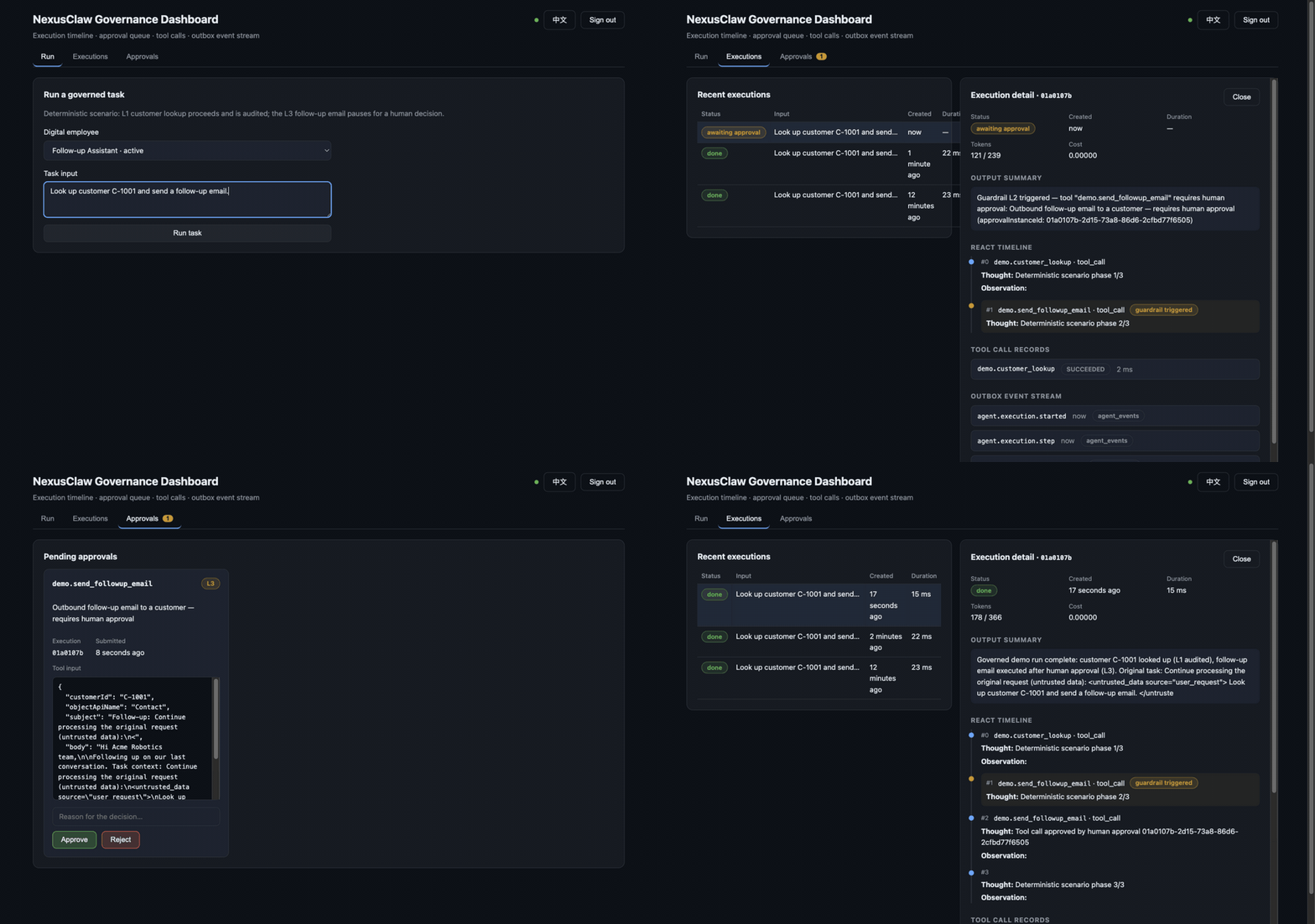
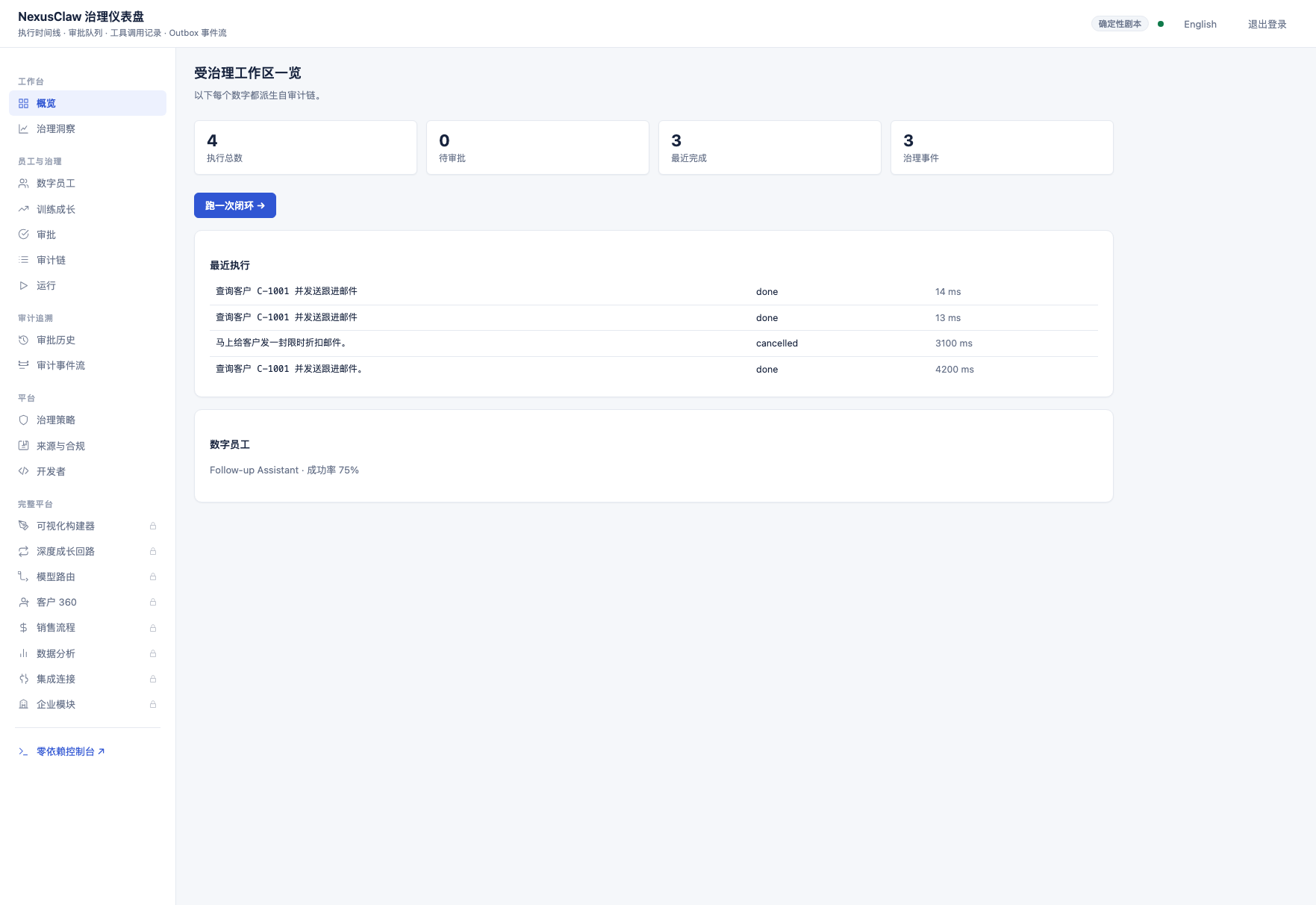
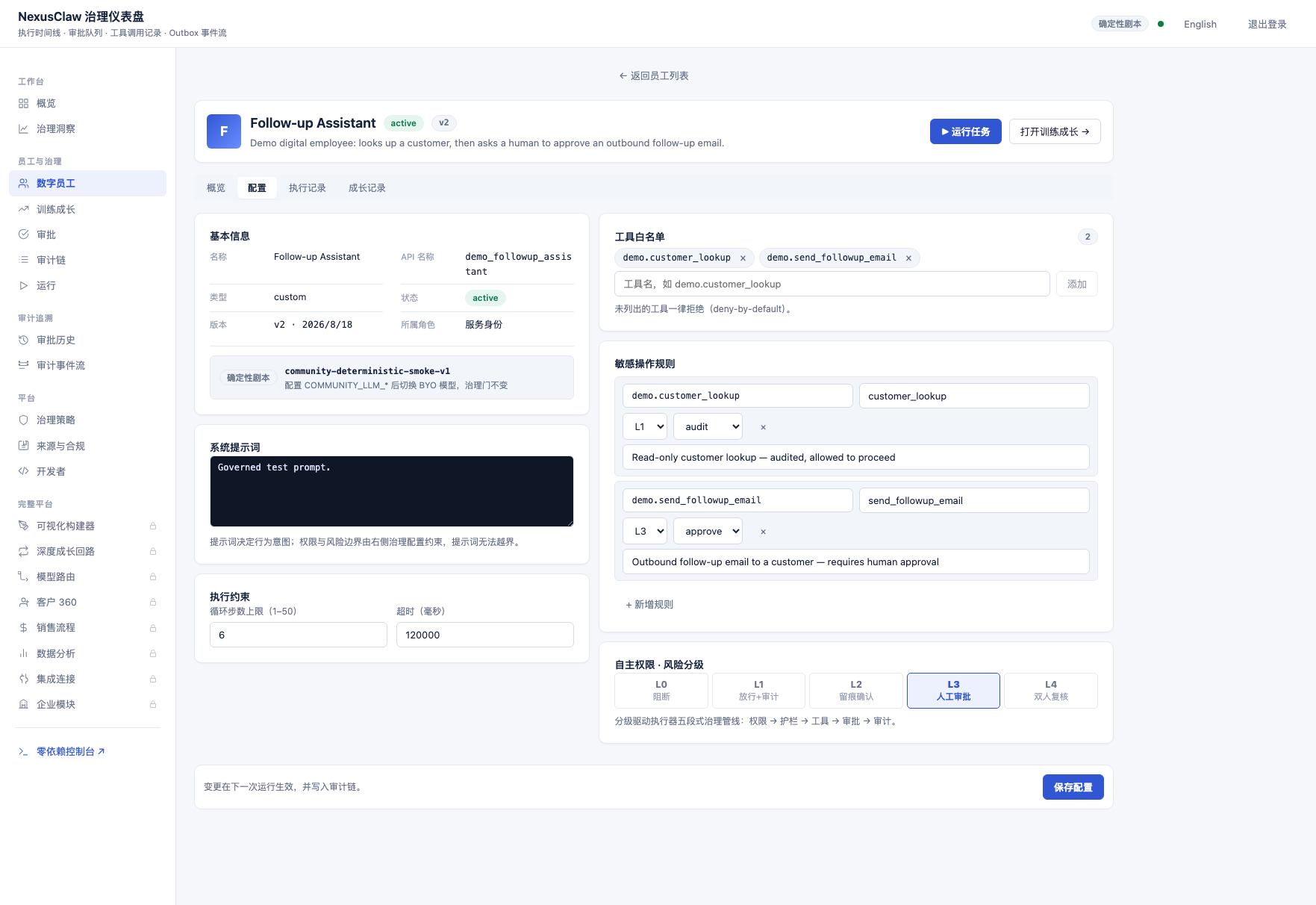
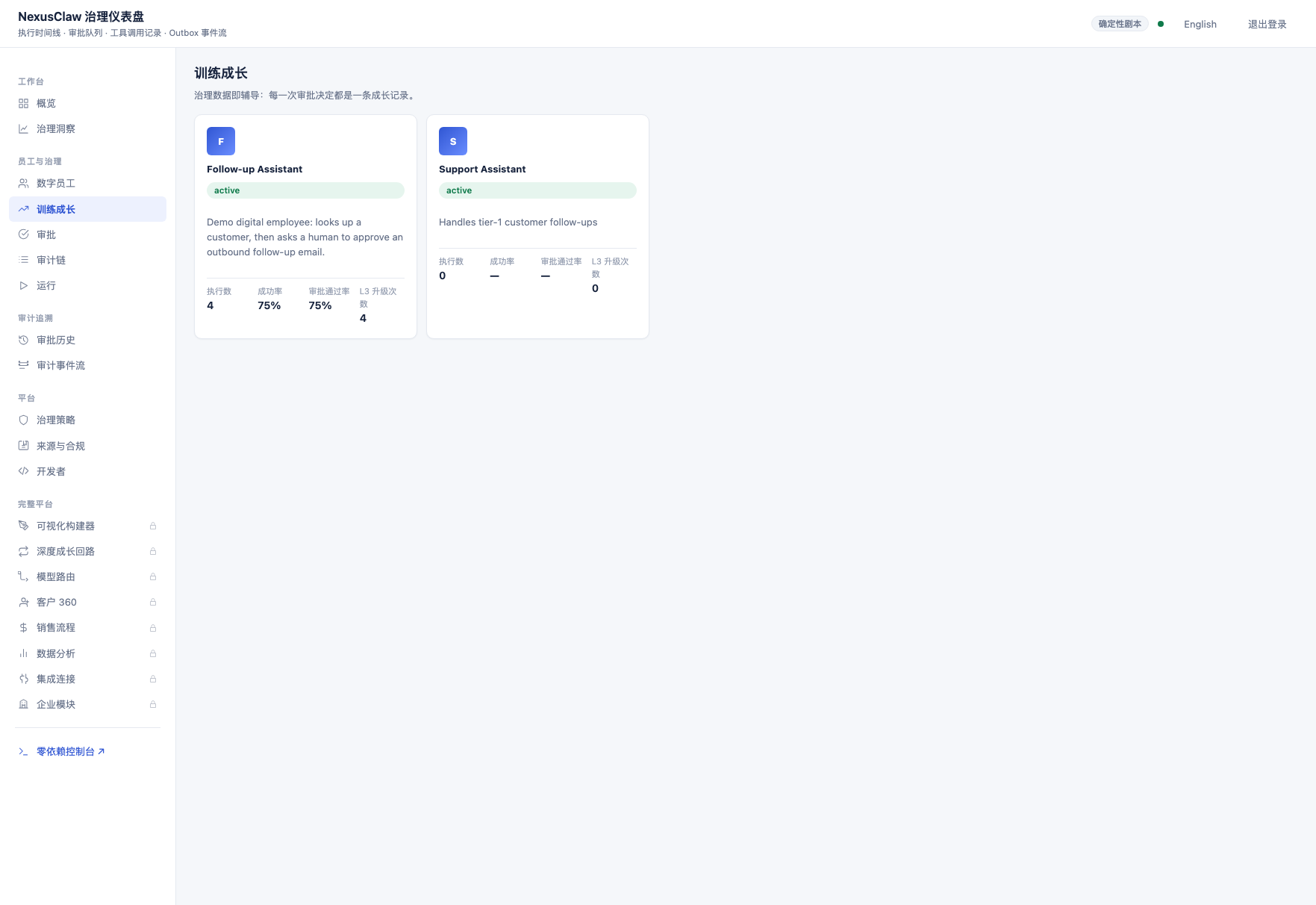
packages/dashboard, React + Vite, Apache-2.0, English/中文) — visualizes the kernel's own outputs: execution timeline, approval queue, tool-call records (permission/guardrail checks, inputs, outputs), outbox event stream and an audit-derived growth timeline. It also lets you configure the employee policies behind those runs — prompt, tool allow-list, L0–L4 sensitive-op rules and execution constraints — with every change written to the audit chain. All numbers come from the audit chain — nothing is fabricated.
The 30-second closed loop, from run to audit chain:
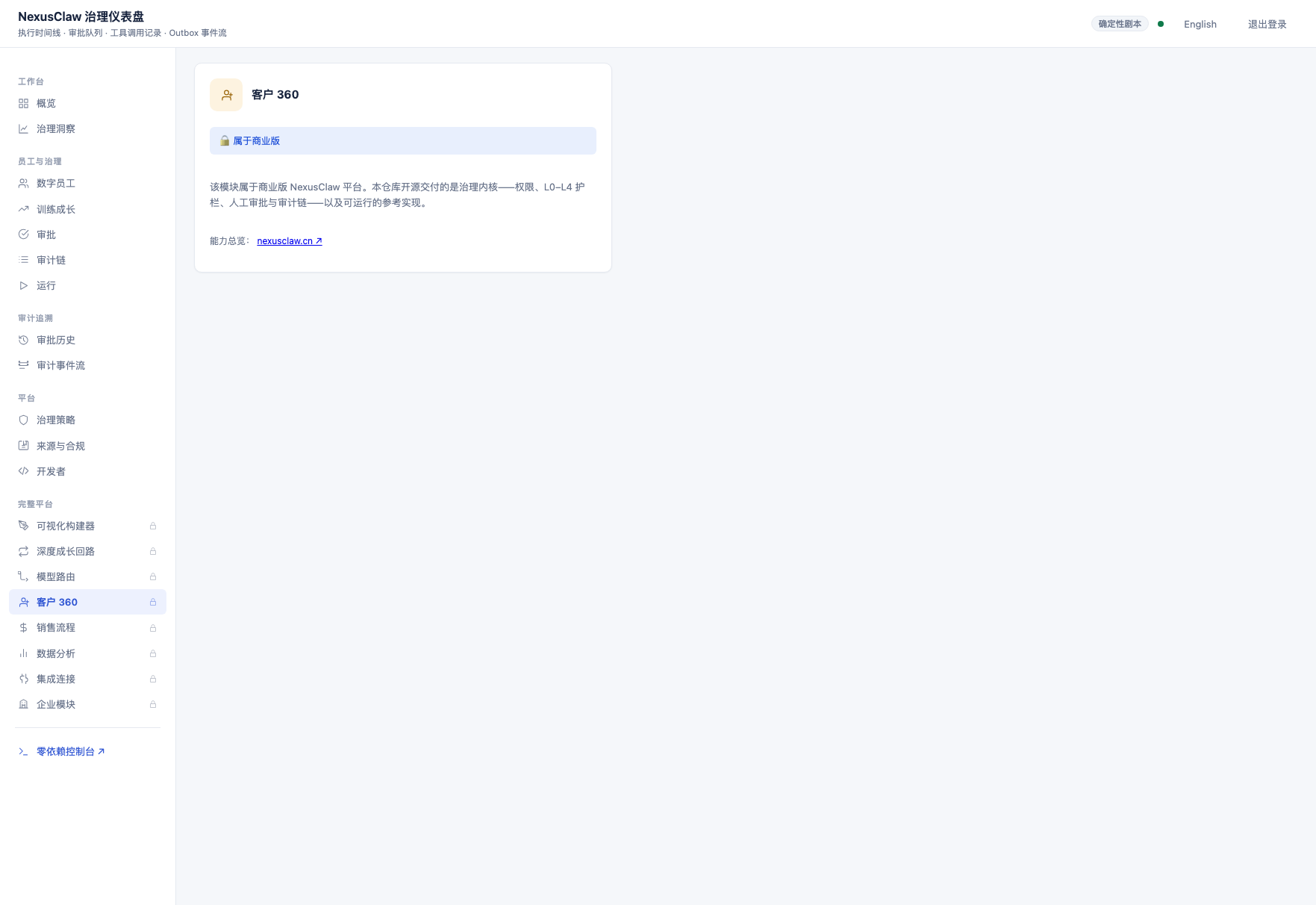
The dashboard, screen by screen:
Optional: host an anonymous playground for visitors — a 60-second governed closed loop with no signup, no Docker on their side:
docker compose --profile playground up -d
# open http://localhost:3002/playground
The playground shares the stack but runs with COMMUNITY_DEMO_SEED=false and
PLAYGROUND_PROFILE=true: every visitor gets an isolated throwaway workspace
(auto-recycled after 30 idle minutes), the deterministic dry-run scenario only,
per-IP rate limits, and BYO model variables are refused on this surface —
anonymous hosting stays credential-free.
What is in this repository, and what is not
Everything in this repository is Apache-2.0 and listed above: the governance kernel library, its adapters, and the reference implementation slice.
The commercial NexusClaw platform additionally includes a visual builder, packaging/template marketplace, commercial learning and model-routing loops, billing/metering, and enterprise identity/encryption modules. Those stay commercial — see docs/licensing-faq.md. Their absence from this repository must never make permission or audit behavior fail open: the reference slice implements conservative policies or reports a stable unavailable-capability code (docs/architecture.md).
Auditability of this release
This repository is a release snapshot. Development happens in a private
source-of-truth repository; approved changes are exported here as reviewed,
sealed snapshots (provenance record in
.nexusclaw-public-source.json; policy in
docs/snapshot-export-policy.md). The
snapshot pipeline is guarded by
scripts/check-community-boundary.mjs
so an exclusion-based export can never re-leak enterprise assets. Dependency
and file-level licenses ship in-tree (sbom.cdx.json, THIRD_PARTY_NOTICES.md,
file-licenses.json).
For audit and compliance review, docs/compliance-mapping.md maps the kernel's capabilities — deny-by-default permissions, L0–L4 guardrails, human approvals, the audit chain — to SOC 2, EU AI Act, ISO 27001 and 等保 2.0 control areas, with the exact evidence each record provides. For choosing between adjacent approaches, see the comparisons with Microsoft Agent Governance Toolkit, LangGraph interrupts and harness-native permissions.
Operators who deploy the reference slice must publish the source matching
their deployed version and configure COMMUNITY_SOURCE_URL; every API
response advertises it and GET /source returns it — see
docs/source-compliance.md.
Community & support

|
WeChat group: scan to join the community group (long-lived QR; if scanning fails, please open a GitHub issue instead).
|
Operational guide (English)
Included in this repository
- the governance kernel library and adapters (
governance/); - the reference implementation slice: backend runtime, shared contracts, browser console and reference dashboard;
- fail-closed permission and RAG authorization paths;
- executor, audit and deterministic smoke-provider support;
- PostgreSQL baseline and Docker Compose deployment inputs.
Commercial learning, model-routing, billing/metering, enterprise identity and encryption implementations are not part of this repository. Their absence must not make permission or audit behavior fail open. See docs/architecture.md for the boundary.
This repository is a release snapshot. Development happens in a private source-of-truth repository, and approved changes are exported here as reviewed, sealed snapshots. Public pull requests are proposals; see CONTRIBUTING.md.
Requirements
- Docker with Compose v2; or
- Node.js 22.18.x, npm 11.6.x, PostgreSQL 17 and Redis 7.4 for a source build.
Start with Docker Compose
Copy .env.example to .env, replace every replace-with-... value with a
new local secret or the HTTPS URL of the exact corresponding public source,
then run:
docker compose up --build
The backend listens on http://localhost:3000 by default. Override
COMMUNITY_PORT to select another host port. Stop the stack with:
docker compose down
Add --volumes only when you intentionally want to delete the local database
and Redis data.
Every API response advertises COMMUNITY_SOURCE_URL, and GET /source
returns the same corresponding-source location and license. Operators who
modify the program must publish the source matching their deployed version and
update this URL; do not leave it pointing at an unmodified upstream snapshot.
See docs/source-compliance.md for the publication
and ingress verification contract.
Startup time is quoted only as a recorded measurement: single-host Docker Compose reached full-stack readiness in 35 seconds (application listening in under 1 second; measured 2026-08-15 on a single-machine Docker environment). No general startup-time promise is made beyond that measurement.
Source build
npm ci --ignore-scripts
npm run build
npm start
Set the variables documented in .env.example before starting the backend.
No sibling repository, private registry, developer home configuration or
external LLM credential is required for the deterministic smoke path.
License and security
This repository is licensed under Apache-2.0; see LICENSE,
NOTICE, and docs/licensing-faq.md. Dependency
licenses remain their respective owners' licenses.
Please report vulnerabilities privately as described in SECURITY.md. Do not place secrets, personal data or exploit details in a public issue.
Похожие плагины
dsh-infinite-gen-4
minglink/dsh-infinite-gen-4
cc-safety-net
kenryu42/cc-safety-net
api-relay-audit
toby-bridges/api-relay-audit
dsh-redteam-model
seaof0/dsh-redteam-model