evo-subagent
zekaishi/evo-subagent
统一的 DeepSeek Harness 插件:基于角色的 subagent 路由 + 逐 agent 演进——把 prefercmd/记忆作为知识白名单/黑名单,让重复任务从已验证命令起步、节省 token。
安装
dsh plugin --profile web add github:zekaishi/evo-subagentREADME
evo-subagent
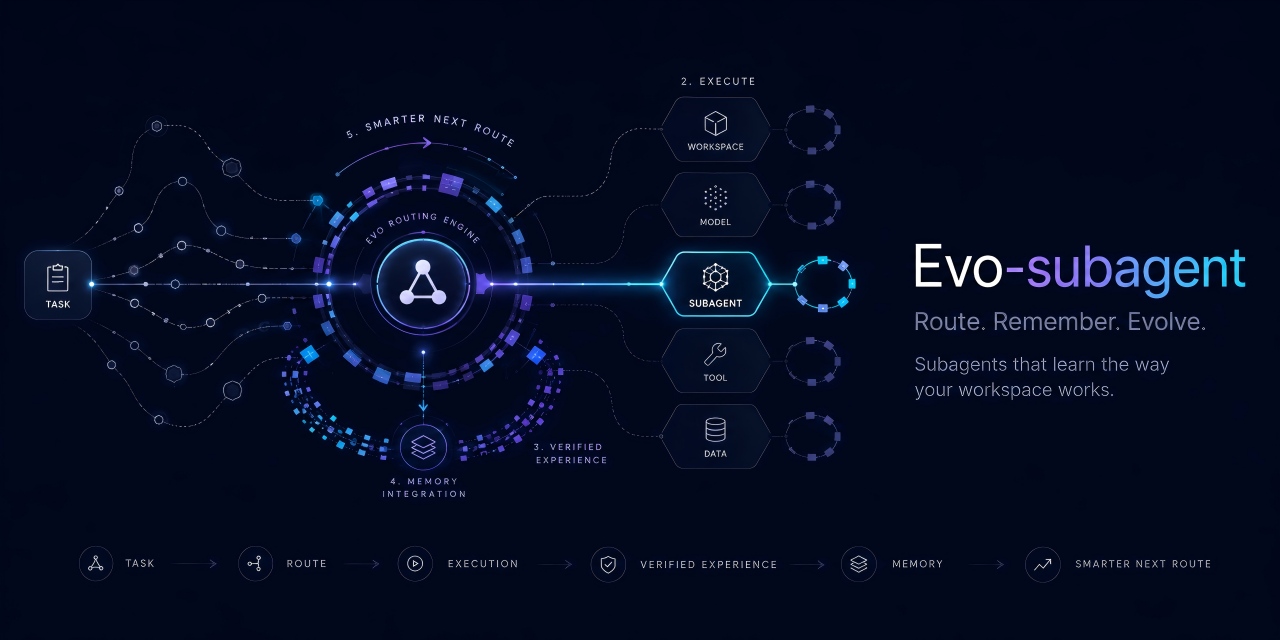
evo-subagent is a lightweight plugin for DeepSeek Harness. It pulls together three capabilities that today live scattered across separate plugins — role-based subagent routing, per-agent evolution (verified commands + lessons), and a knowledge allow/deny list — so repeated tasks start from what already works instead of rediscovering it: fewer retries, fewer re-debugged bugs, fewer tokens.
Routing
Each stable agent_key maps to a same-named Markdown binding file declaring an exact provider/model pair already registered in DSH. Different subagent roles (code reviewer, test runner, researcher, planner, verifier, data analyst, ...) can therefore use predictable model routes without duplicating credentials or maintaining a second provider config. The pair is validated against the live DSH model registry before any child spawns.
Evolution (knowledge allow/deny)
The plugin continuously maintains prefercmd (verified commands) and memory (lessons learned) per agent and per workspace. Think of prefercmd as a whitelist — the subagent starts from commands proven to work instead of re-deriving them — and memory as a blacklist — mistakes are recorded so they are not made, or debugged, again. Together they stop repeated runs from wasting tokens on rediscovery and re-debugging.
Zero-config, project-scoped
Bindings and evolution are isolated per project workspace (.evo_subagent/ under the nearest folder owning an agents/ directory), with official built-in role templates that work out of the box. Nothing depends on where DSH was launched, and the plugin stores no API keys, endpoints, credentials, or provider definitions.
Features
- Maps each
agent_keyto a same-named Markdown binding file. - Reads strict
providerandmodelmetadata from a fenced front matter block. - Validates the exact provider/model pair against the live DSH model registry before spawning.
- Auto-maintains per-agent / per-workspace
prefercmd+memoryevolution files (whitelist + blacklist of knowledge), injected into each foreground run. - Supports foreground one-shot runs and continuable background subagents.
- Preserves DSH's native parent-model inheritance when no binding file exists.
- Stores no API keys, endpoints, credentials, or provider definitions.
- Delegates child creation to the official DSH
spawnprovider.
Installation
Install the published npm package into a DSH profile:
dsh plugin add evo-subagent
Install directly from GitHub:
dsh plugin add github:ZekaiShi/evo-subagent
For local development:
dsh plugin add ./evo-subagent
Add --profile <name> to target a non-default profile.
Binding files
The filename stem is the agent_key. Every binding starts with a strict four-line front matter block. The opening and closing fences must be exactly ---, with no blank lines inside:
---
provider: deepseek-official
model: deepseek-v4-flash
---
# Code reviewer
Optional notes for people or external tooling may follow this header.
For a file named code-reviewer.md, call the registered tool with agent_key: "code-reviewer":
{
"agent_key": "code-reviewer",
"description": "Review implementation",
"prompt": "Inspect the supplied change and report correctness, security, and test coverage issues.",
"run_in_background": true
}
Only the fenced front matter is routing metadata. The remaining Markdown content is not automatically appended to the child prompt; the tool call's prompt is the authoritative task sent to the subagent.
Built-in roles
The plugin ships official role templates in templates/ that work with zero
configuration — no binding file needed. When an agent_key has no matching file
in your binding directory, the plugin falls back to the bundled template of the
same name, using its provider/model route and its role instructions.
| agent_key | Role | Notes |
|---|---|---|
code-reviewer | Rigorous code review with severity-ranked findings | structured Markdown report |
researcher | Evidence-backed investigation with cited sources | facts vs. inferences, confidence |
wps-worker | Office-document producer via the Python trio | python-pptx / python-docx / openpyxl; confirms before writing files |
Official roles are written with a name(evo-subagent) suffix — e.g.
code-reviewer(evo-subagent) — to mark them as built-in and distinguish them
from your own custom bindings. You can use the suffix anywhere the official
source matters (docs, prompts, conversation); the plugin matches on the bare
agent_key stem.
To use a built-in role, pass an empty prompt (the role's own instructions are
injected), or pass your own prompt to override them:
{
"agent_key": "code-reviewer",
"description": "Review the change",
"prompt": "",
"run_in_background": false
}
A template's provider/model must be registered in your DSH profile (the same
validation as user bindings); an unregistered pair fails before any child starts.
Overriding a built-in role works by creating your own <agent_key>.md in the binding
directory — your file wins over the template.
Evolution mode
The plugin continuously refines per-agent prefercmd (verified commands) and
memory (lessons learned) files to reduce token waste on repeated runs by
shortening the rediscovery loop — prefercmd acts as a whitelist of
commands known to work, memory as a blacklist of mistakes already made,
so a subagent never re-derives a command or re-debugs a known failure.
-
Storage keeps entries whole; the size guarantee lives at injection. Each stored file is deduplicated and bounded by entry count (40 prefercmd, 25 memory), never by truncating an entry — a long command or lesson is kept in full even when a file grows beyond 4000 chars. The one hard bound is the injected context: each run injects the two files as a block capped at
MAX_INJECT_CHARS(6000). What gets injected is decided by priority, then compressed by summarization — information is condensed, not discarded. -
Entry priority. Prefix an entry to control how it is injected:
!marks it P0 permanent (always injected in full, never compressed or dropped),?marks it P2 compressible (injected last; the first to be summarized or skipped when the budget is tight, though it stays in the file), and an unprefixed entry is P1 normal (injected newest-first into the remaining budget). Budget allocation is P0 → P1 → P2. -
Similar-command summarization. Instead of injecting every concrete command,
prefercmdentries that share the same leading token and appear>= 3times collapse into a single summary line (e.g.git …(3 条相关命令: …)), and any single entry longer than 300 chars is condensed to a short head + ellipsis. A custom summarizer can be supplied viabuildInjectionAsync(options.summarize, e.g. an LLM-backed summarizer overctx.llm) for semantic summaries. -
Default: on. Disable with
evolution: falsein the plugin config or theEVO_SUBAGENT_EVOLUTION=falseenvironment variable. -
Per-conversation workspace, not the launch directory. Each time the
evo_subagenttool runs, the plugin reads the conversation's working directory (exec.agent.session.header.cwd, the same field the DSH shell tool resolves its workdir from) and walks up to the nearest folder that owns anagents/directory — the project workspace. That folder becomes the bindings directory and evolution lives under<project>/.evo_subagent/evolution/<agent_key>/prefercmd.mdandmemory.md. Different projects therefore never share subagent bindings or evolution state, and nothing depends on where the DSH process was launched. When a conversation has no session cwd or its workspace has noagents/folder, the plugin falls back tobindingsDir/EVO_SUBAGENT_EVOLUTION_DIR/ the process working directory. The evolution files never appear in the project'sagents/folder. The<project>/.evo_subagent/directory is created lazily: it only lands on disk when a subagent actually runs and reports evolution content (or when you save manually from the settings card) - workspace scanning and project detection are strictly read-only. Existing former.smart_subagent/evolutiondata remains a read-only fallback and is copied into the new location on the first save; legacy files are never deleted automatically. -
On each foreground run the plugin injects the two files as a bounded context block (capped at
MAX_INJECT_CHARS= 6000 chars) into the child prompt, so the subagent starts from proven commands instead of re-deriving them. -
At the end of a foreground run the plugin scans the final output for an
[[EVOLUTION]]block and merges new entries:[[EVOLUTION]] prefercmd: - pnpm test # faster test runner memory: - don't use --force on CI [[/EVOLUTION]] -
Entries are deduplicated and kept within limits (40 prefercmd, 25 memory); the oldest entries are dropped first, so injection cost stays bounded.
-
Background runs don't record (no final output is available to the caller).
Use detectAgents(bindingsDir, templatesDir) from evo-subagent/evolution
to list all available agent keys programmatically.
Settings card
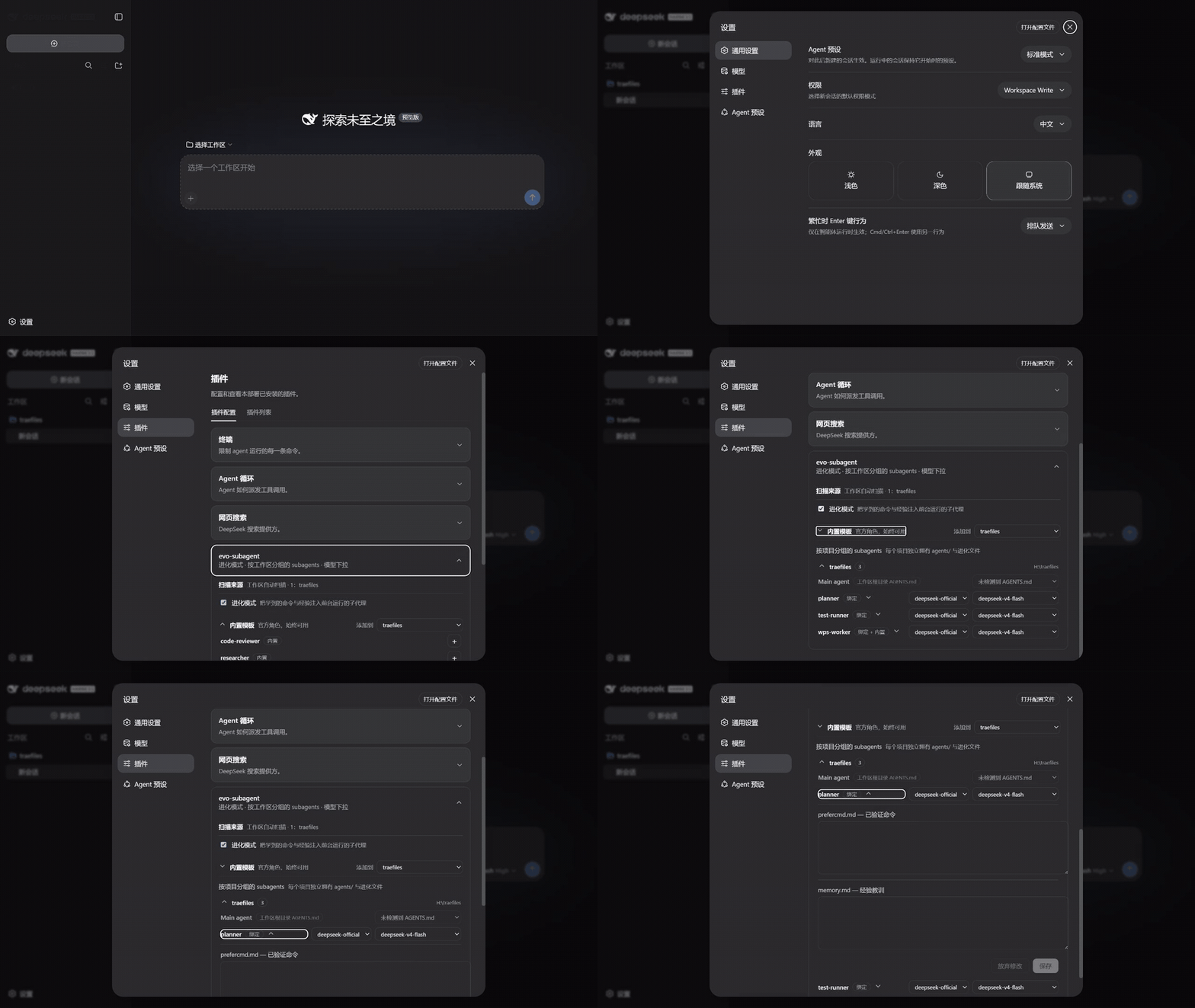
Under the web profile, Settings → Plugins shows an evo-subagent card that:
- Groups subagents by project. The scan source is the profile's
registered workspaces (
ctx.workspaceRegistry- the same workspaces the web UI groups sessions by): each workspace owns only theagents/folder right under it - no recursion into subdirectories. Zero configuration and portable across machines - move to another computer with different workspaces and the card follows automatically; if nothing is found it says so explicitly. Built-in templates are maintained as their own separate group and never mixed into a project. Only when a profile has no registered workspaces does it fall back toEVO_SUBAGENT_PROJECTS_DIRor a fallback dir set in the card. - Shows one fixed Main agent row per workspace. Only the workspace-root
AGENTS.mdcan be bound. Binding adds one reversible, marker-delimited instruction block and stores the selection in.evo_subagent/config.json. The main agent maintains its own.evo_subagent/evolution/main/prefercmd.mdandmemory.md; unbinding removes only the managed block. Workspaces without anagents/directory still appear so their Main agent can be configured. - Shows each agent's routing model (provider · model from its front matter)
and lets you switch it with two dropdowns for project bindings: a
Provider dropdown listing every registered provider and a model dropdown
listing that provider's registered models — any combination is selectable.
The change rewrites the
provider:andmodel:lines of the agent's.mdfile, the same file a developer would edit by hand; picking a provider auto-selects its first model. Built-in template agents are shown read-only. - Edits each agent's hidden
prefercmd.md/memory.md(per-project evolution files) and flips the global evolution toggle.
Binding directory
Set the binding directory before starting DSH, in the same process environment you launch DSH from. Relative paths resolve from the DSH launch working directory.
PowerShell:
$env:EVO_SUBAGENT_BINDINGS_DIR = 'C:\path\to\agents'
dsh # or however you normally start DSH (dsh web, desktop app, ...)
Bash:
EVO_SUBAGENT_BINDINGS_DIR=/absolute/path/to/agents dsh
DSH_AGENT_BINDINGS_DIR remains available as a compatibility fallback.
Tool interface
The plugin registers evo_subagent by default.
| Field | Required | Description |
|---|---|---|
agent_key | Yes | Stable key used to resolve <agent_key>.md. |
description | Yes | Short display label for the delegated task. |
prompt | Yes | Complete task sent to the child agent. |
run_in_background | No | Defaults to true; set to false for a foreground one-shot run. |
Routing behavior
- Validate the
agent_keysyntax and resolve its Markdown file safely. - Parse the fenced
providerandmodelvalues in their fixed order. - Confirm that the provider exists in
ctx.llm.listProviders(). - Confirm that the model exists in
ctx.llm.listModels(provider). - Start a fresh child through the configured DSH subagent provider.
An invalid binding fails before a child is created. A missing binding file is different: the plugin omits agentOptions, preserving the official DSH inheritance behavior.
Spawn vs fork provider
The plugin is provider-agnostic: the same routing, validation, and result handling apply regardless of which DSH in-process subagent provider is configured.
| Provider | Inherited context | Use for |
|---|---|---|
spawn (default) | none — fresh child, zero parent context | one-shot tasks fully described by prompt |
fork | parent's completed turns (balanced prefix up to the last turn/end) | tasks that build on the current conversation |
To route via the fork provider, set provider: fork in the plugin config (see
Bundle configuration). agentOptions — the validated
provider/model pair from a binding file — is passed to the child identically
for both providers; only the inherited conversation seed differs.
Fork inherits conversation history only: the child still gets a fresh scope and does not inherit the parent's tool restrictions or authority.
DeepSeek reasoning effort
evo-subagent does not override reasoningEffort. With provider: deepseek-official, the official DeepSeek adapter uses its configured default; the default DSH setting is high.
This keeps role files focused on provider/model routing and avoids introducing a second model-capability registry. Other registered providers retain their own adapter-defined reasoning behavior.
Bundle configuration
The bundled patch installs the following defaults:
- id: evo-subagent
config:
bindingsDir: /absolute/path/to/agents
provider: spawn
toolName: evo_subagent
maxDepth: 3
To use fork-mode routing instead, override provider to fork:
- id: evo-subagent
config:
bindingsDir: /absolute/path/to/agents
provider: fork
toolName: evo_subagent
maxDepth: 3
DSH patch overrides replace the complete config object, so retain every field you still need when overriding this row.
Security guarantees
agent_keyaccepts only ASCII letters, digits, hyphens, and underscores.- Path traversal through
agent_keyis rejected. - Provider/model matching is exact and case-sensitive.
- Invalid bindings never fall back to another route.
- Binding files contain no credentials.
- Disabling this plugin removes only
evo_subagent; the officialsubagenttool is unchanged.
Development
Requires Node.js 22 or newer.
pnpm install
pnpm test
pnpm run check
npm pack --dry-run
The test suite covers strict front matter parsing, path safety, model registration checks, parent-route inheritance, foreground/background child creation, and the same routing guarantees under both the spawn and fork providers.